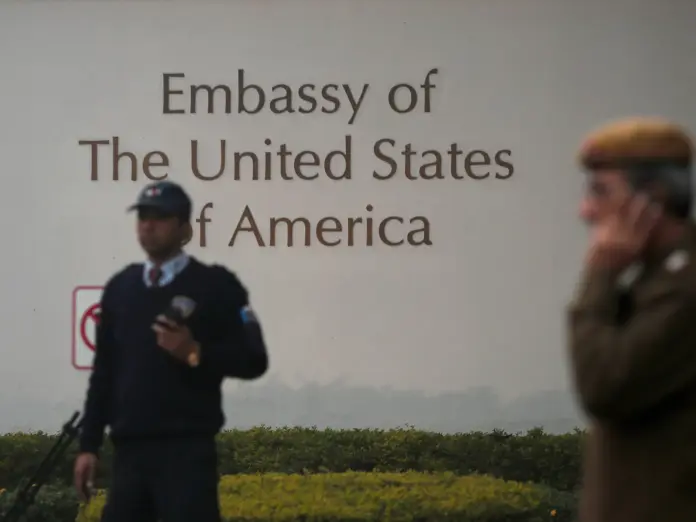
India Us Tanker Strike — India summoned the United States Embassy’s deputy chief of mission, Jason Meeks, in New Delhi on Wednesday after American military forces fired on a commercial tanker carrying 24 Indian sailors in the Gulf of Oman, killing or leaving three crew members missing and triggering a sharp deterioration in relations between the two countries.
US Central Command (CENTCOM) carried out the strike on the Settebello, a Palau-flagged chemical and oil products tanker, on Tuesday evening. The vessel was located approximately 20 nautical miles northeast of the Omani port of Sohar when it reported an engine room fire. CENTCOM maintained that the Settebello’s crew failed to comply with instructions issued by US forces, a justification that India’s government swiftly and forcefully rejected.
Twenty-one Indian sailors were rescued following the attack. Three remain missing. The Omani navy responded to the vessel’s distress call, and India’s embassy in Muscat is actively coordinating with Omani authorities in the ongoing search and rescue operation.
Recommended Reading
India’s Foreign Ministry issued a sharp condemnation, calling for an immediate end to attacks on commercial shipping in the region. The government faced mounting pressure from opposition parties to take an even more confrontational public stance against Washington. Analysts described the episode as pushing India-US ties to their lowest point in decades.
Arsenio Dominguez, secretary-general of the International Maritime Organization, added his voice to the chorus of condemnation on Wednesday, underscoring the gravity with which the international maritime community views the strike on a civilian commercial vessel.
The attack on the Settebello is the latest flashpoint in a rapidly escalating crisis rooted in the US-Israel war on Iran, which began on February 28. At least two other Indian-flagged vessels have been struck since hostilities commenced. India had previously summoned the Iranian ambassador in April following earlier attacks on Indian shipping, but Wednesday’s diplomatic summons directed at a US official marks a significant and unprecedented escalation in New Delhi’s response.
The immediate backdrop is a naval blockade of Iran ordered by President Donald Trump in mid-April. The blockade, designed to strangle Tehran’s oil revenues and compel Iranian leaders to accept Washington’s terms for ending the war, has significantly reduced Iran’s oil exports. Iranian officials, however, have shown no indication of capitulating to the pressure. Trump has also threatened to strike Iran again, signalling that Washington intends to maintain its aggressive posture.
The Settebello incident has intensified already fierce legal and ethical debate surrounding the blockade’s implementation. International maritime law places strict obligations on naval forces before any use of force against commercial vessels, and critics argue that firing on a tanker whose crew had declared an emergency — and whose distress call had already been answered by the Omani navy — raises profound questions about the rules of engagement being applied by US forces in the region.
India Us Tanker Strike: Regional Implications
For India, the stakes extend well beyond the immediate fate of its missing sailors. New Delhi has long sought to position itself as a neutral actor in the Iran conflict, maintaining economic ties with Tehran while managing its strategic partnership with Washington. The killing and disappearance of Indian nationals aboard a vessel struck by US forces makes that balancing act increasingly untenable. The opposition’s calls for a harder line reflect a domestic political reality that Prime Minister Narendra Modi’s government can no longer easily ignore.
The broader humanitarian toll on commercial shipping in the Gulf of Oman continues to mount. Merchant mariners of multiple nationalities have now been killed or endangered as the US blockade of Iran grinds on, and the Settebello attack demonstrates that even vessels flying third-country flags and crewed by nationals of non-belligerent states are not immune from the conflict’s reach.
Search operations for the three missing Indian sailors continued Wednesday, with Omani and Indian authorities coordinating efforts in the waters northeast of Sohar.