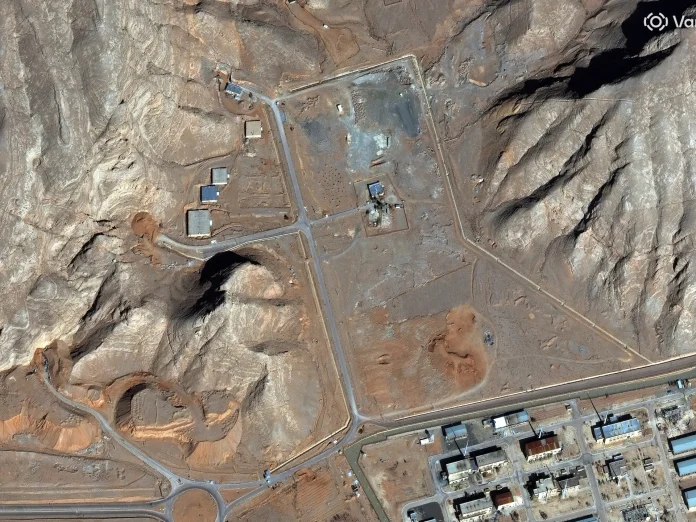

A confidential report circulated by the International Atomic Energy Agency on Friday has confirmed for the first time that Iran is storing the bulk of its highly enriched uranium inside an underground tunnel complex at its Isfahan facility — a site that appears to have survived last June’s Israeli and American military strikes largely intact.
The disclosure, sent to member states ahead of a quarterly meeting of the IAEA’s 35-country board of governors opening Monday in Vienna, identifies Isfahan as a location of acute concern. The tunnel complex holds uranium enriched to both 20 percent and 60 percent U-235 purity. At 60 percent, the material sits only a short technical step away from the 90 percent threshold required for weapons-grade fuel.
Before Israel launched its strikes in June — which the United States briefly joined, targeting three known Iranian enrichment sites — the IAEA had recorded a stockpile of 440.9 kilograms of uranium enriched to up to 60 percent. By the agency’s own benchmarks, that quantity, if enriched further, would be sufficient to produce approximately 10 nuclear weapons. The last confirmed inspection of that stockpile took place on June 10, days before the military campaign began.
Since the strikes, Iran has suspended elements of its cooperation with the IAEA and barred inspectors from accessing bombed sites. Tehran has provided no accounting of what happened to its enriched uranium holdings in the aftermath of the attacks. The agency and Western governments now believe the stockpile remains substantially intact, sheltered within the Isfahan tunnel complex, which satellite imagery shows has continued to see regular vehicular activity around its entrance.
The IAEA report described allowing inspections as ‘indispensable and urgent’, urging Iran to grant the watchdog full access to all its nuclear sites without delay. The agency’s inspectors face an additional blind spot: a fourth uranium enrichment facility that Iran declared it was establishing at Isfahan shortly before the June attacks. Inspectors have never been granted access to that plant, do not know its precise location, and cannot confirm whether it is operational.
The findings land at a diplomatically fraught moment. On Thursday, American and Iranian negotiators concluded a third round of indirect talks in Geneva, mediated by Oman, without achieving any breakthrough. Iranian Foreign Minister Abbas Araghchi publicly called on Washington to abandon what he characterised as its ‘excessive demands.’ The United States has insisted that any agreement must require Iran to fully dismantle its nuclear infrastructure, curtail its ballistic missile arsenal, and cease support for regional proxy forces — a maximalist position Tehran has flatly rejected.
The enriched uranium stockpile and the question of IAEA access have emerged as the central sticking points blocking progress. Technical teams from both sides are scheduled to hold further Oman-mediated sessions in Vienna this week, timed to coincide with the IAEA board meeting, though expectations for a rapid resolution remain low.
The military campaign last June, which Washington described as having ‘obliterated’ three Iranian nuclear facilities, was launched after Israel initiated strikes against Iranian nuclear sites. The US-Israeli operation is assessed to have destroyed or severely damaged the three enrichment sites known to have been active at the time. Yet the Isfahan tunnel complex — and the vast stockpile it apparently sheltered — appears to have averted destruction, fundamentally complicating the strategic calculus that underpinned the strikes.
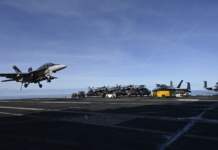
US President Donald Trump has maintained a posture of military pressure, massing forces in the region and issuing warnings of further action should diplomacy fail. That backdrop casts a long shadow over the Vienna talks, where the IAEA board is expected to debate the agency’s findings and press for a resolution to the inspection impasse.
The confirmation that near-weapons-grade uranium remains stockpiled in an underground facility that inspectors cannot fully access — combined with a fourth enrichment plant whose location and status are unknown — underscores the depth of the verification crisis now confronting the international community. Without renewed Iranian cooperation, the IAEA has acknowledged it cannot provide credible assurances about the scope or trajectory of Tehran’s nuclear programme.