Commercial satellite imagery captured between late April and December 2025 reveals that Khalifa Haftar‘s Libyan National Army (LNA) has acquired sophisticated combat and surveillance drones at a desert airbase east of Benghazi, in what weapons experts say constitutes a likely violation of a United Nations arms embargo that has been in force since 2011.
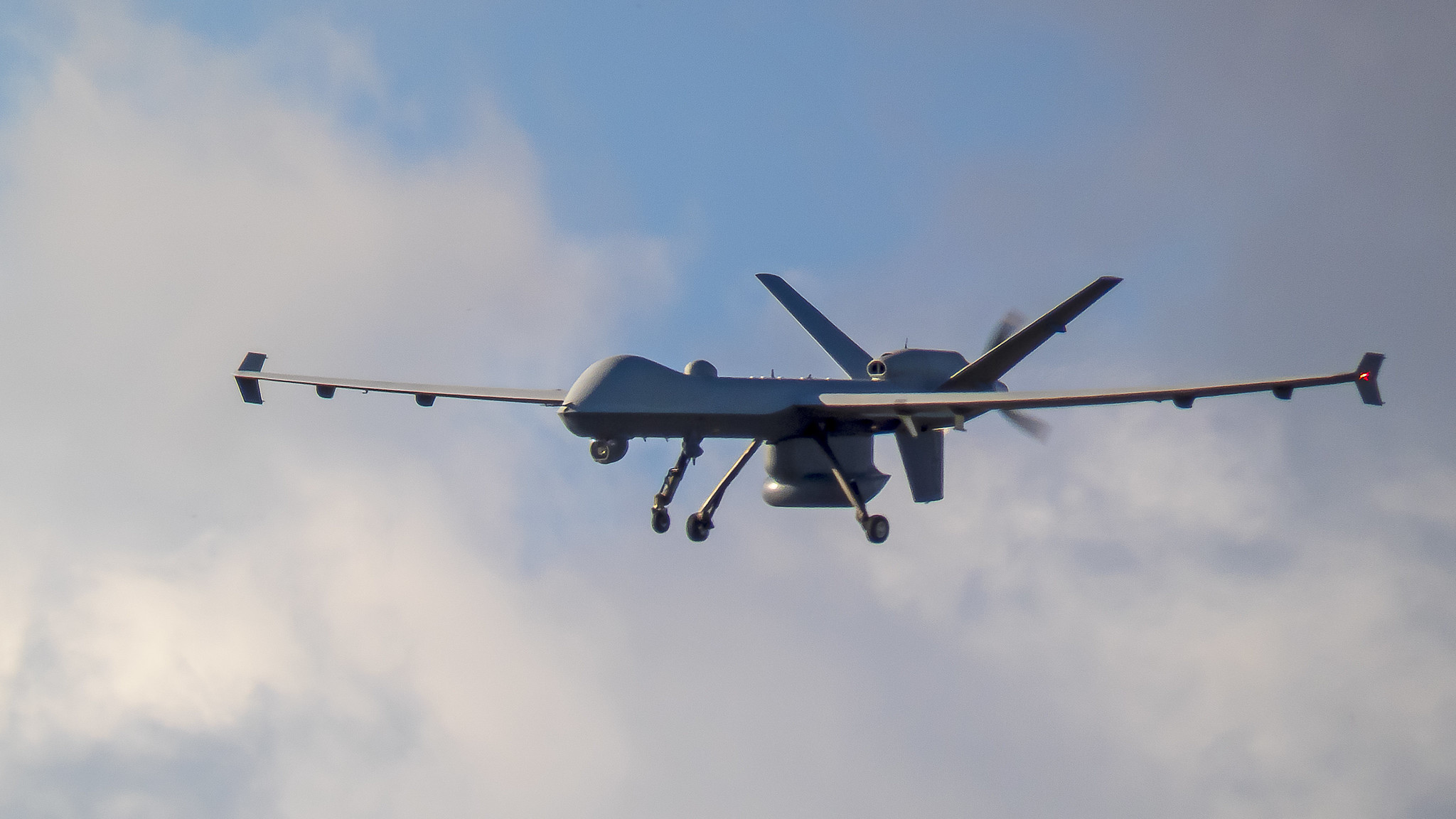
At least three unmanned aerial vehicles are visible at Al Khadim airbase, situated roughly 100 kilometres east of Benghazi. One drone, parked outside a hangar between late April and July 2025, had not previously been documented in Libya. Three independent weapons specialists assessed it as most likely a Feilong-1 (FL-1), an advanced surveillance and attack drone manufactured by Xi’an-based defence company Zhongtian Feilong.
Wim Zwijnenburg, a military technology expert at Dutch peace organisation PAX, analysed the drone’s dimensions and body shape, concluding it closely resembled a Wing Loong II but was more consistent with the FL-1. Jeremy Binnie of defence intelligence company Janes and Joseph Dempsey of the International Institute for Strategic Studies in London independently reached the same conclusion.
A satellite image dated May 3 shows the drone positioned on Al Khadim’s runway. By November, a new shelter had been completed over the precise location where the larger aircraft had previously been parked — a development analysts say suggests efforts to conceal the asset from overhead observation.
Two smaller drones appeared on the airbase’s apron in imagery dated December 17. Their length, wingspan, and distinctive twin-boom tail design are consistent with Bayraktar TB2 drones, manufactured by Istanbul-based company Baykar. Ground control units featuring a characteristic double-antenna configuration were also spotted in satellite imagery captured between July and March, and a truck carrying satellite communications equipment was observed near the apron on January 12.
Al Khadim has undergone substantial expansion throughout 2025, with at least three new hangars constructed since early in the year. Russian forces have previously been based at the facility, using Libya as a staging ground for operations across West and Central Africa. However, the weapons experts who reviewed the imagery did not believe Russians were responsible for operating the drones currently visible at the base.
The LNA is not considered to possess the technical expertise required to independently pilot either the Feilong-1 or the TB2, raising immediate questions about which foreign operators may be involved. The UN embargo, imposed following the NATO-backed uprising that toppled Muammar Gaddafi in 2011, requires UN approval for any weapons shipments to Libya. A UN panel of experts monitoring compliance has previously documented the steady flow of high-tech weaponry into the country in defiance of those restrictions.
Drones played a defining role in Libya’s civil war between 2014 and 2020, when Haftar’s LNA launched a sustained campaign to overthrow the UN-recognised government in Tripoli, accusing it of harbouring armed groups and militants. UN investigators identified the United Arab Emirates, Egypt, and Russia as having provided critical support to Haftar during that conflict, while Turkey backed the Tripoli-based administration. China maintained a position of non-alignment throughout the war. Libya became the first major theatre of drone combat on the African continent, according to UN monitoring bodies.
A ceasefire agreed in 2020 ended the most intense phase of fighting, but the country remains deeply fractured. Haftar’s administration governs the east and controls major oilfields in the south, while the internationally recognised government of Prime Minister Abdulhamid Dbeibah holds authority in the west. The discovery of advanced foreign-origin drones at an LNA-controlled airbase threatens to further destabilise that fragile equilibrium and signals that the aerial arms race that defined Libya’s civil war may be entering a new phase.