Inside a makeshift bakery in Gaza, Abdullah Jamal feeds scraps of wood into a small oven to bake bread. The 40-year-old earns roughly $10 a day — barely enough to survive, and far too little to afford the fuel that once powered his livelihood. His situation is not exceptional. It is the daily reality for most of Gaza’s more than two million residents.
A fuel and energy crisis that predates the current ceasefire has grown catastrophic. Israel’s military campaign destroyed Gaza’s public electricity network entirely, forcing residents to depend on private generators — if they can afford them. The price of electricity from those generators has surged from approximately 2.5 shekels ($0.80) per kilowatt-hour before the war to between 20 and 30 shekels ($7 to $10) today, a more than tenfold increase that places reliable power beyond the reach of most families.
Diesel, the lifeblood of Gaza’s generators, water pumps, and emergency services, tells a similarly grim story. At the height of the conflict, a single litre cost as much as 90 shekels — roughly $29. Prices have since eased but remain approximately triple pre-war levels, hovering around 21 shekels ($10) per litre compared with 7 shekels ($3.30) before the war began. Iyad al-Shorbaji, director general of Gaza’s Petroleum Authority, attributes the persistent inflation to higher purchase costs, transportation expenses, coordination fees, scarcity, and surging demand against constrained supply.
The numbers behind the crisis are stark. Gaza requires 15 million litres of diesel monthly, along with 2.5 million litres of gasoline and between 350 and 400 truckloads of cooking gas, according to al-Shorbaji. What is actually arriving falls dramatically short. Commercial fuel supplies are capped at no more than 3 million litres per month — one-fifth of the diesel requirement alone. Only 100 cooking gas trucks are entering Gaza each month, roughly a quarter of what is needed.
The ceasefire agreement was supposed to change this. Its humanitarian protocol stipulates that 50 fuel trucks enter Gaza every day. Since the ceasefire took effect, Israeli authorities have permitted 1,190 fuel trucks to cross — out of the 8,050 that should have entered under the agreed terms. That represents just 14.7 percent of the fuel and gas amount the protocol committed to delivering.
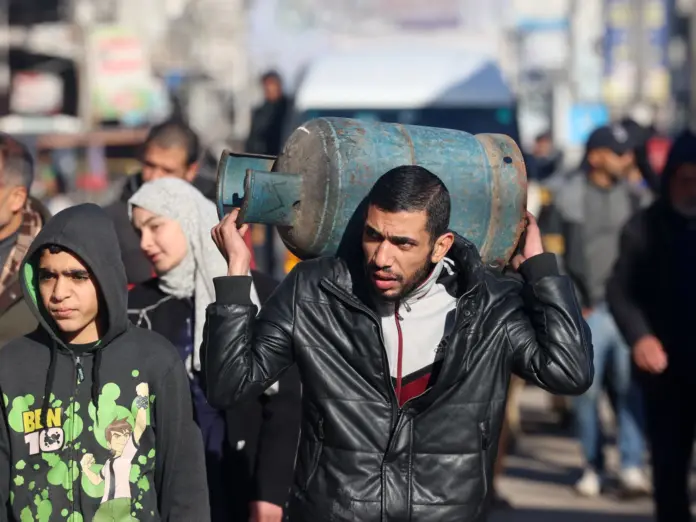
The consequences for ordinary households are severe. Before the war, families could obtain cooking gas cylinders on demand, with average consumption running about 12 kilograms every 25 days. Now, each household receives 8 kilograms delivered every two to three months — and in practice, the wait often stretches from 45 days to as long as 100 days. For Jamal and millions like him, wood fires and improvised solutions have become the only alternative.
The cooking gas shortage has persisted for more than two years, outlasting multiple rounds of fighting and diplomatic negotiations. Most homes in Gaza currently lack both reliable electricity and consistent gas access, a combination that compounds every other dimension of the humanitarian emergency — from food preparation and water purification to medical care and sanitation.
Gaza’s war has killed more than 75,000 Palestinians, according to health authorities, while displacing the vast majority of the enclave’s population and reducing large swaths of its infrastructure to rubble. The destruction of the public power grid was among the earliest and most consequential blows to civilian life, setting in motion the energy collapse that now defines daily existence for survivors.
Al-Shorbaji and other officials have repeatedly called for the full implementation of ceasefire commitments, warning that the gap between agreed supply levels and actual deliveries is not merely an inconvenience but a threat to life. With reconstruction stalled and the energy deficit widening, the prospect of restoring anything resembling normal conditions remains distant for the people of Gaza.