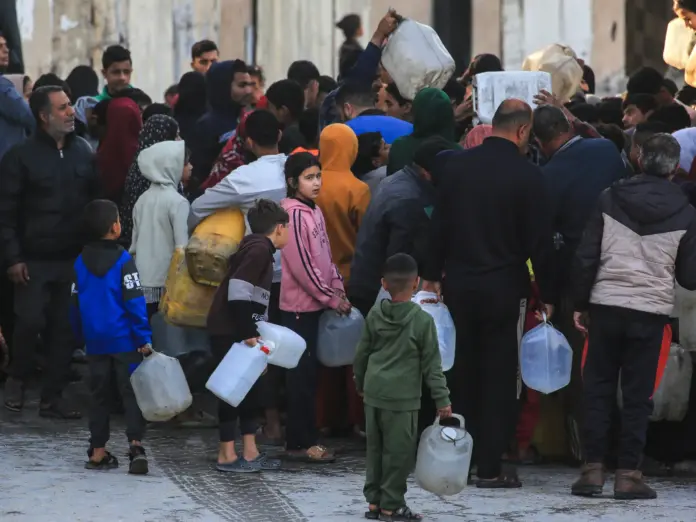
Gaza’s water system is collapsing. Destroyed wells, bombed pipelines, and a near-total blockade on construction materials have left the territory’s 2.3 million residents — most of them already displaced — struggling to access one of the most basic human necessities.
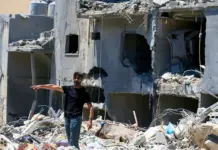
Since Israel launched its military offensive in October 2023, repeated strikes on civilian infrastructure have gutted the water networks that once served Gaza’s densely populated urban centres. In Gaza City alone, more than 72 water wells have been destroyed, along with four main reservoirs and over 150,000 metres of water network pipelines. The United Nations now estimates that approximately 70 percent of Gaza City’s water supply infrastructure is currently disrupted.
Hosny Afana, a municipality spokesman in Gaza City, has described the scale of destruction as unprecedented. The Yassin water station in northern Gaza — once a critical node in the territory’s supply network — is barely functioning, leaving tens of thousands without stable access to clean water.
Repair efforts have stalled at nearly every turn. The Mekorot water supply line, which could restore significant capacity, remains unrepaired because the infrastructure lies east of the Yellow Line — the boundary demarcating territory under Israeli military control. Palestinian maintenance crews cannot access the area.
Even where access exists, the materials needed to carry out repairs are largely unavailable. Israel classifies many basic components required to fix water and sanitation systems as dual-use items — goods that could theoretically serve military purposes — and has banned or heavily restricted their entry into Gaza. Machinery, construction materials, and medical equipment all face severe import curbs.
Tareq Shuhaibar, a maintenance engineer working on water system repairs, says teams have been forced to scavenge debris and rubble for usable parts. The improvised approach has yielded only marginal results against the magnitude of the damage.
The consequences for public health are severe. Contaminated water circulating through what remains of Gaza’s network contains dangerously high levels of salts, nitrates, phosphorus, and sulphur, according to Dr Ghazi al-Yazji, a physician at al-Shifa Hospital. The United Nations Environment Programme has warned that the collapse of Gaza’s sewage treatment infrastructure has likely caused severe contamination of the underground aquifer — the territory’s primary natural water source — raising the prospect of long-term, potentially irreversible environmental damage.
An October 2025 ceasefire between Israel and Gaza offered a brief pause in hostilities, but the violence did not end. Israel killed more than 700 Palestinians after the ceasefire came into effect. Israel continues to occupy more than half of Gaza’s territory, and restrictions on the movement of people and goods remain firmly in place.
Gaza’s two partially opened border crossings — Karem Abu Salem (also known as Kerem Shalom) and the Rafah crossing — provide the territory’s only connections to the outside world. Rafah, which had been shut following the US-Israel war on Iran, was partially reopened last month but is designated exclusively for humanitarian cases. The crossings remain wholly inadequate to meet the scale of Gaza’s reconstruction and humanitarian needs.
With Israel maintaining curbs on aid and goods, and most of Gaza’s population still displaced, the territory’s water crisis shows no signs of abating. Engineers, doctors, and municipal officials warn that without unrestricted access to repair materials and a sustained ceasefire, the infrastructure damage will become permanent — and the public health consequences catastrophic.