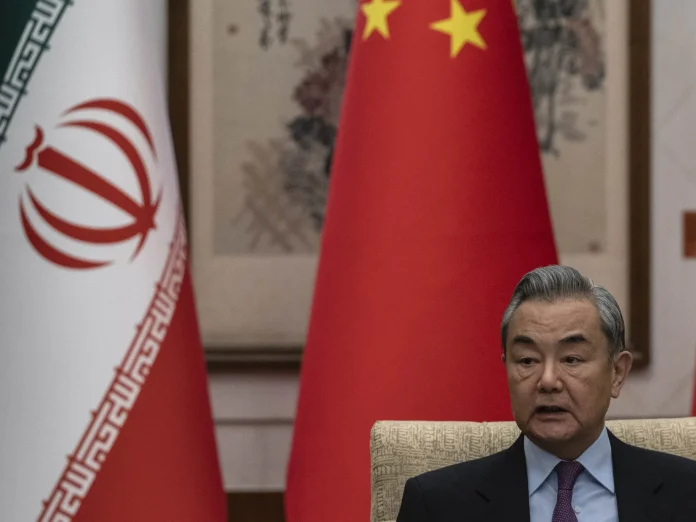
Chinese Foreign Minister Wang Yi voiced unequivocal support for Iran on Monday, urging the United States and Israel to immediately cease military operations after a surprise joint attack struck Iranian territory on Saturday — an assault that shattered a fragile diplomatic process and drew Beijing directly into the unfolding crisis.
Wang made the remarks during a phone call with Iranian Foreign Minister Abbas Araghchi, telling his counterpart that China values its traditional friendship with Iran and stands firmly behind Tehran’s right to safeguard its sovereignty, security, territorial integrity and national dignity. The call underscored the depth of a bilateral relationship formalised through a 25-year strategic agreement signed in 2021 and reinforced by Iran’s membership in both BRICS+ and the Shanghai Cooperation Organisation — both granted at China’s initiative.
Araghchi used the call to deliver a pointed accusation against Washington. The US had launched war against Iran for the second time while negotiations between the two countries were still actively underway, he told Wang, adding that the latest round of indirect talks had produced genuine and positive progress before the strikes began. That progress now lies in ruins.
The timing of the attack has drawn particular scrutiny. Oman‘s Foreign Minister Badr al-Busaidi, who served as mediator in the most recent round of indirect US-Iran talks, told CBS News just hours before the strikes commenced that a peace deal was closer than it had ever been. Within hours, bombs were falling on Iranian soil.
Araghchi also assured Wang that Tehran would take every possible measure to protect the safety of Chinese nationals living and working in Iran — a pledge that reflects both the scale of Chinese economic presence in the country and the personal stakes Beijing has in the conflict’s trajectory.
China’s interest in Iranian stability is not merely diplomatic. More than 80 percent of Iran’s shipped oil in 2025 has flowed to Chinese ports, making Tehran one of Beijing’s most significant energy suppliers. Iranian crude accounts for roughly 13.5 percent of all the oil China imports by sea — a dependency that gives Beijing powerful incentive to resist any outcome that further destabilises or isolates the Islamic Republic.
Ahmed Aboudouh, an associate fellow at Chatham House, describes China as a lifeline for the Iranian economy amid the crushing weight of international sanctions. Beijing and Tehran are formally designated comprehensive strategic partners, and China has worked consistently to end Iran’s isolation on the world stage — a posture now being tested by the most serious military escalation in the region in years.
Wang’s call for an immediate ceasefire places Beijing in direct rhetorical opposition to Washington and Tel Aviv at a moment of acute regional tension. Whether China moves beyond words to exert concrete pressure remains to be seen, but its economic leverage over Iran — and its growing influence within multilateral institutions — gives it tools that few other actors possess.
The strikes have fundamentally altered the diplomatic landscape. What had appeared, by Oman’s account, to be a negotiating process on the verge of a breakthrough has been replaced by open conflict, with Iran now framing the US as an aggressor that chose war over a deal it had been actively pursuing. For Beijing, the attack represents not only a threat to a strategic partner but a direct challenge to the architecture of economic and institutional relationships it has spent years constructing across the region.