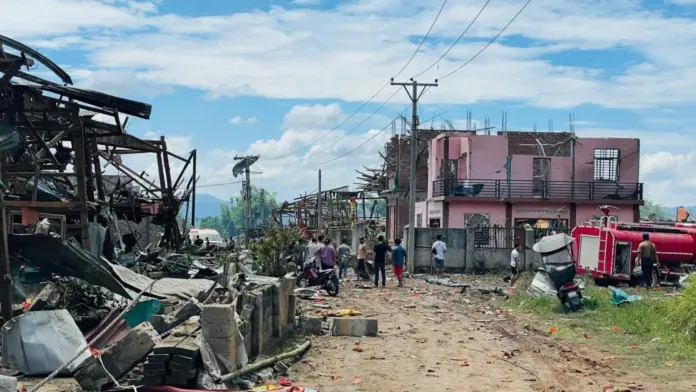
Myanmar Shan State Explosion — An explosion tore through Kaung Tat village in Namkham Township, northern Shan State, killing at least 55 people and wounding dozens more in one of the deadliest single incidents to strike the conflict-ridden region in recent memory. The blast, which obliterated nearly an entire neighbourhood and damaged hundreds of homes, left scenes of chaos and grief as survivors searched frantically through the wreckage.
The dead included 25 women and 30 men, with children also counted among the victims. Rescue teams worked through the destruction, pulling survivors from beneath collapsed structures as the scale of the catastrophe became clear. One resident, who escaped with a minor leg injury, described harrowing scenes in the immediate aftermath — people crying out, calling for their parents, disoriented amid the dust and rubble of what had been their homes.
The Ta’ang National Liberation Army (TNLA), the armed ethnic organisation that controls the area near the Chinese border, confirmed that the explosion originated from a stockpile of explosives used in mining and quarrying operations. The statement offered little comfort to residents who questioned why such a facility had been permitted to operate in such close proximity to a densely populated residential area. Some villagers, conditioned by years of aerial bombardment in a country gripped by civil war, initially believed the blast was the result of a military air strike.
Recommended Reading
The confusion was understandable. Myanmar — formerly known as Burma — has been engulfed in brutal conflict since the military junta seized power in a 2021 coup, and Shan State has been among the most heavily contested regions. The TNLA has been locked in fierce fighting with the junta’s armed forces, and civilian populations across the state have grown accustomed to sudden violence from above. The sound and force of the industrial explosion mimicked the devastation of a strike, sending residents fleeing before the true cause was established.
Casualty figures varied slightly across different accounts, though all confirmed a death toll of at least 55. The physical destruction extended far beyond those killed or injured — hundreds of homes were damaged or destroyed, effectively erasing a significant portion of the village in an instant. Rescue operations were ongoing as teams continued to search for anyone still trapped beneath the debris.
The disaster raises urgent questions about the regulation of hazardous industrial materials in active conflict zones, where governance structures are fragmented and oversight is minimal. In areas controlled by armed groups such as the TNLA, the management of dangerous facilities often falls outside any formal regulatory framework, leaving civilian populations exposed to industrial risks compounded by the ever-present dangers of war.
Myanmar Shan State Explosion: The Conflict in Context
Shan State, which borders China to the northeast, has long been a mosaic of competing armed factions, ethnic militias, and junta forces. The TNLA, representing the Ta’ang people, has been one of the more active resistance groups in the region, participating in coordinated offensives against military installations alongside allied ethnic armed organisations. The area around Namkham Township, situated close to the Chinese frontier, has seen significant military activity in recent years as the junta has struggled to maintain territorial control.
For the residents of Kaung Tat, the immediate reality is one of loss and displacement. Homes are gone. Families are shattered. And the questions being asked — why explosives were stored so close to where people lived, and who bears responsibility — are unlikely to receive answers in a region where accountability has long been a casualty of conflict itself.