Kyrgyzstan Sanctions Evasion — Kyrgyzstan has ordered the closure of 50 companies believed to be facilitating Russia’s evasion of international sanctions, a landmark step for the small Central Asian republic that has found itself at the centre of a geopolitical tug-of-war between Moscow and the West since Russia’s invasion of Ukraine.
The announcement by Kyrgyz authorities marks the first time the country has moved to shut down businesses accused of sanctions circumvention — a significant shift for a nation whose economic ties to Russia run extraordinarily deep. Remittances from Russian-based migrant workers account for between 15 and 26 percent of Kyrgyzstan’s gross domestic product, making the relationship with Moscow far more than a matter of political alignment.
The scale of trade flows that prompted Western concern is stark. Between 2021 and 2022, the annual value of Kyrgyzstan’s exports to Russia surged from $393 million to $1.07 billion — a near-tripling that coincided precisely with the onset of sweeping Western sanctions following Russia’s full-scale invasion of Ukraine. Among the goods flowing northward were luxury cars and microchips, the latter classified as dual-use items that can be imported legally as civilian technology and then re-exported for military applications.
Recommended Reading
Western governments have responded with escalating measures. The European Union imposed an embargo on certain electronic goods destined for Kyrgyzstan, explicitly targeting the rerouting pipeline. The EU also blacklisted two Kyrgyz banks. The United Kingdom went further, imposing sanctions directly on senior Kyrgyz officials — a move that underscored how seriously London views the country’s role in undermining the sanctions architecture built around Russia.
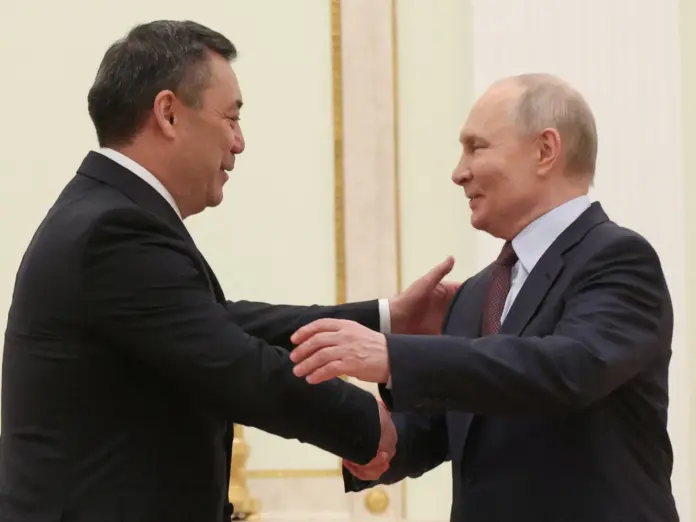
Kyrgyzstan’s position is shaped by structural vulnerabilities that make defying Moscow costly. The country, a mountainous and landlocked nation of roughly seven million people that gained independence in 1991, is a member of the Eurasian Economic Union, the Russia-led trade bloc that facilitates the relatively frictionless movement of goods across member states. Russia also maintains an airbase and other military facilities on Kyrgyz soil, and the two countries are bound by mutual defence agreements — a web of dependencies that gives the Kremlin considerable leverage.
Russia’s deputy foreign minister, Mikhail Galuzin, framed Western pressure on Central Asian nations in explicitly adversarial terms, stating that the West is seeking access to regional resources in order to undermine Russian influence. The comment reflects Moscow’s sensitivity to any erosion of its dominance in a region it regards as a near-abroad buffer zone.
Yet Kyrgyzstan is not solely within Russia’s orbit. China borders the country to the east and has become a significant economic actor through its Belt and Road logistics initiative, in which Kyrgyzstan participates. Bishkek carries substantial debt dependence on Beijing, adding a second major power to the constellation of external pressures the government of President Sadyr Japarov must navigate.
Kyrgyzstan Sanctions Evasion: The Wider European Impact
Domestically, Japarov’s administration has drawn criticism from civil liberties advocates. The investigative outlet Kloop has been blocked under his presidency, and Kyrgyzstan has enacted a foreign agents law modelled closely on Russian legislation — moves that critics argue signal a tightening of political space even as the government attempts to demonstrate compliance with Western demands on sanctions enforcement.
The closure of the 50 companies may represent a calibrated concession designed to relieve the most acute Western pressure without fundamentally restructuring Kyrgyzstan’s relationship with Russia. Whether the move satisfies the EU and UK — or whether it proves to be the beginning of more sustained enforcement — will depend in large part on whether the goods flows that alarmed Western capitals actually diminish in the months ahead.
For Bishkek, the stakes of miscalculation are high on every side. A rupture with Moscow would threaten the remittance lifeline that sustains a significant portion of the population. Continued facilitation of sanctions evasion risks deeper financial isolation from European markets and institutions. And with China watching closely from the east, Kyrgyzstan’s leadership faces the defining foreign policy challenge of its post-Soviet existence: how to remain viable in a world where the great powers are demanding it choose.