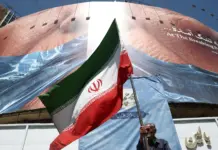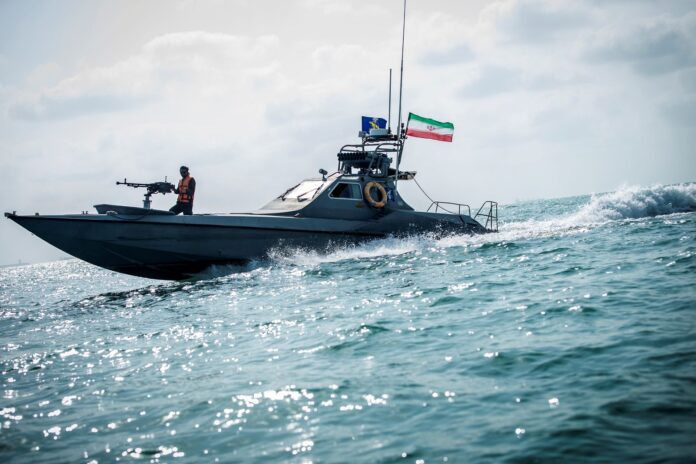
Iran Strait Control — Iran has unilaterally declared military control over more than 22,000 square kilometres of waters surrounding the Strait of Hormuz, establishing a new body called the Persian Gulf Strait Authority and demanding that all vessels transiting the world’s most critical oil chokepoint seek its authorisation. The sweeping claim, which encroaches into the territorial waters of both Oman and the United Arab Emirates, has been met with swift rejection from Washington and its Gulf partners — even as Pakistan’s military chief arrived in Tehran to broker a diplomatic off-ramp.
The Persian Gulf Strait Authority announced that transit through the strait ‘requires coordination with and authorisation from’ the new body, a declaration that effectively asserts Iranian veto power over one of the world’s busiest maritime corridors. Roughly a fifth of global oil supply passes through the strait each day. Iran has not ratified the United Nations Convention on the Law of the Sea, the international framework that governs freedom of navigation in such waters.
Anwar Gargash, diplomatic adviser to the UAE president, dismissed the Iranian claims with pointed contempt. The assertions amounted to ‘nothing but fragments of dreams,’ he said, signalling that Abu Dhabi has no intention of recognising the authority’s jurisdiction over waters it considers its own.
Recommended Reading
The United States was equally unequivocal, instructing commercial vessels to disregard Iran’s new rules entirely. That posture was underscored on Wednesday when US Marines rappelled from a helicopter onto the deck of the Celestial Sea, an oil tanker operating in the Gulf of Oman that US Central Command (Centcom) suspected of violating the American blockade of Iranian ports. After conducting a search and ordering the crew to alter course, US forces released the vessel. Tracking data subsequently showed the Celestial Sea reporting its destination as the Omani port of Duqm. The tanker had previously been sanctioned under a former name for its ties to Iran.
The boarding was not an isolated incident. Centcom confirmed on Thursday that since the blockade of Iranian ports took effect on 13 April, US forces have redirected 94 commercial ships and disabled four vessels. The enforcement campaign reflects a sustained American effort to strangle Iranian oil revenues as diplomatic pressure mounts.
Separately, media outlets linked to Iran’s Islamic Revolutionary Guard Corps (IRGC) published footage purporting to show a ‘punishment’ strike on a tanker in the strait. Analysis matching key vessel characteristics identified the ship as the Barakah, a Liberian-flagged tanker whose operators reported it was struck by unknown projectiles in early May. The incident underscores the volatile environment in which commercial shipping is now operating.
Against this backdrop of escalating maritime confrontation, diplomatic activity is intensifying at pace. Pakistan’s military chief, General Asim Munir, travelled to Tehran on Thursday in a reported mediation effort between Iran and the United States. Iran’s foreign ministry said it was reviewing the latest American proposals for ending the conflict.
Iran Strait Control: Regional Implications
President Donald Trump disclosed earlier this week that he had postponed a military strike on Iran — originally planned for the following day — at the personal request of the leaders of Qatar, Saudi Arabia, and the UAE. ‘Serious negotiations are now taking place,’ Trump said, framing the delay as a concession to Gulf allies rather than a retreat. He added that he could wait a few days for Tehran to agree to a new deal, while making clear he remained willing to resume attacks if talks collapsed. Trump had previously predicted in March that a war against Iran would be over in ‘four to five weeks.’
The convergence of Iranian maritime assertiveness, American naval enforcement, and high-level diplomatic shuttling reflects the precarious equilibrium now defining the Persian Gulf. Iran’s new authority claim appears designed to project strength domestically and internationally at a moment when its economy is under severe pressure from the US blockade. Yet the move risks hardening opposition among Gulf neighbours whose cooperation Tehran may ultimately need.
The UAE’s blunt dismissal and Washington’s instruction to shipping companies to ignore Iranian demands suggest the Persian Gulf Strait Authority will struggle to translate its declarations into operational reality. Whether the diplomatic track — now involving Pakistan as a new intermediary alongside Gulf monarchies — can produce a framework before the next military flashpoint remains the defining question hanging over the region.