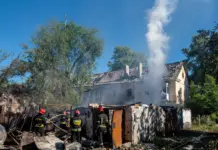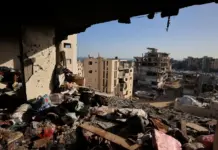
Ukraine Drone Arsenal — Twelve-year-old Liubava and her 17-year-old sister Vira had already endured the loss of their father, killed fighting on Ukraine’s front lines. Earlier this month, a Russian missile obliterated the residential block where they lived in Kyiv, taking both girls along with 22 other civilians — 24 dead in a single strike on an apartment building.
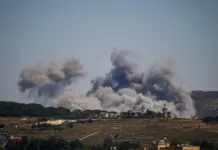
Their deaths arrived amid one of the war’s most ferocious aerial barrages. Within a 48-hour window, Russia launched 1,500 drones and 56 missiles at Ukrainian territory in a sustained assault that tested the limits of the country’s air defences. President Volodymyr Zelensky reported that Ukrainian forces intercepted 94% of the long-range drones and 73% of the missiles — figures that speak to genuine defensive capability, but also to the arithmetic of mass bombardment: even a fraction of projectiles breaking through can devastate entire city blocks.
On 14 May 2025, Ukrainian forces shot down 55% of Russian drones launched nationwide in a single day. The gap between that figure and the near-total interception rates Zelensky cited for other engagements reflects the uneven, evolving nature of the air war — one in which Russia is constantly adapting its tactics, deploying decoy drones to map the locations of Ukrainian air defence systems and developing faster, jet-powered drones designed to outpace existing interceptors.
Recommended Reading
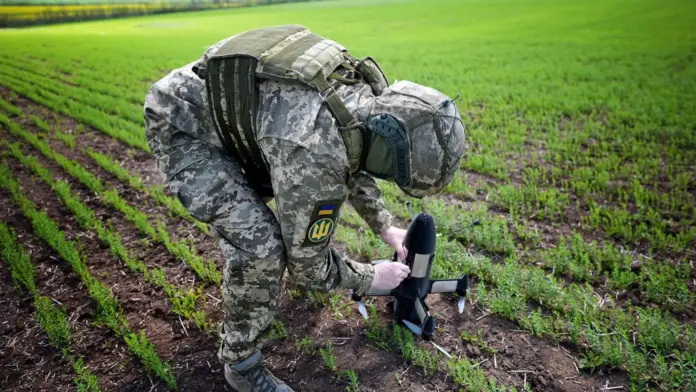
Ukraine’s response has been a rapid, largely homegrown transformation of its defensive architecture. At the start of the full-scale invasion, the country relied heavily on ageing Soviet-era weapons. Three years later, it produces more than 1,000 cheap interceptor drones per day. In March 2025 alone, Ukrainian interceptor drones destroyed more than 30,000 Russian attack drones — a figure that would have seemed implausible at the war’s outset.
Central to this effort is the P1-SUN interceptor, a 3D-printed drone capable of exceeding 300 kilometres per hour with a range of more than 30 kilometres. It costs approximately $1,000 — roughly one-fiftieth the price of the Russian Shahed one-way attack drones it hunts, which carry a price tag of around $50,000 each. The asymmetry is deliberate and economically punishing for Moscow.
Coordinating this layered defence is Sky Map, a system that fuses data from radars, thousands of ground-based sensors, video feeds and artificial intelligence to detect and track incoming threats in real time. The platform’s effectiveness has drawn international attention: the United States is now using Sky Map to protect one of its military bases in the Middle East. Lt Col Yuriy Myronenko, an inspector general at Ukraine’s Ministry of Defence, has been among those overseeing the integration of new technologies into the country’s defensive posture.
The private sector has also mobilised. Twenty-five private companies have signed up to Ukraine’s air defence initiative, contributing resources and innovation outside the traditional military procurement chain. Among them is Carmine Sky, which has constructed a network of towers fitted with remotely controlled machine guns across the Kharkiv region — one of the areas most persistently targeted by Russian aerial attacks.
Western support remains critical, particularly for the highest-end threats. Patriot air defence missiles, supplied by the United States, are currently the only weapons capable of reliably intercepting Russian ballistic missiles. Their limited supply constrains Ukraine’s ability to protect multiple cities simultaneously, a vulnerability Russia has sought to exploit through saturation tactics.
Ukraine Drone Arsenal: The Wider European Impact
Ukraine has simultaneously taken the war deeper into Russian territory. Recent strikes have ignited massive fires at oil refineries across Russia, and Ukrainian attacks have reached as far as St Petersburg and Moscow. The threat was tangible enough that Russia scaled back its World War Two Victory Day parade in May, citing fears of Ukrainian drone strikes on the capital.
Despite the technological advances, the human toll continues to mount. First-person-view drones — cheap, agile and increasingly ubiquitous — remain the single largest cause of casualties on both sides of the front line, a reminder that the most sophisticated air defence network cannot fully insulate soldiers or civilians from the war’s grinding violence.
For the families of Liubava and Vira, no interception rate offers consolation. Their story has become emblematic of what Ukrainian officials describe as deliberate Russian targeting of civilian infrastructure — strikes designed not merely to degrade military capacity but to break the population’s will. So far, the evidence suggests that objective is failing, even as the cost of resistance is measured in lives like theirs.