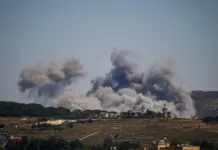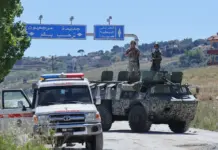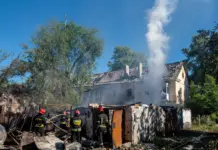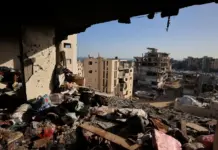
Southern Lebanon/Northern Israel — Hezbollah has sharply intensified drone warfare against Israeli forces, deploying swarms of inexpensive first-person view (FPV) drones that are proving difficult to counter and are inflicting a steady toll of casualties on Israeli soldiers and civilians alike.
Hezbollah Fpv Drones — Close to 100 apparent FPV attacks have been documented on Hezbollah’s Telegram channel since 26 March 2025. Geolocated footage from 35 of those videos confirms strikes on Israeli soldiers, armoured vehicles, and air defence systems across southern Lebanon and northern Israel. The group had not shared comparable footage from the earlier phase of the conflict, which began on 2 March, suggesting a deliberate tactical shift toward the small, agile platforms.
Four Israeli soldiers and one civilian have been killed in FPV strikes, with dozens more wounded. One particularly striking verified video shows at least four drones attacking an Israeli border outpost near Kiryat Shmona in a coordinated swarm. On 26 April, at least two strikes struck the southern Lebanese town of Taybeh, killing one soldier and wounding six others.
Recommended Reading
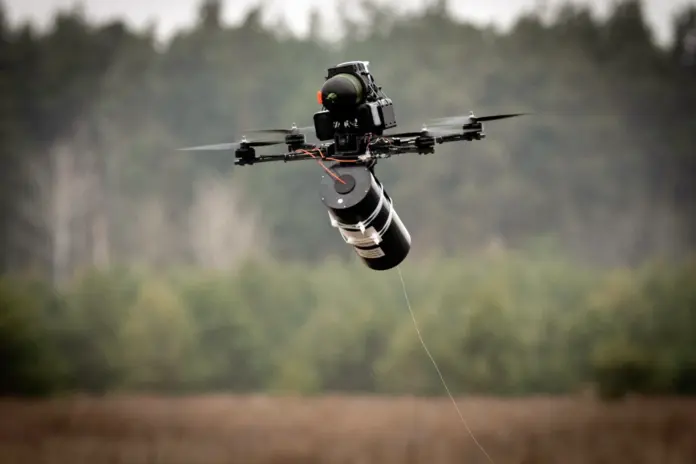
What makes the campaign especially alarming for Israeli defence planners is the guidance technology Hezbollah has incorporated into some of its drones. Rather than relying on radio-frequency signals — which Israeli electronic warfare systems are designed to jam — certain FPV drones are tethered to operators via fibre-optic cables. Because the cables transmit control signals as pulses of light rather than radio waves, they are effectively immune to current Israeli electronic countermeasures, leaving kinetic interception as the primary option.
The drones themselves are built to be cheap and replaceable. Hezbollah is assessed to be assembling them locally, drawing on commercially available components sourced largely from China and supplementing them with parts manufactured on 3D printers. The estimated unit cost sits between $300 and $500 — a fraction of the price of the interceptor missiles Israel would need to shoot them down. Most carry a rocket-propelled grenade warhead, giving each drone a meaningful anti-armour and anti-personnel punch at minimal expense.
The drone escalation is unfolding against the backdrop of a devastating wider conflict. The fighting erupted on 2 March after the United States and Israel launched a wave of air strikes on Iran that killed Supreme Leader Ayatollah Ali Khamenei. Hezbollah responded by firing rockets into northern Israel. Israel then launched widespread air strikes across Lebanon and sent ground forces into the south.
The human cost has been staggering. Lebanon’s health ministry reports at least 2,896 people killed since the conflict began, with more than one million displaced. More than 400 of those deaths occurred after US President Donald Trump announced a ceasefire in April — an agreement that has clearly failed to halt the violence. Israel, for its part, acknowledges four soldiers and 18 civilians killed on its side of the border.
Hezbollah Fpv Drones: Regional Implications
The FPV drone campaign represents a broader evolution in asymmetric warfare that has been observed in other conflict zones, most notably Ukraine, where both sides have used similar low-cost platforms to devastating effect. Hezbollah appears to have absorbed those lessons and adapted them to the Lebanese theatre, where the group faces one of the world’s most sophisticated military establishments.
The fibre-optic variant is particularly significant. Electronic jamming has been a cornerstone of Israeli counter-drone strategy, and the ability to neutralise that advantage with a spool of cable costing a few dozen dollars represents a meaningful tactical innovation. As long as the components remain commercially accessible and assembly can be done locally, Israel faces a persistent and scalable threat that expensive, high-technology defences struggle to address economically.
With the ceasefire in tatters and Hezbollah demonstrating both the will and the capability to sustain its drone campaign, the conflict along the Israel-Lebanon border shows no sign of abating.