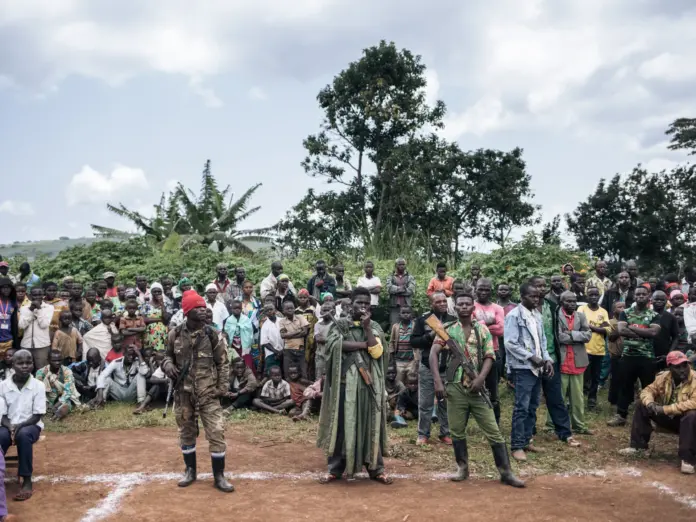
Codeco Militia Ituri — At least 69 people are dead following a wave of militia attacks in the Democratic Republic of the Congo’s Ituri province, as fighters affiliated with the CODECO coalition struck multiple villages on April 28 in what civil society leaders described as a retaliatory massacre rooted in decades of ethnic bloodshed.
A security source confirmed the toll of 69 dead, including 19 militia members and soldiers. Civil society leader Dieudonne Losa placed the figure even higher, saying more than 70 people were killed when CODECO launched its retaliatory campaign in late April. As of Saturday, only 25 bodies had been buried, with the remainder described as strewn across the ground near the village of Bassa.
The violence was triggered in part by an earlier assault carried out by the Convention for the Popular Revolution (CRP), an armed group that claims to defend the Hema ethnic community. CRP fighters attacked positions held by the Congolese national army (FARDC) near the locality of Pimbo, prompting CODECO — a coalition that presents itself as a protector of the rival Lendu ethnic group — to strike back against civilian villages.
Recommended Reading
The United Nations peacekeeping mission MONUSCO intervened on April 30, rescuing nearly 200 people caught in the crossfire during the CRP assault on FARDC positions. The Ente association, which represents the Hema community, condemned the killings as a massacre.
The resurgence of the CRP has added a new and alarming dimension to Ituri’s already complex security landscape. The group was originally founded by Thomas Lubanga, who in 2012 became the first person convicted by the International Criminal Court for the war crime of recruiting child soldiers into his rebel army. Lubanga completed his sentence and was released in 2020, and since early 2025 the CRP has re-emerged as an active armed force in the province.
Ituri, a gold-rich territory bordering Uganda and South Sudan, has been a theatre of ethnic violence between the Hema and Lendu communities for decades. The two groups have clashed repeatedly over land, resources, and political power, with cycles of attack and retaliation claiming tens of thousands of lives since the late 1990s. The province’s mineral wealth — including gold deposits that have drawn both local militias and foreign interests — has consistently fuelled competition and armed mobilisation.
The broader eastern DRC region has been a battleground for more than 30 years, with armed groups vying for control of mines rich in cobalt, copper, uranium, and diamonds. Today, multiple factions operate across the region, including the M23 rebel movement, which has seized significant territory in North Kivu, and the Allied Democratic Forces (ADF), a group with roots among former Ugandan rebels that has pledged allegiance to the Islamic State and continues to carry out deadly attacks across northeastern DRC.
Codeco Militia Ituri: The Broader African Context
The April 28 killings drew immediate condemnation from humanitarian observers. Rawya Rageh, a senior crisis adviser at Amnesty International, has been among those monitoring the deteriorating situation in Ituri as violence has intensified in 2025.
The scale of the carnage and the slow pace of recovery efforts — with dozens of bodies still unburied days after the attack — point to the severe strain on local authorities and humanitarian capacity in a province that has seen little sustained peace. The renewed activity of both CODECO and the CRP signals that Ituri’s fragile calm, never fully consolidated even during periods of reduced violence, has broken down once again, threatening to draw more communities into a cycle of reprisal killings that has proven extraordinarily difficult to break.