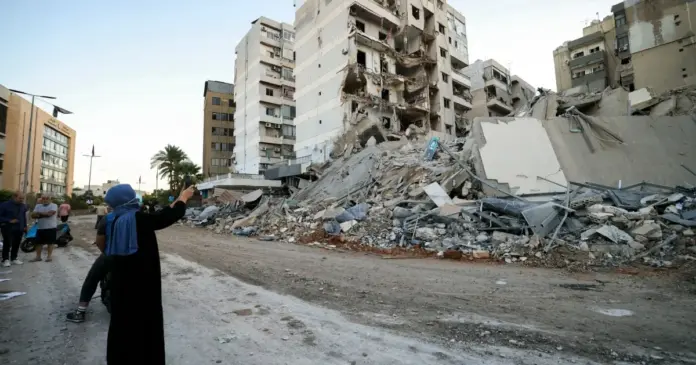
Israel Strikes Beirut — Israeli warplanes struck the Ghobeiri district of Beirut’s southern suburbs on Wednesday, shattering a period of relative calm and marking the first assault on the predominantly Shia area since a ceasefire between Israel and Hezbollah entered into force on April 17. The attack produced a powerful explosion and caused extensive damage across the densely populated neighbourhood.
The Israeli army confirmed the operation was aimed at Malek Balou, a senior commander within Hezbollah’s elite Radwan Force. Prime Minister Benjamin Netanyahu publicly acknowledged the strike, stating that Defence Minister Israel Katz had directed the military to carry it out. Netanyahu characterised the Radwan Force as directly responsible for firing on Israeli settlements and attacking soldiers of the Israel Defense Forces.
The Beirut strike was not an isolated incident. On the same day, an Israeli attack on Lebanon’s eastern Bekaa Valley killed four people. The Israeli military also struck Hezbollah targets across southern Lebanon, issuing evacuation warnings to residents of more than a dozen towns before the bombardments began. The coordinated nature of the operations underscored Israel’s continued willingness to conduct offensive action despite the standing truce.
Recommended Reading
Wednesday’s assault on Beirut represents the second Israeli strike on the city’s southern suburbs this week, deepening concerns that the ceasefire framework is unravelling. The agreement, brokered by Washington between Israeli and Lebanese representatives, has been under sustained strain since its inception. Both Israel and Hezbollah have levelled accusations at each other of violating its terms, and Israeli forces have conducted regular strikes on Lebanon’s south and east throughout the truce period.
Hezbollah has claimed responsibility for multiple operations targeting Israeli forces in southern Lebanon, as well as attacks on communities in northern Israel. The militant group’s continued activity has provided the Israeli government with its stated justification for ongoing military pressure, even within the boundaries of a nominal ceasefire.
The human cost of the conflict has been severe. More than 2,700 people have been killed in Israeli strikes across Lebanon since March 2. Dozens more have died since the April 17 ceasefire alone, a figure that illustrates the degree to which the truce has failed to halt the bloodshed. On the Israeli side, the military has recorded the deaths of 17 soldiers and one civilian contractor during the fighting.
The strike on Ghobeiri carries particular symbolic weight. The southern suburbs of Beirut — known colloquially as the Dahiyeh — serve as a stronghold of Hezbollah’s political and military infrastructure. Targeting the area signals that Israel is prepared to extend its campaign beyond the border regions and into the Lebanese capital itself, a move that risks provoking a significant escalation in hostilities.
Israel Strikes Beirut: Regional Implications
Regional tensions extend beyond the Israel-Lebanon front. In a separate but related development, former US President Donald Trump issued a stark warning to Iran, demanding that Tehran accept a diplomatic deal or face a renewed wave of American military strikes. Iran’s chief nuclear negotiator responded by accusing Washington of seeking to force the country into outright capitulation — a characterisation that reflects the deep mistrust between the two governments as indirect negotiations continue.
The broader geopolitical picture remains volatile. With the Washington-brokered ceasefire visibly fraying, international mediators face mounting pressure to reinforce the agreement before a full resumption of large-scale hostilities. For the residents of Beirut’s southern suburbs, Wednesday’s explosion served as a stark reminder that the truce, however formally intact, has offered little guarantee of safety.