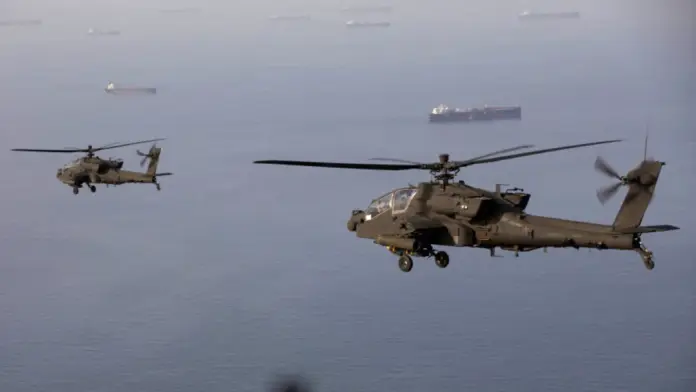
STRAIT OF HORMUZ — President Donald Trump accused Iran on Tuesday of shooting down a United States military Apache helicopter over the Strait of Hormuz, demanding a response even as he acknowledged the risk of derailing delicate ceasefire negotiations with Tehran.
Iran Hormuz Apache — Both crew members aboard the downed aircraft were rescued safely and without injury. The rescue, completed within approximately two hours of the incident, was conducted at 19:33 EDT Monday by an uncrewed surface drone operated by Task Force 59, a Bahrain-based unit established in 2024 that specialises in unmanned maritime systems. The drone transported the pilots to a secondary location, where they were hoisted to a waiting helicopter. The operation was supported by US Naval Forces Central Command, the 82nd Airborne Division, and units of the US 5th Fleet.
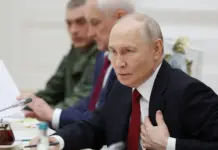
Trump announced the incident in a social media post, stating the United States must respond ‘out of necessity.’ He simultaneously urged both Israel and Iran to ‘immediately stop shooting,’ warning that continued hostilities risk jeopardising ongoing negotiations. Trump said a final deal could be reached within ‘two or three days’ and that the Strait of Hormuz would reopen immediately upon its conclusion — a significant economic and strategic prize given the waterway’s role as a critical artery for global oil shipments.
Recommended Reading
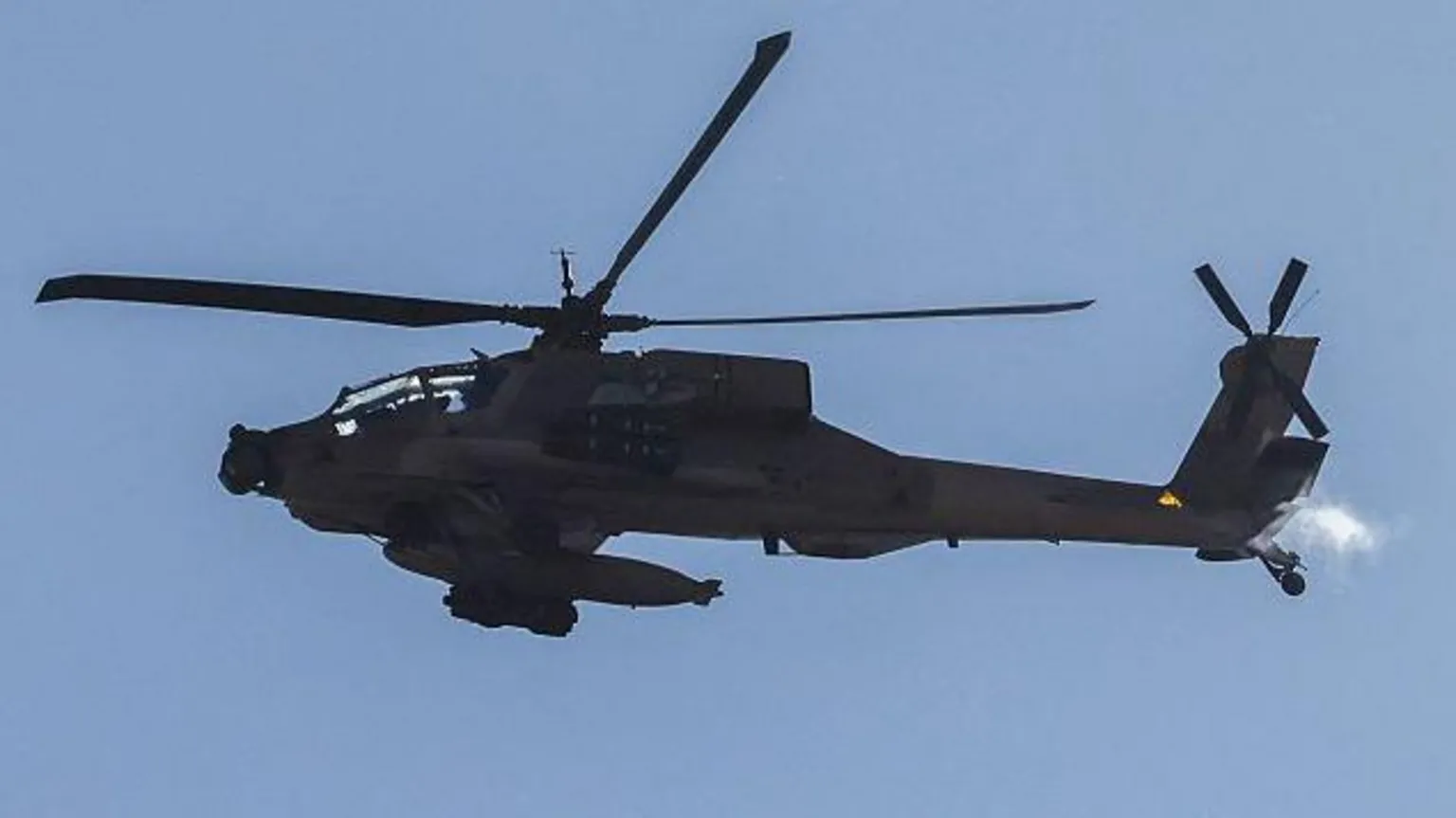
US Central Command (CENTCOM) said the cause of the helicopter’s loss remains under investigation. Iranian forces have not claimed responsibility for the downing, and Tehran offered no immediate response to Trump’s accusation. Iran’s semi-official Mehr News Agency noted that no Iranian entity had claimed the incident.
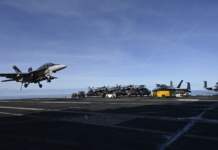
The loss marks the first Apache helicopter downed since the conflict between the United States and Iran began, and it arrives at a moment of acute fragility. An April 8 truce had paused the US-Israeli campaign against Iran, but that ceasefire has been tested repeatedly in recent weeks. On Monday — just hours before the helicopter incident — the US military disabled an Iranian oil tanker in the Gulf. Earlier this month, American forces struck Iran’s Qeshm Island, prompting Tehran to launch missiles at a US base in Kuwait. A drone strike on Kuwait’s international airport killed one person; Iran denied responsibility for that attack.
The regional picture has grown increasingly complex. Iran fired missiles at Israel following Israeli bombing of Beirut, and Israel subsequently carried out retaliatory strikes inside Iran. Israeli forces conducted further strikes across southern Lebanon on Tuesday, a move Iran had explicitly warned would trigger retaliation. Iran’s parliament speaker and chief negotiator, Mohammad Bagher Ghalibaf, posted on social media signalling that Tehran was prepared to respond, stating Iran is not afraid to return to war.
Iranian officials have argued that both the US naval blockade of Iranian ports and Israel’s continued operations in Lebanon constitute violations of the April 8 ceasefire. Israel and Iran had briefly halted direct exchanges of fire following a weekend of hostilities — the first such direct confrontation since the April truce — before Trump intervened publicly to demand both sides stand down.
Iran Hormuz Apache: Regional Implications
The timing of the helicopter incident adds pressure to what Trump had characterised as near-complete negotiations. Sina Azodi, director of the Middle East studies programme at Georgetown University, noted that Iranian leadership is acutely aware the war has grown unpopular domestically within the United States — a factor that may shape Tehran’s calculus as it weighs how aggressively to respond to American accusations.
The United States is also days away from co-hosting the FIFA World Cup, which begins on Friday, adding a layer of domestic and diplomatic sensitivity to any escalation. A major military response in the Gulf in the opening days of the tournament would place Washington in an uncomfortable spotlight before a global audience.
Trump’s position remains contradictory on its face: he has vowed to respond to what he characterises as an Iranian attack while simultaneously acknowledging that doing so risks collapsing the very negotiations he says are nearly complete. Whether Tehran’s silence on the helicopter incident represents a deliberate de-escalatory signal or a prelude to a broader response remains unclear. CENTCOM’s investigation into the cause of the crash may prove pivotal — if evidence of Iranian culpability is confirmed, the pressure on the White House to act will intensify sharply.