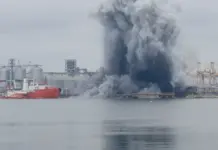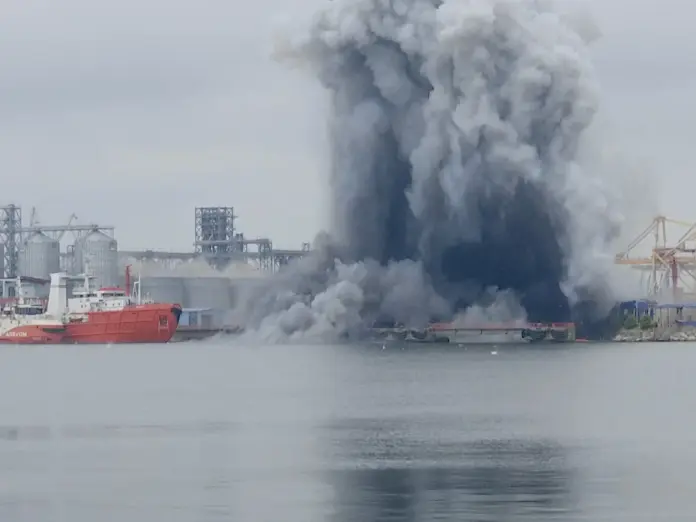
Black Sea Nato Port — A Ukrainian maritime drone detonated near an oil terminal inside Romania’s Constanta port on Friday morning, exploding at 10:30 a.m. local time (07:30 GMT) and forcing the evacuation of one of the Black Sea’s busiest commercial hubs. No injuries were reported.
Romania’s Ministry of National Defence confirmed the drone self-detonated. Interior Minister Raed Arafat said the port was cleared of personnel following the blast, and several additional drones were discovered near the explosion site, prompting a wider security sweep of the area.
Ukraine’s navy acknowledged the drone belonged to its forces, stating that Russian electronic warfare systems had knocked the vessel off course, causing it to lose control and drift toward the Romanian coastline. The explanation underscores how the technological battle being waged over the Black Sea is increasingly producing consequences far beyond the immediate front lines of the conflict.
Recommended Reading
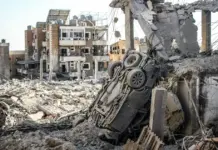
Romanian President Nicusor Dan described the detonation as the second security incident that week on the country’s Black Sea coast. Earlier, Romania’s navy had been forced to detonate a Russian YaRM-type anti-landing mine that had drifted ashore. Last week, a Russian drone crashed into a residential apartment building in Romania — a stark illustration of how the war’s debris, both literal and strategic, is spilling across borders.
European Commission President Ursula von der Leyen characterised the Constanta explosion as a "direct consequence" of Russia’s ongoing invasion of Ukraine, which began in February 2022. Her remarks reflect growing anxiety within European institutions about the vulnerability of NATO’s eastern flank. Romania, a NATO member state, shares a 650-kilometre land border with Ukraine and has recorded dozens of airspace violations over the four years of war. Bucharest has formally requested that NATO help bolster its air defences in response to the mounting incidents.
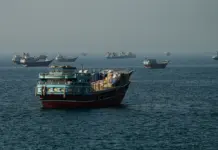
The Constanta incident was not the only maritime flashpoint on Friday. Azerbaijan’s Ministry of Foreign Affairs reported that five of its citizens were killed and three others injured in attacks on two cargo vessels in the Sea of Azov. Ukraine’s drone forces claimed strikes on five ships docked at the ports of Mariupol and Berdyansk, both situated in Russian-occupied territory between Russia and eastern Ukraine.
Commander of Ukrainian drone forces Robert Brovdi defended the strikes, asserting that the targeted vessels were engaged in transporting stolen Ukrainian grain and transferring military cargo — activities Kyiv views as direct support for Russia’s war machine. The attacks highlight Ukraine’s increasingly aggressive use of maritime drones to contest Russian control of strategically vital waterways, even as the unintended consequences of that campaign continue to reverberate across neighbouring countries.
Black Sea Nato Port: The Wider European Impact
The sequence of events this week — a drifting mine, a crashed Russian drone, and now a wayward Ukrainian drone detonating inside a NATO port — paints a troubling picture of a conflict whose physical and electronic boundaries are becoming ever harder to contain. For Romania, a country that has sought to balance its role as a frontline NATO ally with the practical risks of proximity to active combat, the incidents represent an accelerating test of both its defences and its diplomatic resolve.
The Black Sea has emerged as one of the war’s most contested and unpredictable theatres. Ukrainian forces have used maritime drones to strike Russian naval assets with considerable effect, while Russian electronic warfare capabilities have demonstrated a growing ability to redirect those weapons in dangerous and unintended directions. Friday’s explosion in Constanta is the most direct manifestation yet of that dynamic landing on allied soil.