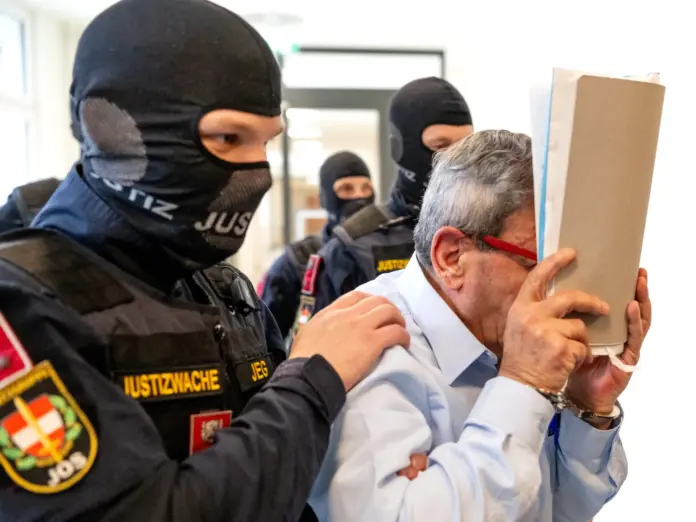
VIENNA — A former Syrian military commander accused of overseeing systematic torture during the early years of the Syrian civil war pleaded not guilty Monday as his trial opened in an Austrian court, marking a significant moment in Europe’s ongoing effort to hold senior Assad-era officials accountable for wartime atrocities.
Brigadier General Khaled al-Halabi, 63, and Lieutenant Colonel Musab Abu Rukba, 54, face charges of aggravated torture, coercion, sexual coercion, and bodily harm. Prosecutors allege the pair either ordered or failed to prevent the systematic mistreatment of detainees held in prisons in Raqqa, Syria, between April 2011 and March 2013 — a period coinciding with the Assad government’s violent crackdown on the country’s protest movement.
Syrian War Crimes Trial — Austrian prosecutors contend that violence was applied methodically, with standardised torture methods including severe beatings and hosing detainees with water. A total of 21 individuals held in those facilities are alleged to have been tortured and abused. Both defendants face up to 10 years in prison if convicted.
Recommended Reading
Al-Halabi, who has been in pre-trial detention since 2024, rejected the accusations outright. He told the court his unit was responsible only for recording the personal details of those detained and did not conduct interrogations. He denied that torture took place under his command. Abu Rukba did not testify at the opening of proceedings. His lawyer, Philipp Wolm, represented him in court.
The Vienna court holds jurisdiction over the case because both men reside in Austria, having applied for and received asylum there in 2015. Al-Halabi is a Druze who fled Raqqa in 2013, shortly before the Islamic State overran the city. The Commission for International Justice and Accountability (CIJA), an organisation that collects and preserves evidence of atrocities from conflict zones, first alerted Vienna authorities to al-Halabi’s alleged crimes in 2016.
At the time of his indictment, al-Halabi was considered the highest-ranking Syrian official implicated in civil war abuses to be present anywhere in Europe — a distinction that underscores the significance of the case for international justice advocates.
The trial is scheduled to run until June 30. Alleged victims currently living in both Syria and Europe are expected to take the stand and provide testimony. Their accounts are anticipated to form a central pillar of the prosecution’s case.
Syrian War Crimes Trial: Regional Implications
The proceedings in Vienna are part of a broader wave of accountability efforts across the continent. Similar prosecutions relating to crimes committed during the Syrian civil war have been pursued in Germany, France, and Sweden, as European nations have increasingly invoked the principle of universal jurisdiction to try individuals accused of grave human rights violations regardless of where those crimes occurred.
The Syrian civil war, which erupted in 2011 following the government’s brutal suppression of pro-democracy demonstrations, produced some of the most extensively documented atrocities of the 21st century. Detention facilities operated by Assad’s security apparatus became notorious for torture, forced disappearances, and extrajudicial killings. Raqqa, the city at the centre of the allegations in this case, later became the self-declared capital of the Islamic State before being retaken by a US-backed coalition in 2017.
The outcome of the Vienna trial will be closely watched by human rights organisations and Syrian diaspora communities across Europe, many of whom have spent years pushing for legal accountability for crimes that claimed hundreds of thousands of lives and displaced millions more.