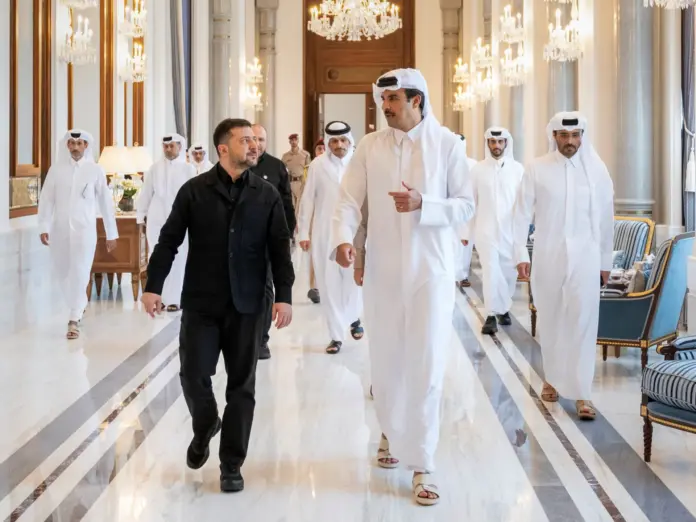
Ukrainian President Volodymyr Zelenskyy swept through the Gulf in a rapid, unannounced diplomatic tour, signing defence cooperation agreements with Saudi Arabia, the United Arab Emirates, and Qatar in the span of three days — cementing a new strategic partnership built on a shared threat: Iranian drones and missiles.
The tour began Thursday in Riyadh, where Ukraine and Saudi Arabia formalised an air-defence agreement. Zelenskyy then travelled to the UAE on Saturday, meeting with President Mohamed bin Zayed Al Nahyan and signing a defence cooperation accord focused specifically on countering Iranian drone attacks — a threat that has grown more acute in the wake of recent US-Israeli strikes on Iran. Later that same day, Zelenskyy flew to Doha for the final leg of his Gulf swing.
In the Qatari capital, Zelenskyy met with Amir Sheikh Tamim bin Hamad Al Thani and Prime Minister Sheikh Mohammed bin Abdulrahman Al-Thani. Qatar’s Deputy Prime Minister and Minister of State for Defence Affairs, Sheikh Saoud bin Abdulrahman bin Hassan Al Thani, also participated in the talks alongside senior Ukrainian officials, including National Security and Defence Council Secretary Rustem Umerov and Armed Forces Chief of Staff Andrii Hnatov.
The Qatar-Ukraine defence agreement was formally signed by Hnatov and Qatari Armed Forces Lieutenant General Jassim bin Mohammed Al Mannai. The accord establishes a partnership lasting at least a decade, covering joint defence industry projects, co-production facilities, technological partnerships, shared investment development, and — critically — the exchange of expertise in countering missiles and unmanned aerial systems.
At the heart of all three agreements lies a proposition Ukraine has been quietly advancing across the region: a strategic swap. Kyiv is offering its drone-interception know-how — refined through nearly four years of near-daily combat against Russian aerial attacks — in exchange for the air-defence missiles that Gulf states have been stockpiling to counter Iranian strikes. Ukraine has already deployed 201 anti-drone specialists across the three Gulf nations, Zelenskyy confirmed on March 18.
The economics of the arrangement are striking. A single Patriot missile costs close to $4 million, while Ukraine charges approximately $2,000 per drone intercepted using its own methods — a cost differential that makes Ukrainian expertise an attractive proposition for Gulf militaries burning through expensive interceptors. Gulf nations have relied primarily on Patriot and THAAD missile systems to neutralise Iranian threats, but the volume and frequency of those attacks has placed enormous pressure on their stockpiles.
Iran has been launching missiles and drones at Gulf targets with increasing regularity, with Tehran insisting it is striking only US assets in retaliation for what it describes as a US-Israeli war against the Islamic Republic. Gulf governments reject that framing, arguing that civilian populations are being placed in direct danger by the assaults.
For Ukraine, the calculus is equally urgent. Russia has been bombarding Ukrainian cities with Iranian-manufactured Shahed drones since at least September 2023, part of a broader aerial campaign that has included hundreds of thousands of drone strikes since Moscow launched its full-scale invasion in 2022. Ukrainian air-defence units have been intercepting Russian drones almost every single day for three and a half years, accumulating a depth of operational experience that no other military in the world can match.
Kyiv has leveraged that experience into a diplomatic asset. Ukraine has positioned its anti-drone capabilities as among the most advanced globally, and the Gulf tour represents the most concrete expression yet of that strategy — transforming battlefield necessity into geopolitical currency. By embedding specialists in Saudi Arabia, the UAE, and Qatar, Ukraine gains not only goodwill but a potential pipeline of the very air-defence munitions it needs to protect its own skies.
The agreements signal a broadening of Ukraine’s diplomatic footprint beyond its traditional Western partners at a moment when the war with Russia shows no sign of abating. For Gulf states navigating their own aerial threat environment, the partnership offers access to hard-won expertise that no training manual can replicate.