Kyiv — Ukrainian President Volodymyr Zelensky has delivered a stinging rebuke to Washington after the United States extended a sanctions waiver allowing countries to continue purchasing Russian oil and petroleum products already loaded on vessels at sea, with the exemption running until 16 May. The decision, announced on Friday, drew immediate condemnation from Kyiv as Russian forces simultaneously escalated their bombardment of Ukrainian cities to some of the most intense levels since the war began.
"Every dollar paid for Russian oil is money for the war," Zelensky declared, warning that the waiver would funnel an estimated $10 billion into Moscow’s coffers. He pointed specifically to Russia’s so-called ‘shadow fleet’ — more than 110 tankers carrying over 12 million tons of oil — as the primary vehicle through which sanctions-busting revenues reach the Kremlin.
The US first eased the Russian oil sanctions on 13 March, citing acute energy supply shortages triggered by the escalating conflict with Iran. Tehran has effectively shut the Strait of Hormuz, the critical maritime chokepoint through which approximately 20 percent of the world’s oil and liquefied natural gas normally flows. Iran stated the strait would remain closed until the US lifts what it described as a blockade, compounding an already volatile global energy market.
The broader regional conflict has drawn in both the US and Israel, which have conducted strikes against Iran. Tehran has retaliated against Israeli targets, US military installations in the Gulf, and energy infrastructure and civilian sites across Arab nations aligned with Washington. The cascading crisis has placed US-led diplomatic efforts to end the war in Ukraine on hold, as American strategic attention and resources pivot toward the Middle East.
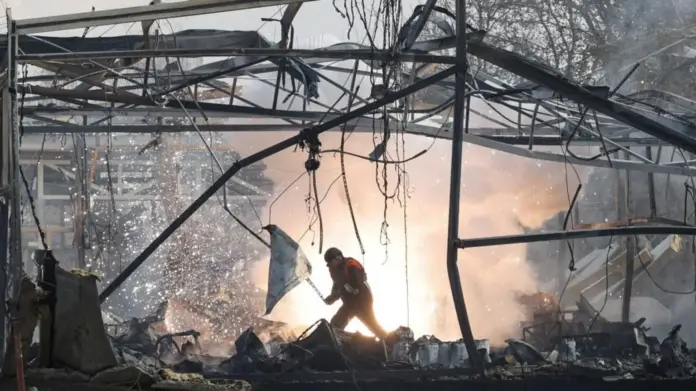
The timing of the waiver extension proved particularly jarring for Kyiv. On the night of 15 April, Russian forces unleashed one of their most devastating attacks of the war, deploying more than 700 drones and missiles in multiple waves against Ukrainian territory. At least 18 people were killed, making it the deadliest single assault against Ukraine in months. Over the preceding week and a half, Russia had launched more than 2,360 attack drones, over 1,320 guided aerial bombs, and nearly 60 missiles of various types — a relentless tempo of destruction that underscored Zelensky’s argument about the direct link between oil revenues and battlefield capacity.
Russia currently controls approximately 20 percent of Ukrainian territory, and the conflict has ground into a grinding stalemate with neither side able to achieve decisive breakthroughs. Ukraine has responded with its own cross-border strikes, targeting Russian energy facilities in particular, seeking to impose economic costs on Moscow in a mirror of the pressure Kyiv says the West should be applying through tighter sanctions enforcement.
The sanctions architecture against Russia has been in place since February 2022, when Moscow launched its full-scale invasion of Ukraine. While Western nations have progressively tightened restrictions on Russian energy exports, critics argue that shadow fleet operations and carve-out waivers have consistently undermined their effectiveness. Zelensky’s latest intervention reflects deep frustration in Kyiv that geopolitical calculations elsewhere are eroding the economic pressure campaign that Ukraine views as essential to its survival.
Washington’s position places it in a difficult balancing act: managing soaring energy prices driven by the Hormuz closure while maintaining the credibility of its commitment to Ukrainian sovereignty. With the waiver now extended and the Middle East conflict showing no signs of rapid resolution, that tension is unlikely to ease in the weeks ahead.