The United States military is executing one of its largest rapid force deployments in decades, surging aircraft carriers, amphibious assault ships, Marines, and airborne soldiers into the Middle East as Operation Epic Fury — the joint US-Israeli air campaign against Iran — stretches beyond four weeks with no sign of conclusion.
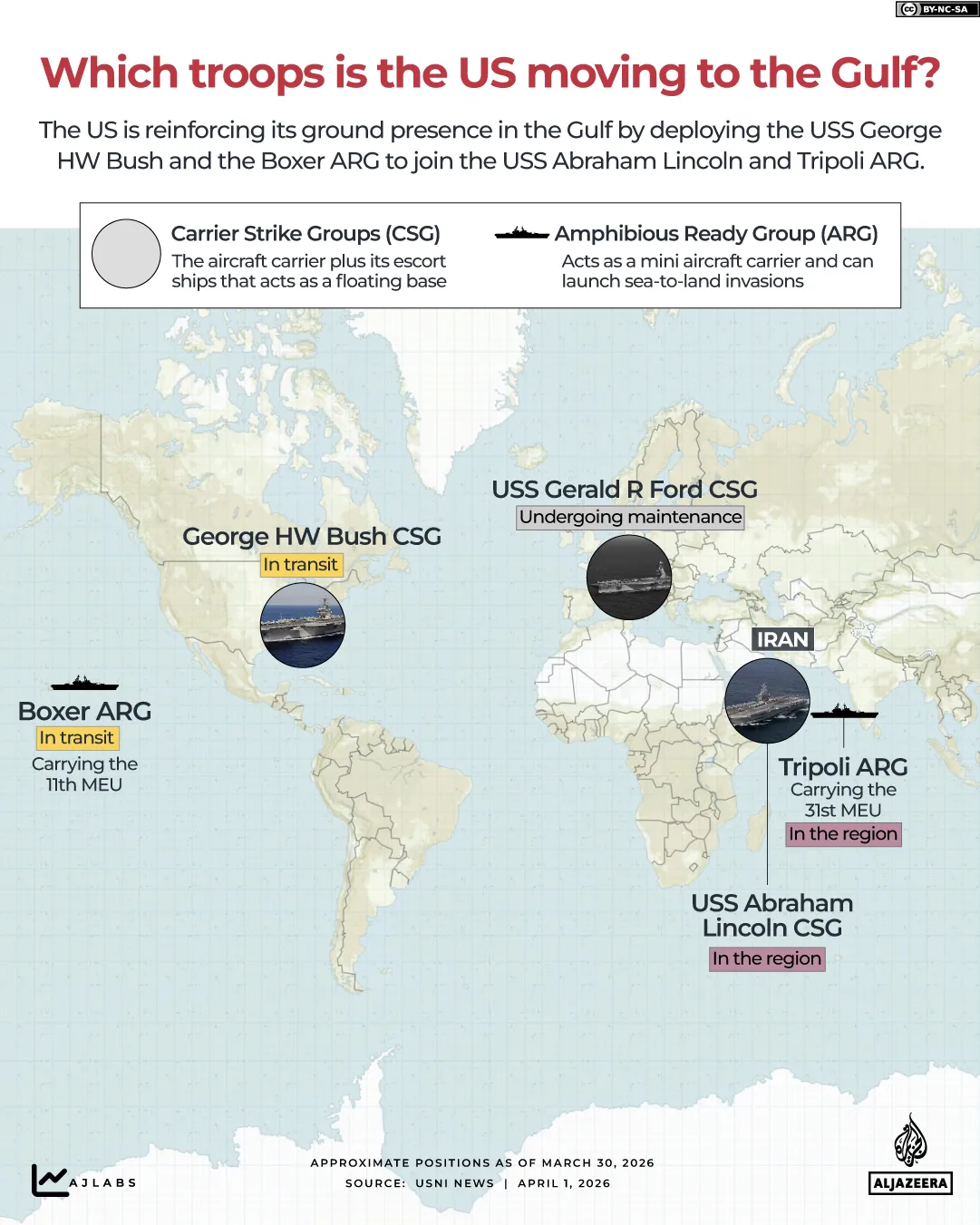
Secretary of Defense Pete Hegseth announced Tuesday that the USS George H.W. Bush (CVN-77), currently in the Atlantic, will join the campaign, with its two assigned destroyers — the USS Mason (DDG-87) and USS Ross (DDG-71) — already having departed their homeport to rendezvous with the carrier. The Bush is certified for deployment and is expected to significantly bolster strike capacity in the region.
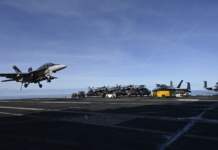
Launched on February 28, Operation Epic Fury has seen sustained strikes across Iran targeting military installations and nuclear infrastructure, killing thousands of Iranians. The campaign has placed extraordinary demands on US naval aviation. As of April 1, the USS Abraham Lincoln, positioned in the Arabian Sea, remains the sole carrier conducting daily combat sorties against Iranian targets. The USS Gerald R. Ford (CVN-78), which arrived at Naval Support Activity Souda Bay in Greece on March 23 following an internal fire, is undergoing repairs at a Croatian facility and is unavailable for operations.
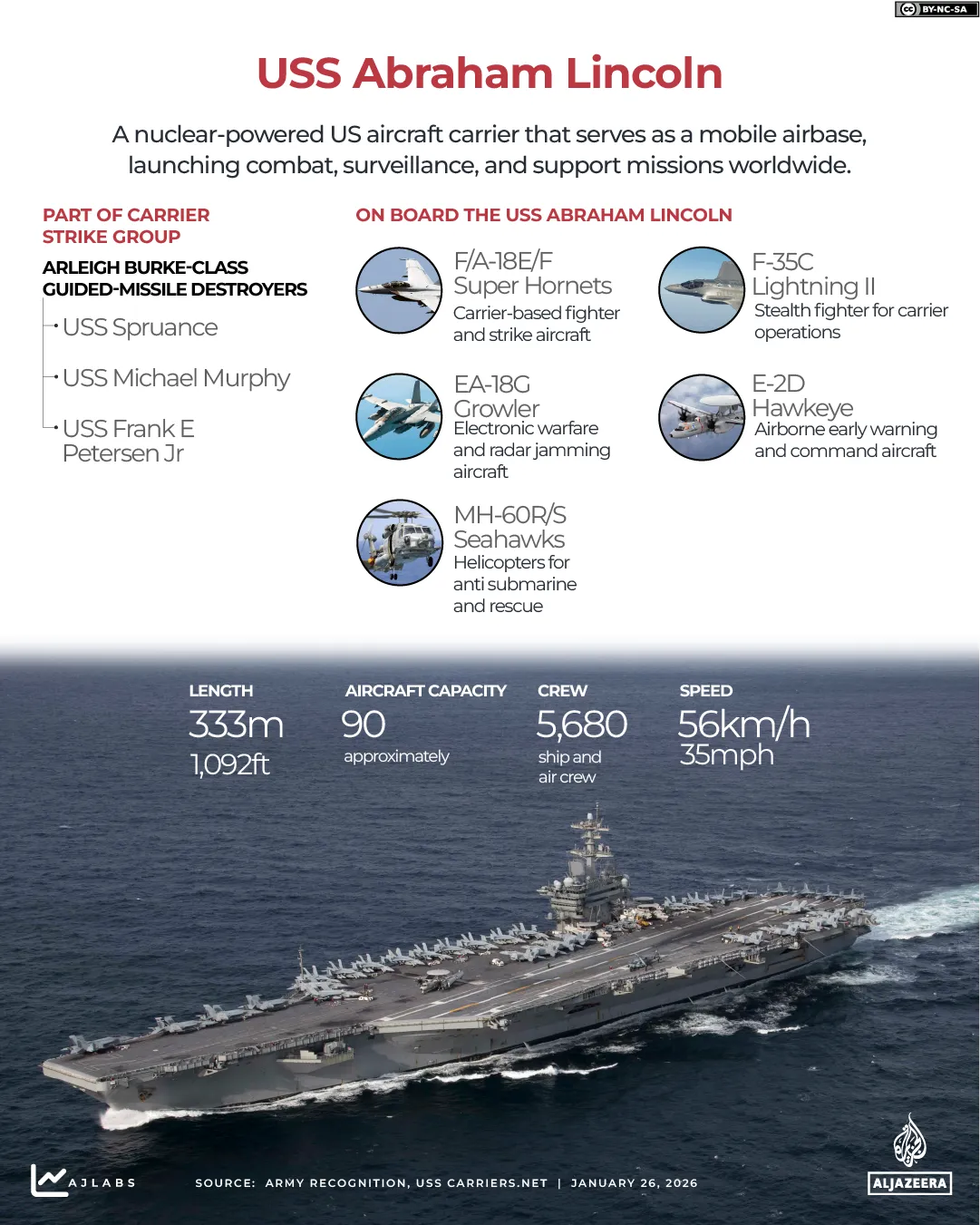
Each carrier strike group fields between 60 and 75 fixed-wing aircraft and helicopters, supported by two to four Burke-class destroyers. With the Lincoln shouldering the full strike burden, the arrival of the Bush’s group cannot come soon enough for US Central Command planners.
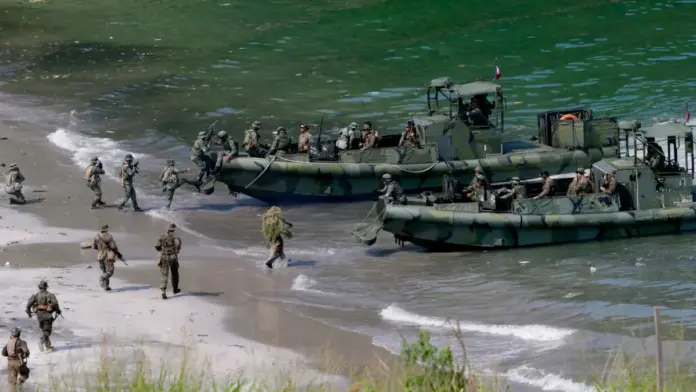
The ground component of the buildup is equally substantial. The 31st Marine Expeditionary Unit, comprising approximately 2,200 Marines, was ordered to depart Sasebo, Japan on March 13 and has since arrived in Middle Eastern waters aboard the USS Tripoli Amphibious Ready Group, which reached the region on March 27. The 11th MEU, carrying roughly 2,500 Marines, departed San Diego on March 18 aboard the USS Boxer ARG — which includes the USS Portland (LPD-27) and USS Comstock (LSD-45) — and is expected to arrive in mid-April. The Pentagon separately ordered approximately 2,000 soldiers from the 82nd Airborne Division to deploy to the region. These additions come on top of the roughly 50,000 US troops already stationed across the Middle East before hostilities began.
Marine Expeditionary Units are self-contained combined-arms forces built around a ground combat element of approximately 1,200 troops, an aviation combat element of around 500, a logistics element of roughly 300 capable of 15 days of independent sustainment, and a command element of about 200. Their versatility has been demonstrated across decades of operations — from the 15th and 26th MEUs flying more than 640 kilometres inland during the 2001 invasion of Afghanistan, to the 15th MEU securing the Iraqi port of Umm Qasr in 2003, to the 31st MEU’s participation in the Second Battle of Fallujah in 2004.
Yet the pace and scale of the current campaign is exposing significant gaps in US military readiness. The Navy’s mine countermeasure capacity in the region is particularly thin. The US Fifth Fleet, headquartered in Manama, Bahrain, operates three Littoral Combat Ships equipped with mine countermeasures packages — but two were in Singapore for scheduled maintenance as of mid-March, with only one reportedly operating in the Indian Ocean. Compounding the problem, the Navy decommissioned four of its eight Avenger-class Mine Countermeasure ships assigned to the Fifth Fleet in September 2025, leaving the remaining four homeported in Sasebo, Japan, far from the operational theatre.
Amphibious shipping presents its own challenges. A 2024 Government Accountability Office report found that nine out of ten Landing Ship Docks were in poor material condition, and that the Navy and Marine Corps’ LHA and LHD fleet cannot meet the service’s target of having 80 percent of the force ready to deploy at any given time. The USS Bonhomme Richard was lost to a fire in 2020 and subsequently decommissioned, further thinning the amphibious fleet. The USS Iwo Jima remains committed to the Caribbean, unavailable for redeployment.
To preserve capacity, the Navy extended the service life of the USS Nimitz (CVN-68) — previously scheduled for decommissioning in May 2026 — through March 2027. The USS Theodore Roosevelt (CVN-71) has completed maintenance and is conducting workup exercises off San Diego in preparation for an imminent deployment that could bring additional strike capacity to the campaign.
Operation Epic Fury represents the most intensive US combat air campaign since the 2003 invasion of Iraq, and the logistical strain it is generating across the carrier fleet, amphibious forces, and specialised mine warfare units is testing the limits of a military that has faced years of readiness shortfalls. Whether the arrival of the George H.W. Bush and the two incoming MEUs will be sufficient to sustain operations — and what ground role, if any, the Marines may ultimately be called upon to play — remains the central question for US military planners in the weeks ahead.