The United States Senate voted Tuesday to block a resolution that would have constrained President Donald Trump‘s ability to order military action against Cuba without first obtaining congressional authorisation, in a 51-47 vote that fell almost entirely along party lines.
The procedural measure, a war powers resolution led by Democratic Senator Tim Kaine of Virginia, was stopped in its tracks by a point of order introduced by Republican Senator Rick Scott of Florida. Scott argued the resolution was inappropriate because Trump has not deployed troops against Havana, and that no active US hostilities against Cuba are underway. He added that the Castro/Diaz-Canel regime is illegitimate and must fall.
Kaine pushed back forcefully, contending that the United States is already engaged in a form of military action through an economic blockade enforced by the US Coast Guard and other military assets. He argued that blocking fuel shipments from reaching Cuba constitutes hostile action — and that if any foreign power did the same to the United States, Washington would treat it as an act of war.
Tuesday’s vote marked the first Senate vote pertaining to Cuba under the current administration. It also represents the latest in a string of failed Democratic efforts in both chambers of Congress to compel Trump to seek legislative approval for military operations. The House of Representatives has similarly rebuffed such attempts on multiple occasions.
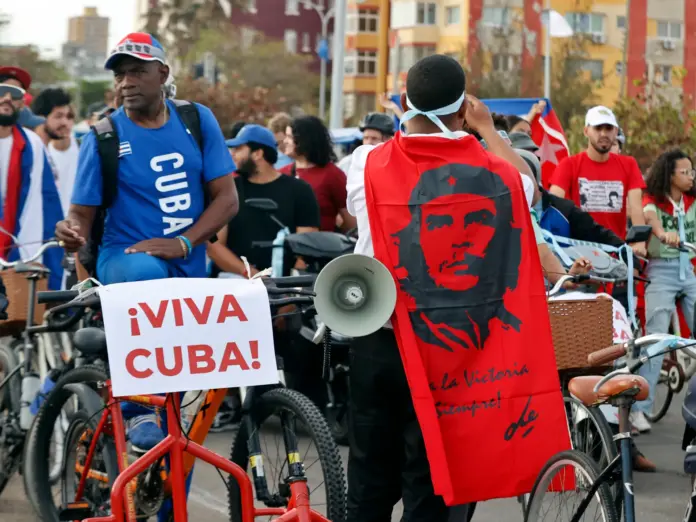
The backdrop to the vote is a pattern of escalating presidential rhetoric and action in the Western Hemisphere. Trump has warned on multiple occasions that "Cuba is next," and most recently pledged what he called "a new dawn for Cuba." Those statements have alarmed Democratic lawmakers, who point to the administration’s recent record as evidence that the threats carry real weight.
In early January, US forces abducted Venezuelan President Nicolas Maduro and his wife in an operation that received no congressional authorisation. Democrats have cited that episode repeatedly as proof that the executive branch is willing to conduct significant military operations in Latin America without consulting or notifying Congress in advance.
The US Constitution reserves the power to declare war exclusively for Congress, not the president. However, that restriction does not apply to short-term operations or counter-measures taken in response to immediate threats — a carve-out the White House has leaned on to defend Trump’s actions. Administration officials maintain that the president is acting within his rights and obligations as commander-in-chief to protect the United States.
The partisan divide on display Tuesday reflects a broader and deepening disagreement over the limits of executive war-making authority. Republicans, led by Scott, insist there is no legal or factual basis for invoking war powers against Cuba at this time. Democrats counter that waiting for troops to be deployed before invoking those powers misses the point — that economic blockades enforced by military assets are themselves acts of war under international norms.
Kaine’s argument drew a sharp distinction between the letter of US law and the practical reality of what American forces are doing in Cuban waters. The use of Coast Guard vessels to intercept fuel shipments, he said, is not a peacetime activity — it is coercion backed by military force, and it deserves the same congressional scrutiny as any other use of armed power.
With Republicans holding a Senate majority and showing no appetite for constraining the president’s hemispheric ambitions, Democrats face a steep climb in their efforts to reassert legislative oversight. The failure of Tuesday’s resolution ensures that Trump retains broad latitude to escalate pressure on Havana — or to go further — without a formal congressional check on his authority.