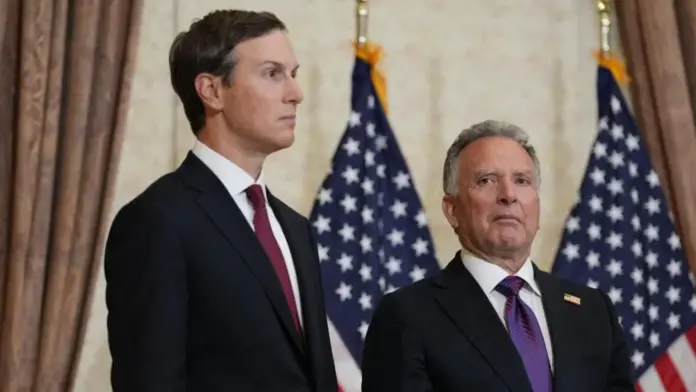
ISLAMABAD — Senior White House envoys Steve Witkoff and Jared Kushner arrived in Pakistan’s capital on Saturday morning for what the Trump administration described as a critical diplomatic opening with Iran, as both sides manoeuvred carefully around the prospect of direct negotiations following weeks of military confrontation.
The mission was authorised personally by President Donald Trump, who directed the two envoys to travel to Islamabad to hear the Iranians out. White House press secretary Karoline Leavitt confirmed the trip, stating that the president is always willing to give diplomacy a chance and that progress had been observed from the Iranian side over the preceding days. Leavitt added that the Iranians want to talk.
Iranian Foreign Minister Abbas Araghchi and foreign ministry spokesman Esmail Baqaei arrived in Islamabad early Saturday, with Araghchi scheduled to meet senior Pakistani officials to review bilateral matters and discuss regional developments. Despite the simultaneous presence of both delegations in the Pakistani capital, Tehran flatly denied that any direct meeting between Iranian and American officials was planned.
The diplomatic activity follows a period of intense military escalation. The United States and Israel launched coordinated strikes against Iran beginning on 28 February, prompting Tehran to restrict commercial shipping through the Strait of Hormuz — one of the world’s most critical maritime chokepoints. US Defence Secretary Pete Hegseth warned this week that Washington’s blockade of the strait was growing and going global, while simultaneously offering Tehran a path forward, saying Iran had a chance to make a good deal if it abandoned its nuclear weapons programme in meaningful and verifiable ways.
Iran’s parliamentary speaker, Mohammad Bagher Ghalibaf, pushed back sharply on Wednesday, declaring it impossible to reopen the Strait of Hormuz given what he characterised as ongoing ceasefire violations by the US and Israel. Ghalibaf accused Washington of imposing a naval blockade on Iranian ports and accused Israel of warmongering on all fronts. Iranian President Masoud Pezeshkian echoed those grievances, saying Tehran remained open to negotiations but pointing to breached commitments, the blockade, and continued threats as significant obstacles.
Trump moved to preserve diplomatic space earlier in the week by announcing an indefinite extension to the ceasefire with Iran, which had been set to expire on Wednesday. The decision to send Witkoff and Kushner to Islamabad followed, with Vice-President JD Vance placed on standby to travel should the talks yield sufficient progress. Vance had led the US delegation during the first round of negotiations earlier in the month.
The economic pressure campaign accompanying the military and diplomatic effort intensified simultaneously. The US Treasury Department imposed sanctions on a major Chinese refinery along with 40 additional targets, including vessels and their owners, in a move explicitly aimed at disrupting Iran’s illicit oil trade. The measures signal Washington’s intent to maintain maximum economic leverage even as it pursues a negotiated settlement.
The broader regional picture remains volatile. Israel and the Iran-backed Hezbollah militia in Lebanon traded accusations of ceasefire violations, prompting Trump to announce a three-week extension to the Israel-Lebanon truce on Thursday. The overlapping ceasefires and competing allegations of violations underscore the difficulty of sustaining any durable de-escalation across multiple fronts simultaneously.
Pakistan’s role as host for the indirect talks reflects Islamabad’s longstanding relationships with both Washington and Tehran, positioning it as a rare neutral venue capable of facilitating communication between parties that have not held direct high-level contact in years. Whether the Islamabad channel produces a substantive breakthrough or remains a preliminary exchange of positions will likely determine whether Vance makes the journey — and whether the broader conflict moves toward resolution or deeper entrenchment.