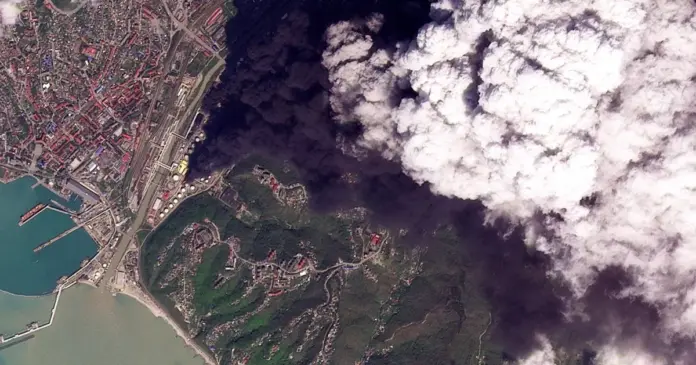
Ukraine Energy Strikes — Ukraine’s SBU security service launched a drone assault on one of Russia’s most strategically significant energy export hubs on Saturday, striking the Tamanneftegaz terminal in the Temryuk district of Russia’s Krasnodar region and killing at least one person in an attack that underscores Kyiv’s intensifying campaign against Moscow’s energy revenues.
The SBU described the Tamanneftegaz facility as the largest liquefied hydrocarbon transshipment complex in southern Russia. The terminal, located in the Black Sea coastal village of Volna, handles exports of crude oil, petroleum products, and liquefied gas — making it a high-value target in Ukraine’s broader strategy to drain the financial resources sustaining Russia’s military.
Drone debris ignited fires across the terminal’s freight transport depot and storage facilities. The SBU said the strikes directly hit five fuel tanks and two oil loading stands. Krasnodar Governor Veniamin Kondratyev confirmed the attack in a post on Telegram, acknowledging the death and the damage caused by the strike.
Recommended Reading
In a separate operation on the same day, Ukraine’s military claimed to have struck an oil processing and pumping facility near the town of Kotovo in Russia’s Volgograd region, triggering a fire at that site as well. The dual strikes signal a coordinated effort to degrade Russian energy infrastructure across multiple fronts simultaneously.
The SBU made no attempt to obscure its intent. The service pledged to continue targeting Russia’s oil and gas sector, characterising it explicitly as the financial engine powering Moscow’s war machine. ‘This is where the money for the war comes from,’ the service stated in its claim of responsibility.
The strikes arrive at a moment of acute sensitivity around Russian energy and nuclear infrastructure. The International Atomic Energy Agency (IAEA) reported this week that external electricity supply had been restored to the Zaporizhzhia nuclear power plant in Russian-occupied Ukraine, several days after a strike severed the facility’s power connection — an incident that had raised alarm among international nuclear safety monitors.
Russian President Vladimir Putin has publicly acknowledged that Ukrainian strikes are inflicting real damage on Russian territory, though he has insisted the country will recover rapidly and promised to escalate retaliatory attacks on Ukrainian infrastructure. That posture reflects a war now well into its fifth year, with both sides locked in a grinding campaign of attrition targeting each other’s economic and military capacity.
Ukraine Energy Strikes: The Energy Security Dimension
The conflict, which began in February 2022, shows few signs of approaching resolution. Peace negotiations mediated by the administration of U.S. President Donald Trump — who pledged early in his term to bring the war to a swift end — have largely stalled. Putin recently declined an invitation for direct face-to-face talks with Ukrainian President Volodymyr Zelenskyy, a rebuff that has further dimmed prospects for near-term diplomacy.
Trump is scheduled to participate in a G7 working session with Zelenskyy in France on Tuesday, according to a senior administration official. The meeting will be closely watched for any signals of renewed diplomatic momentum, particularly as Ukraine continues to press its military advantage against Russian energy targets.
The Tamanneftegaz strike represents one of the most significant hits on Russian export infrastructure in recent months. By targeting the transshipment complex that channels hydrocarbons from southern Russia to international markets, Ukraine is attempting to tighten the economic vice on Moscow at a time when energy revenues remain critical to sustaining Russian military expenditure. The SBU’s explicit pledge to continue such operations suggests the energy war is far from over.