A coordinated settler attack on a small Palestinian community in the occupied West Bank’s Jordan Valley has become one of the most disturbing cases in a sweeping new report documenting conflict-related sexual violence against Palestinians across nearly three years of escalating tensions.
On March 13, more than 70 settlers descended on Khirbet Hamsa al-Fawqa, a rural community in the Jordan Valley. The assault lasted approximately 45 minutes. During the raid, five settlers entered the tent where Qusay Abu al-Kabash, 29, was sleeping alongside two foreign female activists. Abu al-Kabash was sexually assaulted. The attackers also stole hundreds of livestock before withdrawing.
The attack is among the cases catalogued in a report published on April 20 by the West Bank Protection Consortium, a body led by the Norwegian Refugee Council and funded by the European Union and several European governments. The report, titled Sexual Violence and Forcible Transfer in the West Bank, found that sexual violence has become a driver of displacement, with more than 70 percent of displaced families interviewed citing threats against women and children as a decisive factor in abandoning their homes.
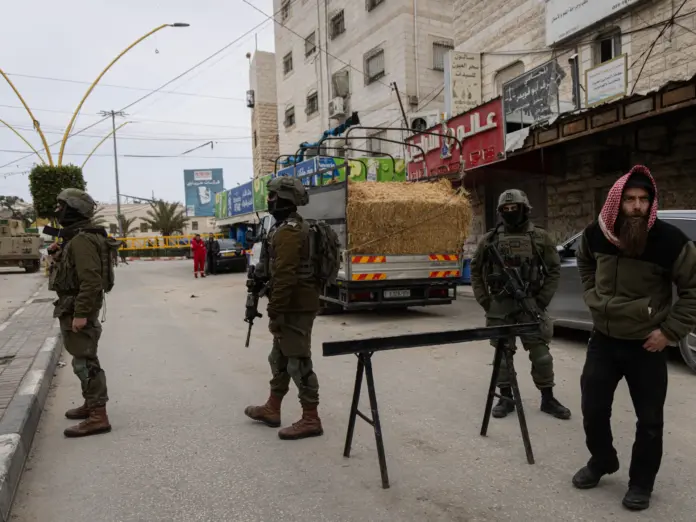
The report’s findings are reinforced by accounts from other parts of the territory. In Hebron, Issa Amro, coordinator of the Youth Against Settlements group, described daily harassment at Israeli military checkpoints surrounding the Ibrahimi Mosque in the city’s Old City. He recounted an incident roughly 18 months ago in which a soldier pulled down his trousers in front of a 17-year-old Palestinian girl at a checkpoint in the Tel Rumeida area. The Israeli human rights organisation B’Tselem published its own documentation of soldier mistreatment and humiliation in Hebron in December 2024.
The consequences extend beyond individual trauma. Palestinian girls have dropped out of school to reduce the likelihood of encountering soldiers or settlers who might assault or harass them. Women have stopped working for the same reason, compounding the economic and social isolation already imposed by the occupation’s physical infrastructure.
In Jenin, the dynamics of military control have created their own flashpoints. The Jenin refugee camp was sealed by Israeli forces for a year following a deadly weeks-long military raid. On April 13, the Israeli army permitted women to enter the camp for a limited period to inspect their homes. Abeer al-Sabbagh, 60, was subjected to a strip search by soldiers during that brief window of access — an experience she described as deeply humiliating.
Conditions inside Israeli detention facilities have drawn separate scrutiny. A Human Rights Watch report published in August 2024 documented torture and ill-treatment in Israeli detention centres, including testimonies of sexual violence. Five Israeli soldiers were charged in connection with the sexual abuse of a Palestinian detainee from Gaza at Sde Teiman prison. Those charges were dropped in March following a campaign mounted by Israel’s far right.
Sami al-Sai, a journalist from Tulkarem in the northern West Bank, described being raped with a metal object while in Israeli custody. Al-Sai was held from February 2024 to June 2025 in Megiddo and Rimon prisons. He reported bleeding for two weeks following the assault and said he was denied access to a doctor throughout that period.
The Israeli government has consistently characterised incidents of sexual violence by its military personnel as isolated cases that do not reflect any broader institutional policy. Critics and human rights organisations argue that the volume and geographic spread of documented cases, combined with the impunity illustrated by the collapse of the Sde Teiman prosecution, point to a systemic failure of accountability.
The West Bank Protection Consortium’s report arrives at a moment of intensified international scrutiny over conditions in the occupied territory, where settler violence and military operations have both escalated sharply since October 2023. For communities like Khirbet Hamsa al-Fawqa, the March attack was not an aberration — it was the latest episode in a pattern that the report’s authors argue is reshaping Palestinian life across the West Bank through fear, displacement, and silence.