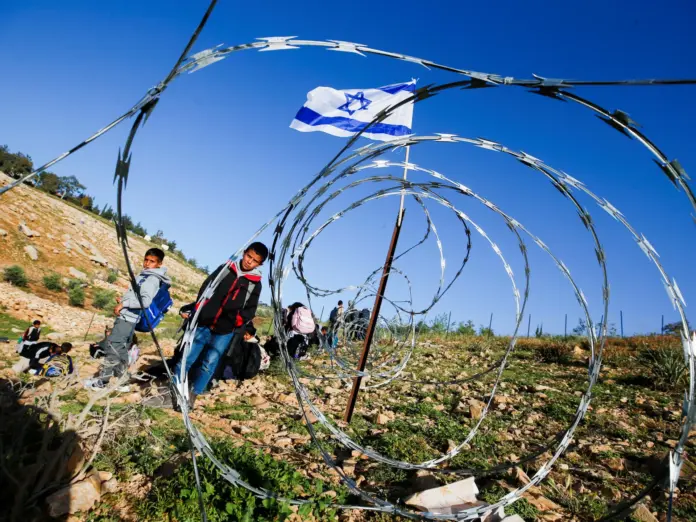
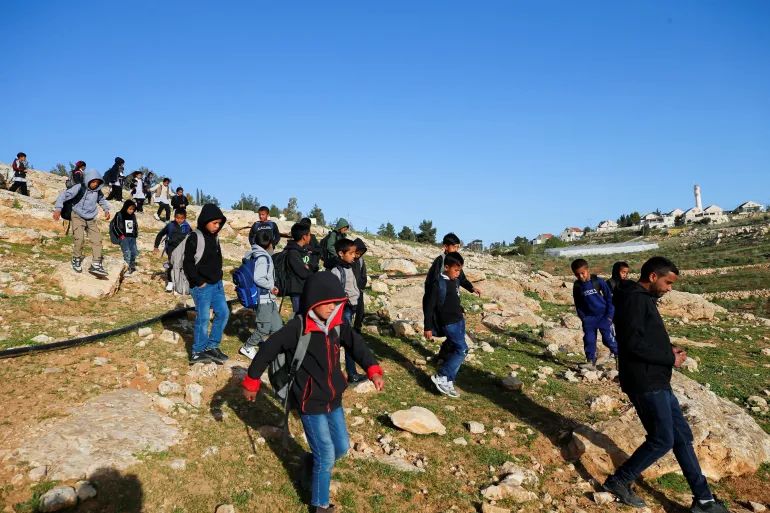
A barbed-wire fence erected by Israeli settlers in the occupied West Bank has prevented at least 55 Palestinian children from reaching their classrooms for nearly two months, drawing international condemnation and daily protests from a community already made famous by an Oscar-winning documentary.
The fence, which cuts across the path students use to access school in Umm al-Khair, a small Bedouin village in the Hebron governorate, has been in place for ten school days since its construction. Combined with a broader school shutdown across the West Bank that followed the United States and Israel launching military operations against Iran on February 28, children in the village have effectively been locked out of education for close to two months.
Students, teachers and parents have staged peaceful daily sit-ins at the fence line in protest. During some of those demonstrations, children were exposed to tear gas, according to the West Bank Education Cluster. The community’s plight has drawn renewed attention to a village already known internationally — Umm al-Khair was featured in No Other Land, the 2024 Academy Award-winning documentary that chronicled Palestinian life under occupation in the South Hebron Hills.
The fence’s construction followed a surge in settler activity in the area. A nearby outpost was established in the days after Awdah Hathaleen, a Palestinian activist from the community, was killed on July 28, 2025, by Israeli settler Yinon Levi. Israeli settlements and outposts built on occupied Palestinian land are considered illegal under international law.
The situation in Umm al-Khair is part of a sharply worsening picture for Palestinian children across the West Bank in 2026, according to aid organisations operating in the territory. Save the Children, which works in the village directly and through its partner the Agricultural Development Association (PARC), provides essential supplies to residents including winter kits and animal feed. Ahmad Alhendawi, Save the Children’s regional director for the Middle East, North Africa and Eastern Europe, has highlighted the compounding crises facing children in the region.
Three million Palestinians currently live in the West Bank. More than 1,100 of them — including over 230 children — have been killed since October 7, 2023. This week alone, two children were killed by Israeli settlers, according to the Palestinian Ministry of Health.
Among the dead is Mohammad Majdi al-Jaabari, 16 years old, who was struck and killed by a vehicle belonging to a security convoy in Hebron. He had been cycling to school shortly after dawn when the convoy — which was escorting Israeli Settlement Minister Orit Strock, a resident of a Hebron settlement — ran him over. His death has intensified calls for accountability over settler-linked violence against Palestinian civilians.
The crisis in the West Bank unfolds alongside an ongoing catastrophe in Gaza, where children are now entering their third consecutive year without regular schooling. Together, the two situations represent what aid groups describe as a generational educational emergency for Palestinian children.
For the families of Umm al-Khair, the barbed wire is more than a physical obstruction — it is the latest in a long series of pressures on a community that has resisted displacement for decades. Their continued presence, and their daily sit-ins at the fence, reflect a determination that has come to define the village. Whether that determination will be enough to reopen the path to school remains uncertain.