A massive Russian drone and artillery offensive killed at least five people and wounded dozens more across Ukraine overnight, striking port infrastructure in Odesa, civilian settlements near the Russian border, and residential areas in multiple southern and eastern regions as the war entered its fourth year with no diplomatic resolution in sight.
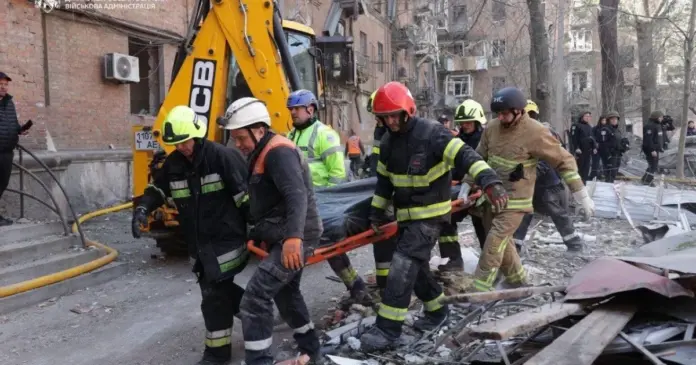
The deadliest single incident unfolded in the Sumy region, where a Russian drone strike killed two men in the town of Bilopil, situated close to the Russian border. The attack targeted civilians in an area that has faced persistent cross-border pressure throughout the conflict. In Zaporizhia region, Russian forces launched more than 700 attacks on 50 settlements within a 24-hour period, killing two people and injuring four others — a tempo of bombardment that underscores the grinding intensity of frontline combat in the south.
Dnipropetrovsk region saw strikes across four districts that killed one person and left four others wounded. In Kherson region, Russian shelling wounded seven people, adding to a civilian toll that has accumulated steadily since Russian forces were pushed from the regional capital in late 2022.
The port city of Odesa sustained significant infrastructure damage. Russian strikes hit warehouses, technical equipment, cargo storage tanks, and administrative buildings throughout the port zone. A civilian vessel flying the flag of Palau was damaged during the assault, though no injuries to the crew were reported. The targeting of port facilities represents a continued effort to disrupt Ukraine’s maritime trade corridor, which has been a persistent flashpoint since the early stages of the war.
Ukraine’s air force intercepted 124 of the 144 Russian drones launched overnight — a success rate that reflects the growing sophistication of Ukrainian air defences but also the scale of the threat posed by sustained drone campaigns. Russia’s Ministry of Defence offered a competing account, claiming its forces destroyed 203 Ukrainian drones between Saturday evening and Sunday morning and eliminated 95 Ukrainian drone control centres over the preceding 24 hours.
Ukrainian drone operations also struck Russian territory. Five people were injured when a drone hit a nitrogen complex in Russia’s Vologda region. In Sevastopol, the Russian-controlled port city on the Crimean peninsula, Ukrainian drone activity caused significant disruption: debris struck the cardiology department of a hospital, injuring one person, while damage to overhead power lines triggered train delays across the city. Russian air defences shot down 16 Ukrainian drones over Sevastopol overnight.
Against this backdrop of relentless violence, Ukrainian President Volodymyr Zelenskyy travelled to Baku on Saturday, where he signed agreements on security and energy cooperation with Azerbaijani President Ilham Aliyev. The visit carried diplomatic weight beyond the bilateral accords. Zelenskyy stated that Ukraine is prepared for future peace negotiations with Russia to be hosted in Azerbaijan, positioning Baku as a potential neutral venue for talks that have so far failed to materialise.
Zelenskyy also indicated that Ukraine intends to share its hard-won expertise in defending airspace against drone and missile attacks — experience accumulated through nearly three years of near-nightly bombardment. The offer signals Kyiv’s intent to leverage its battlefield knowledge as a diplomatic and strategic asset even as the fighting continues.
Diplomatic efforts to end the conflict remain stalled. Despite intermittent signals from various international actors about the possibility of negotiations, no formal talks between Kyiv and Moscow have taken place, and the pace of Russian offensive operations shows no sign of abating. The war, now in its fourth year, has reshaped European security architecture, strained global energy markets, and displaced millions of Ukrainian civilians.
The combination of mass drone launches, sustained artillery bombardment across multiple regions, and the targeting of critical infrastructure — including port facilities essential to Ukraine’s economy — reflects a Russian operational strategy aimed at exhausting both Ukrainian defences and civilian morale. Ukraine’s continued ability to intercept the majority of incoming drones, while simultaneously striking targets deep inside Russian territory, suggests the aerial dimension of the conflict will remain central to both sides’ strategies in the weeks ahead.