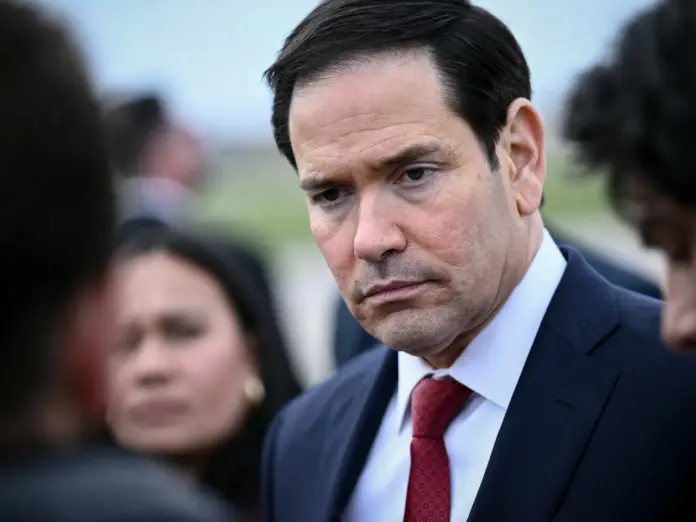
U.S. Secretary of State Marco Rubio departed a Group of Seven foreign ministers’ meeting in France on Friday after delivering sharp warnings to allied counterparts about Iran‘s plan to impose a tolling regime on the Strait of Hormuz — a chokepoint through which approximately 20 million barrels of oil passed daily before the outbreak of war on February 28.
Iran has pledged to close the strait since hostilities began and is now moving toward a formal tolling system that would require commercial vessels to request passage through the Islamic Revolutionary Guard Corps and pay a fee for transit rights. The scheme, if implemented, would place one of the world’s most critical energy corridors under direct Iranian military control, threatening a waterway that previously supplied roughly 20 percent of global liquid petroleum.
Rubio conveyed the gravity of the threat to his G7 counterparts — ministers from Japan, Canada, France, the United Kingdom, Italy, Germany, and the European Union — urging collective action to preserve freedom of navigation. The bloc’s joint statement underscored the ‘absolute necessity to permanently restore safe and toll-free freedom of navigation in the Strait of Hormuz’ and called for an immediate cessation of attacks against civilians and civilian infrastructure. Notably absent from the communiqué was any pledge of resources or direct support for the U.S. and Israeli war effort.
The diplomatic gathering coincided with the one-month anniversary of the war, which began on February 28. President Donald Trump has repeatedly called on other nations to share the burden of securing the strait, and has publicly accused NATO alliance members of being ‘cowards’ for their reluctance to join the offensive. Many European allies have stated they will limit their involvement to defensive actions only.
The Trump administration has faced persistent difficulty rallying international partners behind its campaign. Legal experts have criticised the initial strikes against Iran as an unprovoked act of aggression, further complicating Washington’s efforts to build a coalition. Despite the diplomatic headwinds, Rubio struck a confident tone, asserting that the United States is ahead of schedule on most war objectives — including the destruction of Iran’s navy, missile stockpiles, and uranium enrichment programme — and that ground troops will not be required to achieve those goals.
Beyond the Strait of Hormuz, Rubio also denounced settler violence in the occupied West Bank, where Israeli settlers torched Palestinian homes and vehicles in March. The condemnation carries a degree of tension with the administration’s broader posture: upon returning to office in January 2025, President Trump cancelled sanctions against Israeli settlers accused of grave abuses in the territory.
The human toll in the West Bank has been severe. The United Nations estimated on March 19 that more than 1,000 Palestinians have been killed there since October 2023, when Israel launched its war in Gaza. A quarter of those victims were youths, according to the UN assessment.
The G7 meeting in France underscored the widening gap between Washington’s war aims and the appetite of its closest partners. While allied governments share concern over Iranian control of a waterway critical to global energy markets, they have so far declined to translate that concern into tangible military or financial commitments — leaving the United States and Israel to prosecute a conflict that has already reshaped the geopolitics of the Middle East in just one month.