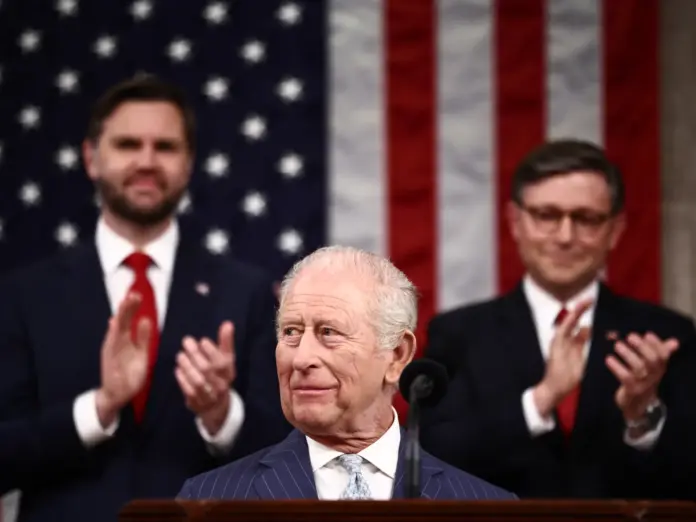
King Charles III stood before a joint session of the United States Congress on Tuesday and delivered a sweeping defence of the transatlantic alliance, urging American lawmakers to maintain unyielding resolve in support of Ukraine as Russia’s invasion grinds on and pressing the case for NATO unity at a moment of acute geopolitical uncertainty.
The address, part of a four-day state visit to the United States, drew repeated standing ovations from assembled members of Congress. It was a rare honour — and a carefully calibrated moment of British soft power deployed at a time when the relationship between London and Washington faces genuine strain.
Charles opened with characteristic wit, describing Washington, DC as ‘a tale of two Georges’ — a nod to President George Washington and his own ancestor, King George. He assured the chamber he had not arrived ‘as part of some cunning rearguard action’ to relitigate the Revolutionary War, drawing laughter before pivoting to the serious business at hand.
At the heart of the speech was an unambiguous call for continued Western solidarity behind Kyiv. Charles invoked the long arc of Anglo-American cooperation — two world wars, the Cold War, and Afghanistan — as evidence of what the partnership can achieve when tested. He praised NATO’s invocation of Article 5, the alliance’s collective defence clause, in the aftermath of the September 11, 2001 attacks, framing it as a defining expression of shared values under pressure.
The King’s appeal for Ukraine carried particular weight given the political backdrop. President Donald Trump has repeatedly questioned the value of NATO commitments and has shown ambivalence toward continued military and financial support for Kyiv. Charles did not name Trump, but his message was unmistakable: the defence of Ukraine and her people demands resolve that does not waver with the political weather.
The economic dimension of the relationship also featured prominently. Charles cited $430 billion in annual trade between the United States and the United Kingdom — a figure he noted continues to grow — alongside $1.7 trillion in mutual investment binding the two economies together. Those numbers landed against a fraught backdrop: just days before the speech, Trump threatened to impose a sweeping tariff on British goods if London refused to scrap its digital services tax on American technology companies. The King made no direct reference to the dispute, but the implicit argument — that the relationship is too valuable to be sacrificed to short-term commercial friction — was hard to miss.
Charles also addressed global environmental concerns, a subject that placed him in quiet but clear tension with his host. Trump has dismissed climate change as a ‘con job’ and withdrew the United States from the Paris Agreement climate accords during both his first and second terms in office. The King, a lifelong environmental advocate, did not soften his position for the occasion.
Perhaps the most pointed passage of the speech came when Charles turned to democratic principles. He drew a direct line from the Magna Carta — the 13th-century document that established the British king was subject to the law — to the modern ideal that executive power must be constrained by an independent judiciary and the rule of law. He described these as common ideals shared by both nations. The remarks, delivered to a Congress that has spent years navigating questions about institutional integrity and the limits of presidential authority, were received with sustained applause.
The visit carries a packed schedule beyond Capitol Hill. Trump was set to host King Charles and Queen Camilla for an official state dinner following the Congressional address, with a formal farewell ceremony at the White House scheduled for Thursday. The royal couple were also due to travel to New York and Virginia before departing.
The visit unfolds against a crowded and volatile geopolitical landscape. The ongoing US-Israel conflict with Iran, persistent questions about Washington’s commitment to its NATO allies, and the unresolved trade dispute between the US and UK all cast long shadows over the pageantry of a state visit. Charles navigated those tensions with the careful diplomacy of a constitutional monarch — speaking plainly about values while leaving the politics, nominally at least, to others.
For a British monarchy that has worked hard to define its modern relevance, the address to Congress offered a striking answer: as a voice for continuity, alliance, and the democratic inheritance that both nations claim as their own.