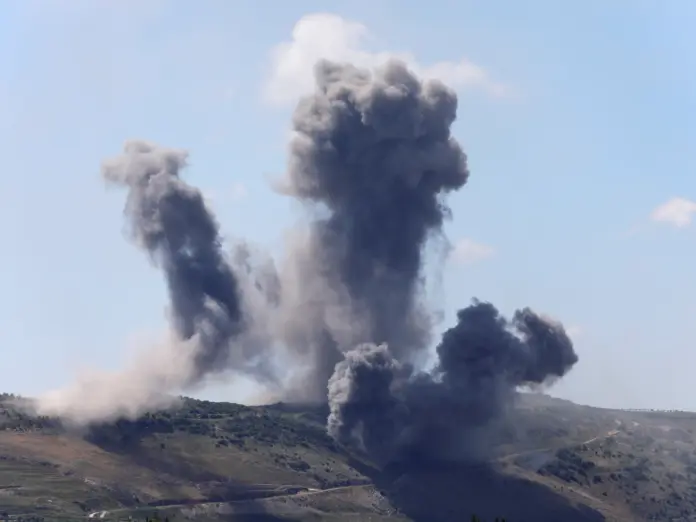
Israeli Strikes Lebanon — At least six people were killed across southern Lebanon on Saturday as Israeli air strikes struck multiple towns and villages, reducing a residential building to rubble, killing a first responder, and prompting the Israeli military to issue 16 separate evacuation orders throughout the region.
In the town of al-Namiriya, two young men riding a motorcycle were killed when an Israeli strike hit them directly. A similar attack in al-Duweir claimed the life of another young man, also on a motorcycle. In the town of Abba, a Syrian national was killed under identical circumstances, struck while riding through the area. A fourth fatality was recorded in Jebchit, where one man died in an air raid.
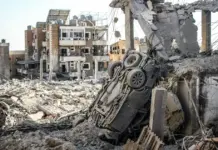
The deadliest single incident occurred in Srifa, in the Tyre district, where Israeli warplanes targeted a house. Rescue workers subsequently pulled three bodies from the wreckage. A sixth death was recorded in Bazouriyeh, also in the Tyre area, where one person was killed in an air raid.
Recommended Reading
Among the most striking casualties of the day was a paramedic killed in Arab Salim. The first responder had arrived at the site of a previous Israeli strike to assess the damage when a drone struck, killing him. The attack on a medical worker inspecting a strike site drew immediate attention from Lebanon’s National News Agency, which documented the incident alongside the broader wave of violence.
Hezbollah responded with its own attacks. The group deployed a drone against Israeli soldiers stationed inside a house in the Biyyada area of the South Governorate, and launched a rocket barrage targeting Israeli troops in the town of Rashaf in Nabatieh Governorate. The exchanges underscored the fragility of a ceasefire that, despite remaining nominally in effect, has done little to halt the daily trading of fire between the two sides.
Since the current phase of the conflict began in early March, Israeli air strikes have killed 3,151 people in Lebanon and wounded a further 9,571, according to figures from Lebanon’s Health Ministry. The toll reflects a sustained campaign that has reshaped daily life across the country’s south, displacing communities and destroying infrastructure in dozens of towns and villages.
The Israeli military’s issuance of 16 evacuation orders on Saturday signalled the likelihood of further strikes, with residents in targeted zones given little time to flee. Such orders have become a recurring feature of the campaign, though critics argue they provide inadequate warning given the pace and scale of the bombardments.
Israeli Strikes Lebanon: Regional Implications
The violence in Lebanon is unfolding against a broader regional backdrop defined by diplomatic uncertainty. United States President Donald Trump confirmed that negotiations with Iran over a potential nuclear agreement are ongoing, describing a deal as "largely negotiated" while simultaneously instructing his negotiating team "not to rush." Trump also reaffirmed that a blockade on Iran would remain "in full force" until a final agreement is reached. The talks are described as tense, with significant gaps remaining between the two sides.
Compounding pressure on Tehran, Washington announced sanctions against nine individuals with ties to Hezbollah, the Iran-backed militant group whose secretary-general is Naim Qassem. The sanctions represent the latest in a series of financial measures aimed at constraining Hezbollah’s operational and logistical capacity as the group continues its confrontation with Israel along Lebanon’s southern border.
The combination of sustained Israeli military pressure, Hezbollah’s continued resistance, and the unresolved diplomatic standoff between Washington and Tehran has left southern Lebanon trapped in a cycle of violence that shows no immediate sign of abating. For the communities caught between these forces — in towns like Srifa, Arab Salim, and al-Namiriya — the human cost continues to mount with each passing day.