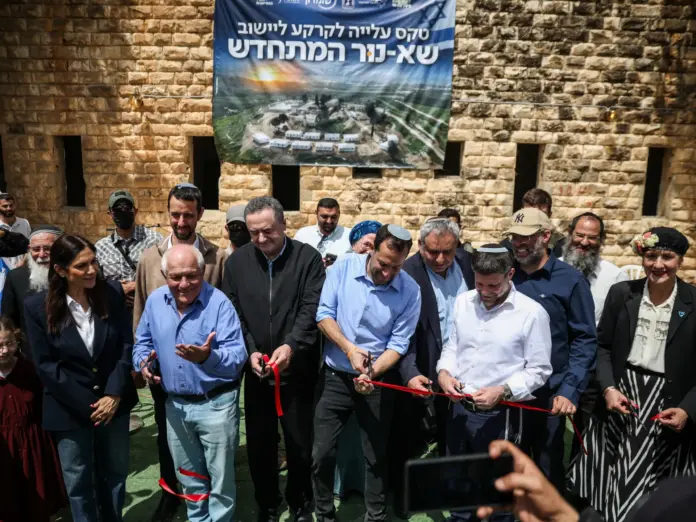
Israeli Finance Minister Bezalel Smotrich stood at a ribbon-cutting ceremony in the Sa-Nur settlement on Sunday and declared that Israel was "burying the idea of a Palestinian state" — words that drew immediate international attention as the government formally re-established a community evacuated nearly 21 years ago.
Smotrich, joined by Energy Minister Israel Katz, called the reopening "a historic correction to the criminal expulsion," framing the return to Sa-Nur as a righting of historical wrongs. The settlement, located in the northern West Bank south of Jenin, was among four communities dismantled during Israel’s 2005 disengagement from parts of the territory. Israeli authorities have now approved 126 housing units there, and 16 families have already moved in.
Among those present was Yossi Dagan, head of the West Bank Settlements Council, who was himself among the settlers forced to leave Sa-Nur in 2005. His presence underscored the deeply personal dimension of a political moment that carries profound legal and diplomatic consequences.

Sa-Nur is one of four former settlements — alongside Homesh, Ganim, and Kadim — that the Israeli government has recently moved to re-establish. The trajectory of their revival has been swift. In March 2023, the Knesset passed an amendment to the disengagement law that had previously barred Israeli settlers from returning to all four sites. Just two months later, Smotrich announced plans for 22 new settlements across the West Bank, explicitly naming Sa-Nur and Homesh. By December 2023, Ganim and Kadim had received formal government recognition as settlements.
The re-establishment of these communities is widely regarded as a violation of international law, which prohibits an occupying power from transferring its civilian population into occupied territory. The move has drawn condemnation from Palestinian leaders and human rights organisations, who argue it forecloses any viable path to a two-state solution — a concern Smotrich’s own remarks appeared to confirm rather than deflect.
The broader settlement enterprise has expanded significantly under Prime Minister Benjamin Netanyahu‘s government, which took office following the 2022 elections. Israeli organisation Peace Now reports that 104 settlements have been approved since that government’s formation. In the month preceding Sunday’s ceremony alone, 34 new settlements received approval. Approximately 700,000 settlers now live across the West Bank and East Jerusalem.
Rights groups warn that the pace of expansion has intensified sharply since the Hamas attacks of October 7, 2023. Settler violence has surged alongside the construction drive. On April 11, a Palestinian man was shot and killed by Israeli settlers in Deir Jarir, near Ramallah. The United Nations Relief and Works Agency for Palestine Refugees (UNRWA) reported that March was among the deadliest months for settler violence on record in the West Bank, a grim benchmark that reflects the deteriorating security environment for Palestinian communities throughout the territory.
The reopening of Sa-Nur arrives at a moment of acute geopolitical tension across the region, with international attention focused on the trajectory of Israeli policy in the occupied territories. For Palestinian leaders, Sunday’s ceremony was not merely a symbolic provocation but a concrete step toward the permanent foreclosure of statehood — a reading that Smotrich’s own language did little to contradict.
For the families now settling into Sa-Nur’s newly approved housing units, the return represents a fulfilment of a decades-long aspiration. For the international community, it represents one of the most explicit statements yet of where Israel’s most powerful ministers intend to take the country’s relationship with the land between the Jordan River and the Mediterranean Sea.