A rabbi who boasted of destroying 50 buildings per week in Gaza and whose name has become a colloquial Israeli verb meaning to flatten or obliterate was chosen to light a ceremonial torch at Israel’s Independence Day celebration on Tuesday evening — an honour that has ignited fierce controversy both domestically and internationally.
Rabbi Avraham Zarbiv, a 52-year-old state rabbinical judge, father of six, and self-described soldier of the Givati Brigade, was among twelve individuals selected to light torches at the annual ceremony held over the resting place of Theodor Herzl, the founder of modern Zionism. The ceremony marks the anniversary of Israel’s establishment in 1948, an event that also precipitated the displacement of at least 750,000 Palestinians.
Zarbiv’s selection was made by Transport Minister Miri Regev. The Israeli military moved swiftly to separate itself from the decision, with a spokesperson confirming that Zarbiv was not chosen in coordination with the armed forces and was not representing the military at the ceremony — a notable clarification given that he serves as an army reservist.

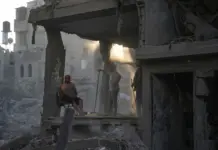
The rabbi’s battlefield conduct has attracted sustained scrutiny. Zarbiv filmed himself throwing grenades at Palestinians during fighting in Khan Younis in the early months of 2024 and recorded footage of himself participating in the demolition of Palestinian homes across Gaza. He has also shared video of himself taking part in the destruction of structures in southern Lebanon. In January 2025, he told a television channel that there are tens of thousands of dead in Gaza — a figure broadly consistent with the Israeli military’s own acknowledgement that it has killed more than 70,000 Palestinians in the territory.
Zarbiv has delivered sermons from the ruins of Rafah, promising victory and future Jewish settlement in the area. His persona has become so associated with destruction that his surname entered informal Israeli usage as a verb denoting total obliteration.
The Hind Rajab Foundation, a Belgian-based NGO co-founded by Dyab Abou Jahjah, filed a formal complaint against Zarbiv with the International Criminal Court in January 2025. The organisation’s lawyers cited his own recorded statements, including the claim that he personally oversaw the demolition of 50 buildings per week during his deployment in Gaza.
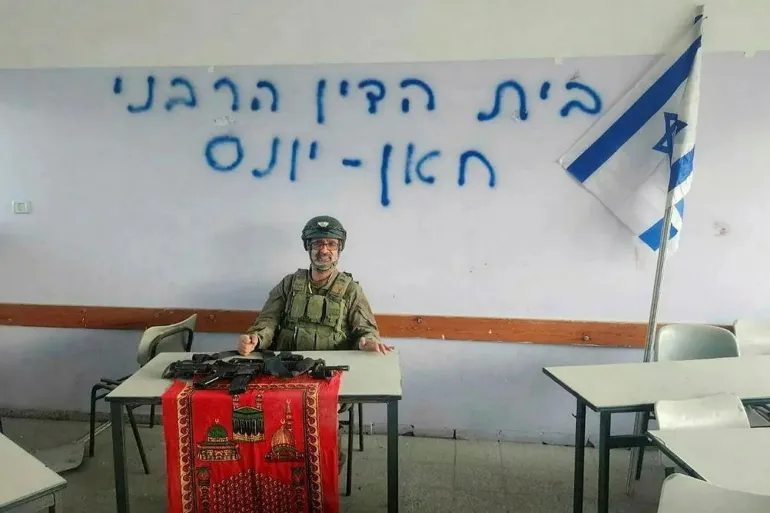
Zarbiv’s conduct extends beyond the battlefield. Kerem Navot, an Israeli organisation that monitors illegal settlement construction, filed a complaint confirming that Zarbiv built his home on private Palestinian land within the Beit El settlement — construction deemed illegal under international law.
B’Tselem, one of Israel’s most prominent human rights organisations, formally objected to Zarbiv’s inclusion in the Independence Day ceremony. The group stated that his selection amounts to a state-level endorsement of the dehumanisation of Palestinians, arguing that honouring an individual whose public record consists of filmed demolitions, boasts of mass destruction, and an ICC complaint sends a deliberate and dangerous message about the values the state chooses to celebrate.
The controversy arrives as Israel’s Independence Day carries an increasingly contested international dimension. The 77th anniversary of the country’s founding is observed simultaneously as Nakba Day by Palestinians worldwide — a commemoration of the mass displacement that accompanied Israel’s creation. The decision to elevate Zarbiv to a position of national honour at this particular moment has amplified that tension considerably.
The torch-lighting ceremony, in which twelve flames are ignited together to represent the collective spirit of the nation, has historically been used to recognise individuals deemed to embody Israeli achievement and values. Previous honorees have included scientists, educators, athletes, and community leaders. Zarbiv’s inclusion marks a significant departure from that tradition and reflects a broader shift in which military conduct in Gaza — however extreme — is increasingly celebrated rather than scrutinised within certain political circles in Israel.
Neither Zarbiv nor Regev’s office had issued a public response to the mounting criticism at the time of publication.