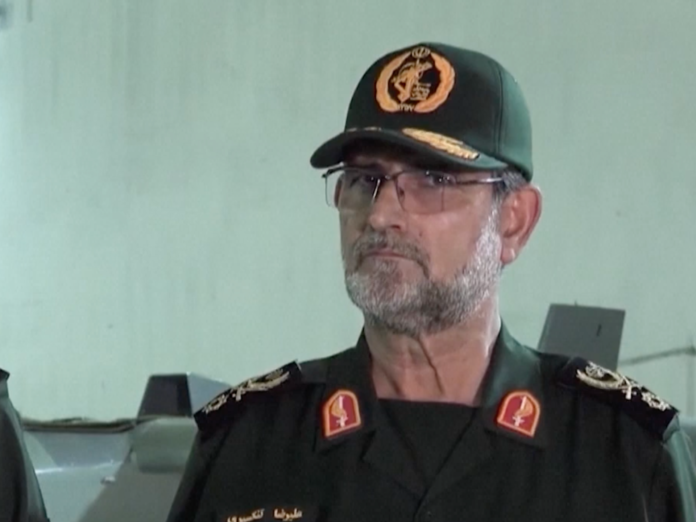
BANDAR ABBAS, Iran — Israeli Defence Minister Israel Katz announced Wednesday night that Rear Admiral Alireza Tangsiri, the commander of Iran’s Islamic Revolutionary Guard Corps (IRGC) Navy, had been killed in an Israeli air strike on Bandar Abbas, Iran’s strategically vital southern port city. The strike also targeted other senior officers of the naval command, Katz said, in what amounts to one of the most consequential targeted killings of the ongoing conflict.
Tangsiri, appointed to lead the IRGC Navy in 2018 by Supreme Leader Ayatollah Ali Khamenei, was a veteran of the Iran-Iraq War and a central architect of Iran’s asymmetric naval doctrine in the Gulf. His tenure was defined by relentless brinkmanship — repeated threats against Western naval forces, the backing of detentions of foreign sailors in Iranian waters, and the expansion of IRGC maritime capabilities. In the days before his reported death, he had issued fresh warnings to Israeli and American audiences about the closure of the Strait of Hormuz.
Israeli officials directly attributed to Tangsiri the decision to mine and block the Strait of Hormuz, the narrow waterway through which a significant share of the world’s energy supplies passes. Iran has been selectively barring vessels it perceives as linked to the US-Israeli campaign, while allowing a limited trickle of other ships through. Jasem Mohamed Albudaiwi, secretary-general of the Gulf Cooperation Council — the bloc of six Gulf Arab nations — stated that Iran had been charging fees for safe passage through the strait, a claim that underscores the degree to which the waterway has become a tool of economic coercion.
Iranian and Israeli military authorities have not formally acknowledged the strike. No official confirmation of Tangsiri’s death has emerged from Tehran. A correspondent reporting from the Iranian capital noted the absence of any government statement on the matter at the time of publication.
The killing, if confirmed, would represent a dramatic deepening of a campaign that has already claimed the lives of several of Iran’s most senior security figures. Since the war began on February 28, Israel has announced the assassinations of Ayatollah Ali Khamenei, security chief Ali Larijani, Brigadier General Gholamreza Soleimani — head of the Basij paramilitary forces — and Intelligence Minister Esmail Khatib. The pace and seniority of these targeted killings signal a deliberate Israeli strategy of decapitating Iran’s military and security leadership.
The human toll inside Iran has been severe. Deputy Health Minister Ali Jafarian reported that at least 1,937 people have been killed in nearly one month of conflict, among them 452 women and children. A further 24,800 people have been wounded, including 4,000 women and 1,621 children. Two teenage boys were among those killed in the city of Shiraz. Iran, for its part, has launched repeated waves of missile and drone attacks as part of its ongoing military campaign.
Israeli strikes have extended well beyond Iranian territory. Last week, Israeli air attacks struck several Iranian naval vessels in the Caspian Sea, destroying ships equipped with missile systems alongside support vessels and patrol craft — a significant blow to Iran’s northern naval presence and a demonstration of the geographic breadth of Israel’s operations.
The Strait of Hormuz crisis is drawing in regional and international actors. Malaysian Prime Minister Anwar Ibrahim said Thursday that Iran had agreed to allow Malaysian tankers through the strait following discussions with Iranian, Turkish and other regional leaders — a sign that back-channel diplomacy is attempting to carve out limited exceptions to the blockade even as the broader conflict intensifies.
Washington is also deepening its posture in the region. The United States is considering deploying elements of the 82nd Airborne Division to the area, a move that would signal a significant escalation of American ground-force readiness in proximity to the conflict.
Tangsiri’s career was built on confrontation. He previously commanded key naval districts before rising to lead the IRGC Navy, and his strategic outlook — centred on deterring foreign military presence in the Persian Gulf through aggressive signalling and asymmetric tactics — shaped Iran’s maritime posture for nearly a decade. His reported death removes a figure who was, by Israeli account, the operational architect of the Hormuz closure and a linchpin of Iran’s naval deterrence strategy.
Whether Tehran will acknowledge the loss, and how it chooses to respond, may determine the next phase of a conflict that has already reshaped the security landscape across West Asia.