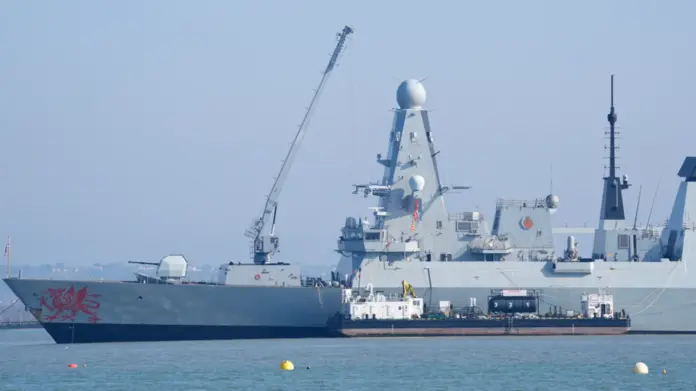
Hms Dragon Hormuz — Britain has ordered HMS Dragon to the Middle East, positioning one of the Royal Navy’s most capable warships in the region as London and Paris push to assemble a multinational force to safeguard commercial shipping through the Strait of Hormuz. The Ministry of Defence announced the deployment on Saturday, describing it as "part of prudent planning" for a mission it characterised as "strictly defensive and independent."
The Type 45 destroyer — purpose-built for anti-aircraft and anti-missile warfare — is the first Royal Navy vessel sent to the Middle East since the Iran conflict erupted in late February. Its dispatch signals a significant escalation in British military engagement with the crisis, even as Prime Minister Sir Keir Starmer insists the UK will not be drawn into the wider war. "We will not be dragged into this conflict," Starmer has stated, adding that any shipping protection mission will only commence once fighting in the region ends. He also confirmed Britain will not support a US blockade of Iranian ports.
HMS Dragon arrives with recent operational experience. The warship had been stationed in the eastern Mediterranean as part of UK defensive operations, with its primary role being the protection of British air bases in Cyprus. That mission took on added urgency after RAF Akrotiri was struck by an Iranian-made drone in March. The vessel did suffer a minor technical issue shortly after arriving at Cyprus, requiring a brief docking, but has since been cleared for onward deployment.
Recommended Reading
The strategic stakes are considerable. Iran has maintained control over the Strait of Hormuz for months, a chokepoint through which approximately 20% of the world’s oil and liquefied natural gas passes. Tehran’s grip on the waterway has been framed as retaliation for strikes by the United States and Israel. A ceasefire between Washington and Tehran has nominally been in place since April, yet both sides accused each other of launching attacks in the strait this week, underscoring how fragile that arrangement remains.
The diplomatic groundwork for a protective mission has been building for weeks. Sir Keir Starmer and French President Emmanuel Macron have emerged as the leading advocates for a coordinated international response. Last month, 51 countries convened to discuss options for protecting commercial vessels navigating the strait, with dozens offering to contribute assets to a joint operation led in part by France. In a visible show of commitment, the French aircraft carrier Charles de Gaulle transited the Suez Canal earlier this week, signalling Paris’s readiness to project naval power into the region.
Britain is also preparing additional assets. RFA Lyme Bay, a Royal Fleet Auxiliary vessel, is being fitted with autonomous mine-hunting equipment ahead of a potential deployment — a capability that would prove critical in a waterway where the threat of naval mines has loomed large throughout the crisis.
HMS Dragon is one of only six Type 45 destroyers in the Royal Navy’s fleet, making its deployment a significant commitment of high-end military capability. The class represents Britain’s most sophisticated surface air-defence platform, designed to protect task groups from saturation missile and drone attacks — precisely the threat profile that has defined the Hormuz crisis.
Hms Dragon Hormuz: Regional Implications
The MoD has been careful to frame the mission in limited terms. The language of "prudent planning" and a "strictly defensive" mandate reflects the political tightrope London is walking: demonstrating resolve to allies and the commercial shipping industry while avoiding entanglement in a conflict that has already drawn in the United States and Israel. The UK government has been bolstering its defensive posture in Cyprus since January, and HMS Dragon’s pre-positioning in the Middle East represents the most concrete extension of that posture yet.
For global energy markets, the resolution of the Hormuz crisis carries enormous weight. The strait’s role as the world’s most critical oil transit corridor means that any sustained disruption — or conversely, any credible international commitment to keeping it open — will reverberate through commodity prices worldwide. Whether the multinational mission championed by Starmer and Macron can move from planning to operation will depend, in large part, on whether the fragile ceasefire between the US and Iran holds.