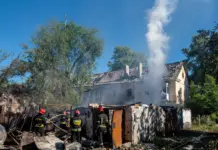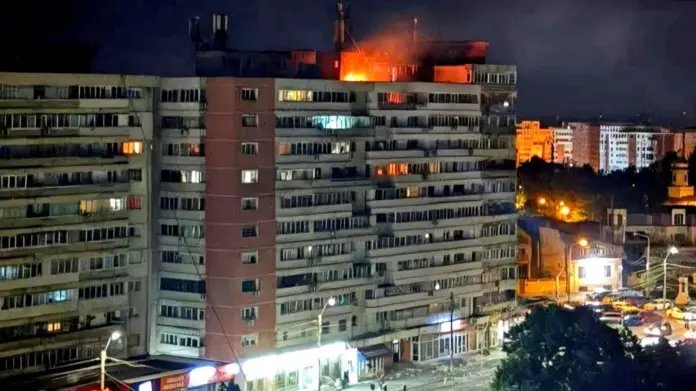
Russian Drone Strikes Romania — A Russian drone slammed into an apartment block in the eastern Romanian city of Galati on Friday, detonating its full explosive payload on the building’s 10th floor, wounding two people and triggering a fire that forced the evacuation of around 70 residents. The strike represents a significant escalation in the spillover of the Ukraine war into NATO territory — the first time Romanian citizens have sustained injuries from a Russian drone since Vladimir Putin ordered the full-scale invasion of Ukraine in February 2022.
The two wounded individuals received medical treatment for abrasions sustained during the incident. Emergency services evacuated approximately 70 residents from the stricken building as crews worked to contain the blaze ignited by the impact. Galati sits in Romania’s far east, close to the borders with both Ukraine and Moldova, with the River Danube forming the natural boundary between Romania and Ukrainian territory.
Romanian air defences scrambled two F-16 fighter jets after the drone was detected, but the response window proved critically narrow. Military forces had just four minutes between detection and impact — an interval too short to mount an effective intercept. Complicating matters further, Romanian forces were constrained from firing munitions that would have violated Ukrainian airspace, a restriction that severely limited their options.
Recommended Reading
President Nicușor Dan convened an emergency session of Romania’s Supreme Defence Council in the wake of the strike. Romania’s foreign ministry moved swiftly to demand accelerated transfers of anti-drone capabilities to the country, underscoring the urgent need to bolster defences against a threat that has now drawn blood on NATO soil.
NATO condemned what it described as Russia’s recklessness following the strike. The alliance’s rebuke reflects growing alarm among member states about the frequency with which Russian drones have been straying across Romania’s border. Since the war began, fragments from Russian drones have been recovered on Romanian territory on 47 separate occasions, with 12 of those incidents occurring in the current year alone. In April, a separate Russian drone caused material damage in Galati, though that incident produced no casualties.
Friday’s strike did not occur in isolation. A nationwide air raid alert was issued overnight across Ukraine, and the port of Izmail in the Odesa region — situated close to the Romanian border along the Danube — came under drone attack in the early hours of Friday morning. Ukrainian ports have been subjected to repeated Russian air strikes throughout the conflict, as Moscow targets the country’s grain export infrastructure and logistics networks.
The broader theatre of war continued to exact a human toll. In the Russian-controlled Donetsk region, a Ukrainian drone strike on Thursday killed three utility workers, with a fourth man sustaining serious injuries.
Russian Drone Strikes Romania: The Wider European Impact
The Galati incident lays bare the acute vulnerability of NATO’s eastern flank to drone warfare that does not respect international borders. Romania’s geographic position — with the Danube running along its frontier with Ukraine — places it directly in the path of drones launched against Ukrainian port cities. The four-minute detection-to-impact window exposed on Friday illustrates the near-impossibility of intercepting fast-moving, low-flying drones with conventional air defence systems operating under strict rules of engagement.
Romania’s call for accelerated anti-drone transfers signals that Bucharest regards the current defensive posture as inadequate. The country has now experienced drone incursions on nearly 50 documented occasions, yet Friday marked the moment the conflict’s violence became personal — injuring Romanian civilians in their own homes, on the 10th floor of an apartment building in a city that sits squarely within the European Union and the NATO alliance.
Putin launched the full-scale invasion of Ukraine in February 2022, setting in motion a war that has now, with increasing regularity, spilled beyond Ukraine’s borders and into the territory of its neighbours.