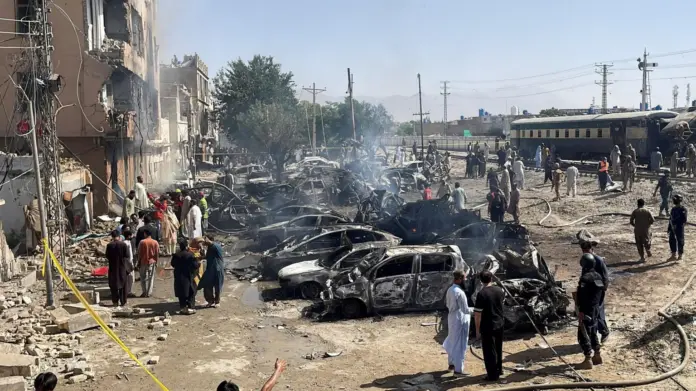
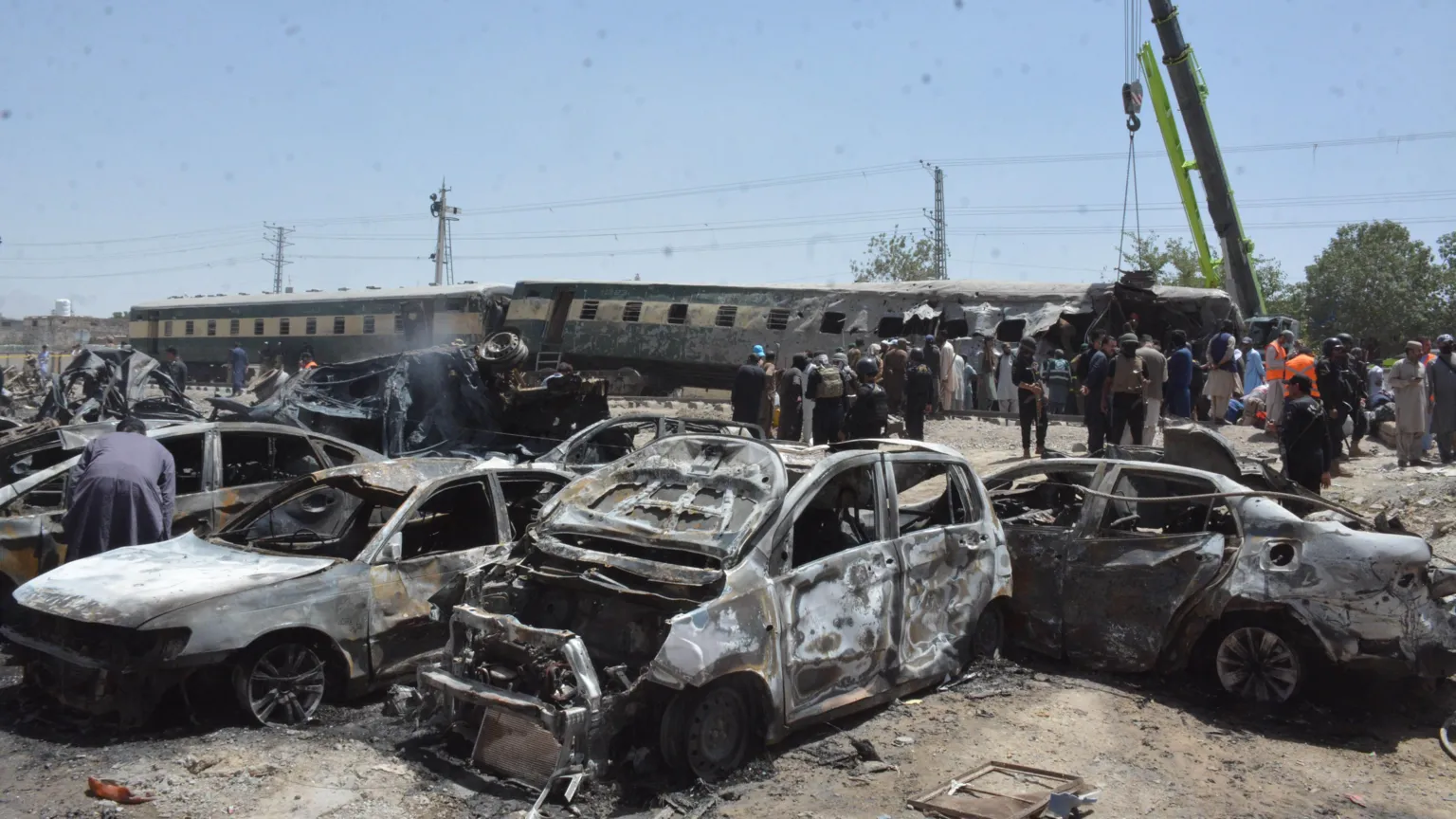
Balochistan Liberation Army Attack — A suicide bombing tore through a military passenger train at Chaman Phatak station in Quetta on Sunday morning, killing at least 24 people and wounding more than 50 others in one of the deadliest attacks on Pakistan’s rail network in recent memory. The blast derailed three coaches and the engine, overturned two carriages, and set several train cars ablaze, leaving charred wreckage strewn across the tracks.
The train was transporting military personnel and their families from a nearby military encampment toward Quetta’s main railway station, where passengers were scheduled to continue onward to Peshawar and then to their hometowns for the Eid holiday. The timing — with soldiers and their relatives travelling for one of the Islamic calendar’s most significant celebrations — amplified the human toll of the attack.
The Balochistan Liberation Army (BLA), a separatist militant group, claimed responsibility, stating the assault was carried out as a suicide bombing. Pakistani officials have not yet confirmed that characterisation, though the scale of destruction is consistent with a close-range explosive detonation. Several houses and buildings adjacent to the railway line sustained severe damage, and emergency services worked through the morning to extract casualties from overturned and burning carriages.
Recommended Reading
![Security personnel and residents rescue injured blast victims from derailed carriages after an explosion targeted a train in Quetta, in Pakistan's Balochistan province, on May 24, 2026 [AFP]](https://world-tension.s3.us-east-2.amazonaws.com/articles/1106/50a5a44e5aff41eabde2dbd9d078192a.webp)
Hospitals across Quetta were placed on emergency footing, with doctors and medical staff ordered to remain on duty to manage the influx of wounded. The scenes outside treatment centres reflected the chaos at the blast site — charred vehicles and toppled train carriages visible along the line as rescue workers combed through debris.
Prime Minister Shehbaz Sharif condemned the attack in a statement posted to X, formerly Twitter, declaring that Pakistan remains determined to eliminate terrorism in all its forms. His response came as security forces cordoned off the area around Chaman Phatak and investigators began assessing the full extent of the damage.
Sunday’s attack is the latest in a sustained campaign by the BLA against Pakistan’s security infrastructure and transport network. The group has targeted trains in Balochistan on multiple occasions over the past two years. In March 2025, BLA militants hijacked the Jaffar Express and took passengers hostage during a journey toward Peshawar, an incident that drew widespread international attention. The Jaffar Express has been targeted by the group on multiple separate occasions.
The BLA frames its campaign as resistance against what it describes as the federal government’s exploitation of Balochistan’s vast mineral wealth. The province covers nearly 44 percent of Pakistan’s total land area but is home to only around 5 percent of the country’s more than 240 million people. Despite its resource base — which includes significant deposits of natural gas, coal, and minerals — Balochistan remains the country’s least developed province, a disparity that has fuelled decades of separatist grievance.
Balochistan Liberation Army Attack: Regional Security Implications
The region’s strategic significance extends well beyond its borders. Balochistan shares volatile frontiers with both Iran and Afghanistan and stretches along part of the Arabian Sea coastline. The port city of Gwadar, located within the province, serves as the southern terminus of the China-Pakistan Economic Corridor (CPEC), a multi-billion-dollar infrastructure programme that connects China’s Xinjiang region to the Arabian Sea. The BLA has repeatedly targeted Chinese workers and infrastructure projects tied to CPEC, reflecting deep-seated opposition to Beijing’s expanding economic footprint in the region.
Violence in Balochistan has intensified in recent months. In early February, clashes between BLA fighters and Pakistani security forces killed 31 civilians in Quetta and across the broader region. Separatist attacks have grown not only in frequency but in ferocity, with militants demonstrating an increasing willingness to strike high-profile targets with mass-casualty potential.
Sunday’s bombing underscores the persistent threat facing Pakistan’s security forces as they attempt to suppress an insurgency that has proven resilient across successive military operations. With Eid travel at its peak and military families among the dead and wounded, the attack carries both tactical and symbolic weight — a deliberate strike at the human cost borne by those serving in a conflict that shows little sign of resolution.