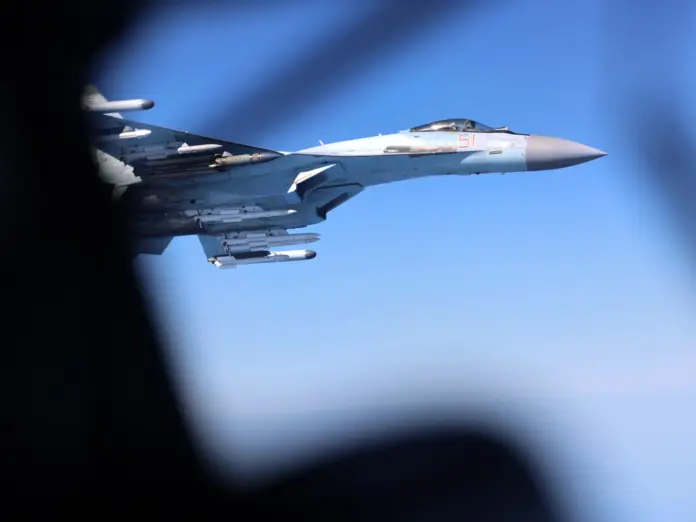
Russian Jets Intercept Raf — Russian military aircraft conducted a series of dangerous and repeated interceptions of an unarmed British Royal Air Force surveillance plane over the Black Sea in April, bringing one jet within six metres — less than 20 feet — of the aircraft’s nose in what UK officials have condemned as reckless and destabilising behaviour.
The targeted aircraft, an RAF Rivet Joint, was operating in international airspace on a routine mission to support NATO’s eastern flank when a Russian Su-35 made multiple close passes, flying near enough to trigger the plane’s emergency warning systems. A second aircraft, a Russian Su-27, conducted six separate passes at dangerously close range. The Rivet Joint carried no weapons and posed no offensive threat.
Defence Minister John Healey characterised the incident as the most dangerous Russian action against a British surveillance aircraft since 2022, warning that such conduct creates a genuine risk of accidents and potential escalation between nuclear-armed powers. He made clear, however, that the provocations would not alter the United Kingdom’s commitment to defending NATO and its allies. The UK Ministry of Defence issued a formal statement on the matter, and both defence and foreign ministry officials lodged a direct complaint with the Russian embassy in London. Moscow had not publicly responded at the time of the statement.
Recommended Reading
The episode draws an uncomfortable parallel to a 2022 incident in the same region, when a Russian aircraft released a missile in proximity to a British surveillance plane over the Black Sea. Russian authorities attributed that event to a technical malfunction, a characterisation that Western officials received with considerable scepticism.
The aerial confrontation is not the only dimension of Russian military activity that has drawn British attention in recent weeks. On April 9, Healey disclosed that the Royal Navy had tracked three Russian submarines conducting what appeared to be a covert, monthlong operation in the Atlantic Ocean north of the United Kingdom. The submarines were operating in close proximity to critical undersea infrastructure, including cables and pipelines that underpin global communications and energy supply chains.
The monitoring operation was a substantial undertaking. Roughly 500 UK personnel were involved, with aircraft logging more than 450 flight hours and a Royal Navy frigate covering several thousand nautical miles to shadow the submarines’ movements. By making the operation public, Healey appeared to send a deliberate signal to Moscow that British and allied forces maintain persistent awareness of Russian military movements, even when those movements are designed to be clandestine.
The disclosures come against the backdrop of a recently completed UK defence review, which concluded that Russia represents an ‘immediate and pressing’ threat to the United Kingdom and its allies. That assessment has sharpened focus in London on the need to maintain robust surveillance and deterrence capabilities across both the air and maritime domains.
Russian Jets Intercept Raf: The Wider European Impact
Analysts note that the pattern of behaviour — aggressive aerial interceptions combined with submarine probing near undersea infrastructure — reflects a broader Russian strategy of testing Western resolve and gathering intelligence on NATO’s response capabilities. The Black Sea, in particular, has become a focal point of tension since Russia’s full-scale invasion of Ukraine in February 2022, with both sides conducting regular surveillance operations in the contested airspace above it.
The UK’s decision to publicise both the aerial incident and the submarine tracking operation represents a calibrated transparency, intended to demonstrate capability and resolve without triggering a formal escalation. Healey’s framing of the Black Sea interception as dangerous rather than merely provocative underscores the degree to which London views the current threat environment as qualitatively different from earlier periods of East-West tension.
Russia’s silence in the immediate aftermath of the UK statement leaves open the question of whether Moscow will acknowledge the incidents, dismiss them as routine, or escalate its own rhetoric in response. For now, British officials appear content to let the facts speak for themselves.