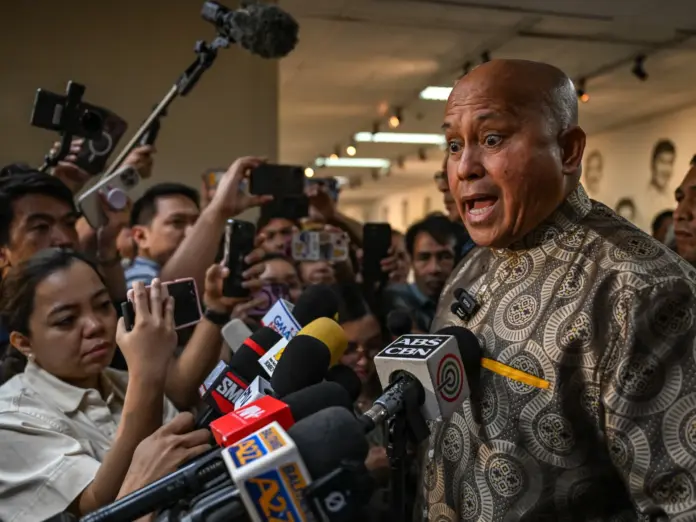
Icc Arrest Philippines — The Philippine Supreme Court has declined to halt the arrest of Senator Ronald dela Rosa, removing a key legal obstacle for authorities seeking to deliver the former national police chief to the International Criminal Court on charges of crimes against humanity.
The court denied dela Rosa’s application for a temporary restraining order on Wednesday, though it noted that other aspects of his petition remain unresolved. The interim ruling effectively validates the ICC warrant and opens the door to his potential detention, a significant moment in the Philippines’ fraught relationship with international justice.
President Ferdinand Marcos Jr‘s spokeswoman, Claire Castro, confirmed Wednesday that the arrest warrant is legally valid against the senator. Justice Secretary Fredderick Vida went further, stating that authorities will ‘definitely’ pursue dela Rosa and execute the ICC warrant. Despite that resolve, the senator’s location is currently unknown.
Recommended Reading
Dela Rosa had argued that the ICC warrant could not be enforced on Philippine soil without a corresponding order from a domestic court — a position the Supreme Court’s ruling now undermines. His lawyer announced plans to file a motion for reconsideration, signalling the legal battle is far from over.
The senator’s flight from justice has been dramatic. After spending six months in hiding, dela Rosa resurfaced last week, only to take refuge inside the Senate building for several days. He fled the compound in the early hours of Thursday. A shooting incident between government agents and Senate security personnel occurred during the tense standoff, underscoring the volatile atmosphere surrounding his case.
Dela Rosa served as chief of the National Police during former President Rodrigo Duterte‘s administration from 2016 to 2022, overseeing a brutal anti-narcotics campaign that became the subject of international condemnation. Thousands of alleged drug dealers were shot dead in police operations across the country. The ICC has estimated that between 12,000 and 30,000 people were killed between 2016 and 2019 alone in connection with the crackdown. Dela Rosa has consistently denied involvement in any illegal killings.
The senator’s case is inextricably linked to that of Duterte himself. The former president, also accused of crimes against humanity by the ICC, has been held in custody at The Hague since March 2025. Duterte maintains his innocence. His transfer to ICC custody marked a watershed moment — the first time a former head of state from Southeast Asia faced international criminal proceedings of this magnitude.
Icc Arrest Philippines: Indo-Pacific Security Context
The ICC, seated in The Hague in the Netherlands, has jurisdiction over crimes against humanity, war crimes, and genocide. The Philippines withdrew from the Rome Statute — the court’s founding treaty — in 2019 under Duterte, but the ICC has maintained that it retains jurisdiction over alleged crimes committed while Manila was still a member.
The Supreme Court’s decision represents a pivotal shift in how the Marcos administration is navigating its relationship with international legal institutions. While Marcos has maintained a degree of political distance from his predecessor, the government’s willingness to enforce the ICC warrant signals a meaningful departure from the posture of the Duterte era, when the court was routinely dismissed as a tool of foreign interference.
For dela Rosa, the legal and physical walls are closing in. With the Supreme Court declining to shield him, domestic authorities publicly committed to his arrest, and his former patron already in ICC detention, the senator faces an increasingly narrow set of options. Whether he surrenders, is apprehended, or continues to evade capture will shape not only his own fate but also the broader trajectory of accountability for one of the most lethal domestic security campaigns in recent Philippine history.