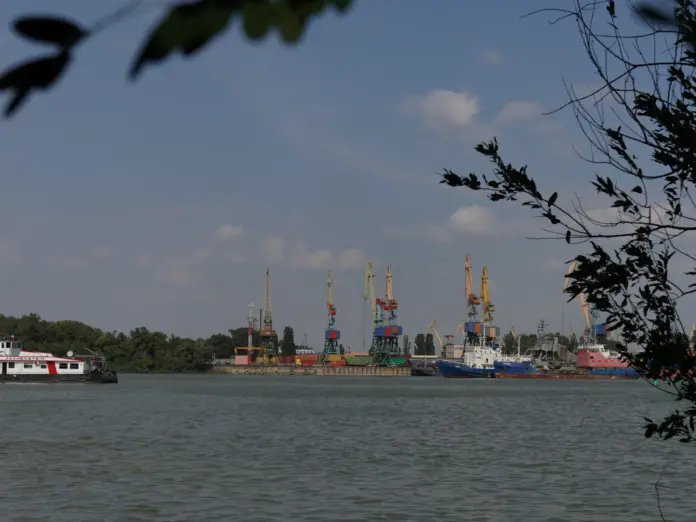
Izmail Port Strike — Russian forces struck port infrastructure in Izmail, Ukraine’s largest grain-export hub on the Danube River, in a sustained overnight attack that lasted from approximately 1am to 3am local time on Tuesday, igniting a blaze that firefighters struggled to contain as windows in a nearby building were blown out by the blast.
The Odesa Regional State Administration said Ukrainian air defences destroyed nearly all incoming Russian drones over open territory outside populated areas of the Izmail district, though the damage to port facilities confirmed that at least some munitions reached their targets. The attack was the second major strike on Izmail’s port infrastructure in weeks, following a similar assault on the night of May 2.
Izmail, situated in the Odesa region close to the Romanian border, has become a critical artery for Ukrainian grain exports since Russia’s blockade of Black Sea routes forced Kyiv to reroute agricultural shipments through the Danube corridor. Repeated strikes on the port threaten to disrupt food supply chains that extend well beyond Ukraine’s borders.
Recommended Reading
The violence was not confined to the south. In Kharkiv, Ukraine’s second-largest city, a Russian drone strike left at least two people requiring rescue from rubble. Mayor Ihor Terekhov warned that one additional person may still be trapped beneath the debris. Further east, Russia’s Kursk region reported a Ukrainian strike on Monday evening that killed one woman and wounded two others, while Russia’s southern Rostov region and Yaroslavl — a city northeast of Moscow that hosts significant oil refining infrastructure — also reported drone attacks.
In Moscow, Mayor Sergei Sobyanin announced that four Ukrainian drones heading toward the capital were intercepted and downed. The attempted strikes followed a heavy Ukrainian drone assault on Moscow over the weekend, to which Russia responded by hitting residential buildings in Odesa and Dnipro, injuring dozens of civilians.
Ukrainian President Volodymyr Zelenskyy said the cumulative effect of Ukrainian drone and missile campaigns has reduced Russian refining capacity by 10 percent in recent months — a figure that underscores Kyiv’s strategy of targeting energy infrastructure deep inside Russian territory.
The escalating exchange of strikes comes against a fraught diplomatic backdrop. A US-brokered three-day ceasefire agreed earlier this month, which included a planned exchange of 1,000 prisoners on each side, collapsed amid mutual accusations of violations. Neither side has indicated willingness to return to the negotiating table in the near term.
Izmail Port Strike: The Wider European Impact
As the fighting intensified, Russian President Vladimir Putin was set to arrive in Beijing on Tuesday evening for a two-day state visit, where he will meet Chinese President Xi Jinping. The visit marks the 25th anniversary of the 2001 Sino-Russian Treaty of Friendship and is expected to focus heavily on energy cooperation, including the long-discussed Power of Siberia 2 gas pipeline, which would dramatically expand Russian gas exports to China. The timing of the visit — amid active combat operations and a deteriorating ceasefire — signals Moscow’s intent to deepen its strategic partnership with Beijing as Western pressure mounts.
Adding a further layer of tension, Russia’s Ministry of Defence announced a large-scale exercise scheduled from May 19 to 21 to prepare for the deployment of nuclear forces. The drill will involve more than 64,000 personnel and 7,800 pieces of military equipment, with ballistic and cruise missiles to be launched from test sites on Russian territory. The announcement drew immediate international attention, coming at a moment when diplomatic efforts to end the war have stalled and cross-border strikes are intensifying on multiple fronts.
The Izmail attack illustrates the broader pattern of the conflict: Russia continues to target Ukrainian economic infrastructure, particularly export routes that sustain Kyiv’s war economy, while Ukraine presses deep into Russian territory with drone strikes designed to impose costs on the Kremlin’s industrial and energy base. With a fragile ceasefire already in tatters and a major Russian military exercise on the horizon, prospects for a near-term de-escalation appear remote.