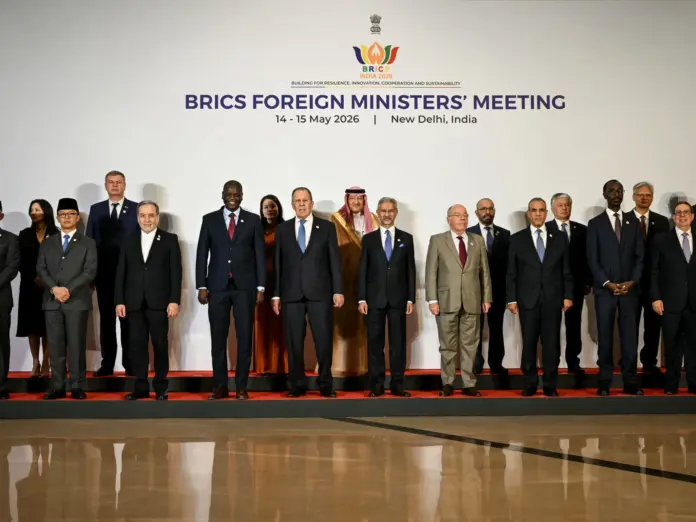
Brics Foreign Ministers Iran — New Delhi’s Bharat Mandapam conference centre hosted one of the most fractious diplomatic gatherings of 2025 this week, as foreign ministers from the BRICS bloc concluded two days of talks Friday without reaching a common position on the war between the United States, Israel and Iran — now in its 77th day.
The meeting, the first major ministerial engagement under India‘s 2026 BRICS presidency, brought together senior diplomats from the bloc’s ten member states. It was chaired by Indian External Affairs Minister Subrahmanyam Jaishankar, who also hosted a brief sideline reception with visiting ministers before Prime Minister Narendra Modi departed for Abu Dhabi.
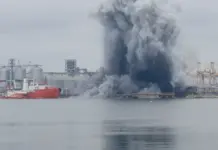
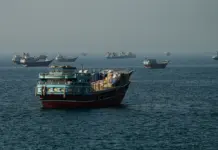
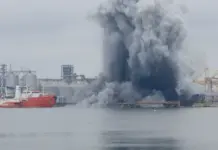
The conflict, which began on February 28 with coordinated US and Israeli strikes on Iranian military installations, nuclear facilities and critical infrastructure, has since reshaped global energy flows. Iran closed the Strait of Hormuz to commercial shipping in the immediate aftermath, and Washington imposed a naval blockade on Iranian ports on April 13, sending energy prices surging across international markets.
Recommended Reading
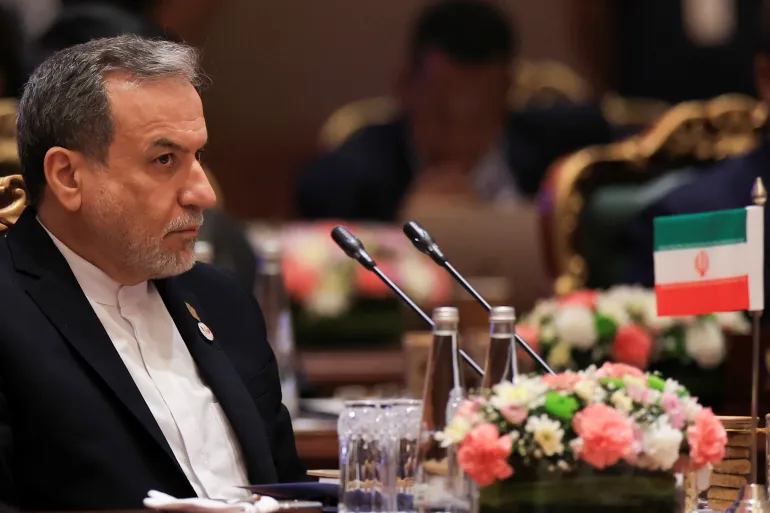
Inside the conference hall, the fault lines within BRICS were impossible to conceal. Iran and the United Arab Emirates — both full members of the expanded bloc — found themselves on a direct collision course. The UAE’s representative, Minister of State for Foreign Affairs Khalifa bin Shaheen Al Marar, used his national statement to call for a formal condemnation of Iranian actions. Iranian Foreign Minister Abbas Araghchi responded by accusing the UAE of permitting the United States to use Emirati territory as a launchpad for attacks on Iran, and alleged that Emirati aircraft had directly participated in strikes against his country.
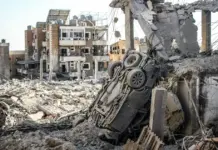
The UAE, for its part, stated it had intercepted more than 2,800 Iranian drones and missiles since February 28. Iran has cited the human cost of the conflict, including a claim that approximately 170 students were killed in an attack on a school in Minab city on the opening day of hostilities.
The outcome document from the meeting acknowledged only that "there were differing views among some members" on the Middle East conflict — diplomatic language that underscored the bloc’s inability to speak with one voice on the war’s most consequential questions. This marks the second consecutive BRICS gathering in India to end without consensus on the conflict; a meeting of deputy foreign ministers and special envoys on the Middle East, held in New Delhi on April 24, similarly produced no joint statement. Since the war began, BRICS has not issued a single collective statement on the fighting under India’s chairship.
The absence of Chinese Foreign Minister Wang Yi added another layer of complexity. Wang remained in Beijing to participate in a landmark summit between President Xi Jinping and US President Donald Trump, whose state visit to China coincided directly with the New Delhi meeting. China was instead represented by its ambassador to India, Xu Feihong. Russia’s Sergey Lavrov, Brazil’s Mauro Vieira and South Africa’s Ronald Lamola all attended in person, as did the foreign ministers of Indonesia, Egypt and Ethiopia.
Brics Foreign Ministers Iran: Regional Implications
Despite the impasse on Iran, delegates did manage to reach agreement on more than 60 separate issues, spanning energy cooperation, trade facilitation, digital infrastructure, climate action and multilateral institutional reform — a reminder that the bloc retains significant common ground beyond the current crisis.
Diplomatic efforts to end the fighting have so far yielded little. Pakistan hosted US-Iran talks last month, but those negotiations have since stalled. A BRICS leaders’ summit is scheduled for September in India, where the war — and the bloc’s fractured response to it — is expected to dominate the agenda once again.
The New Delhi meeting underscores a broader challenge for BRICS as it seeks to project itself as an alternative pole of global governance: its expanded membership, which now includes nations on opposing sides of active armed conflicts, makes unified positions on security crises increasingly difficult to achieve. With the Strait of Hormuz closed, global shipping disrupted and no ceasefire in sight after 77 days of fighting, the pressure on India’s BRICS chairship to broker at least a rhetorical consensus will only intensify ahead of September’s summit.