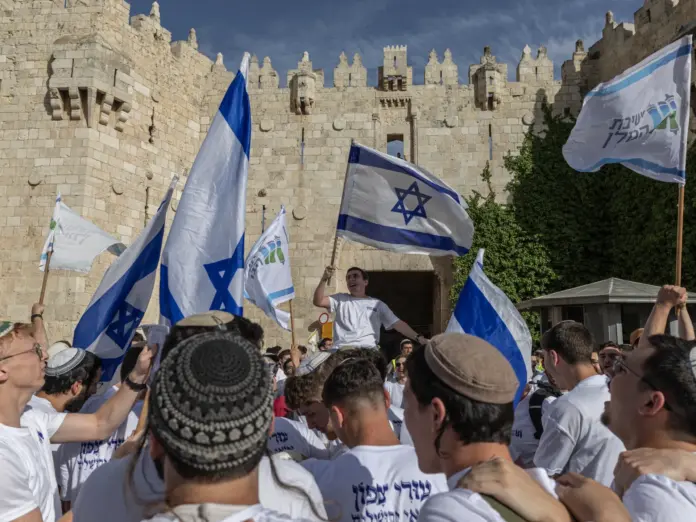
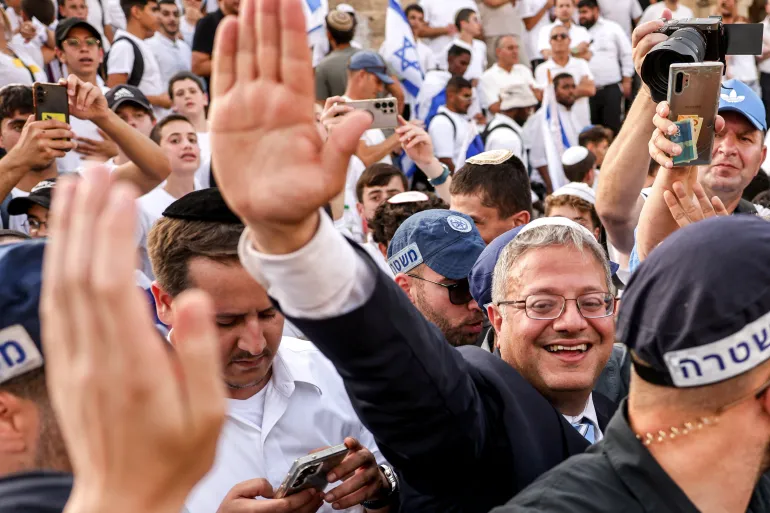
Jerusalem Flag March — Violence erupted across occupied East Jerusalem on Thursday as tens of thousands of far-right Jewish marchers surged through the Old City for the annual Flag March, attacking Palestinians and peace activists before the procession had even officially begun. The day’s events, which included a charged incursion by a senior government minister into one of Islam’s holiest sites, drew sharp international condemnation and underscored the deepening tensions gripping the city.
Ultranationalist marchers attacked Palestinians in the Christian Quarter before the march formally commenced, with footage circulating widely showing participants spitting at residents and hurling abuse. Chants of ‘May your village burn’ and ‘Death to Arabs’ rang through the ancient alleyways. Israeli police, meanwhile, forced Palestinian shop owners to shutter their businesses for the duration of the march and barred Palestinians from outside the Old City from entering the area at all. Thirteen people were arrested, including both Jews and Palestinians.
National Security Minister Itamar Ben-Gvir led a large contingent of Jewish Israelis into the Al-Aqsa Mosque compound, where he displayed the Israeli flag in front of the Dome of the Rock — a gesture immediately condemned by Jordan as ‘a blatant violation of international law’ and ‘an unacceptable provocation.’ Jordan administers the Jerusalem Waqf Department, the body responsible for overseeing Islamic holy sites in occupied East Jerusalem, giving Amman a direct custodial stake in events at the compound.
Recommended Reading
Approximately 200 activists from Standing Together, a joint Jewish-Palestinian peace organisation, positioned themselves between the marching crowds and Palestinian residents in an attempt to shield the latter from attack. Wearing distinctive purple vests, the volunteers drew on a strategy of physical interposition in one of the most volatile urban environments in the world. Uri Weltmann, the organisation’s national field director, was among those present as the group faced down the advancing crowds.
‘This march is not a celebration — it is an act of intimidation,’ Weltmann said, describing the annual event as a vehicle for organised aggression against Palestinian communities in the city.
Jerusalem Day is observed each year by Jewish Israelis to mark the capture of East Jerusalem, the West Bank, Gaza, and the Golan Heights during the 1967 Arab-Israeli war. For Palestinians, the day carries an entirely different weight: East Jerusalem is envisioned as the capital of any future Palestinian state, and the annual march is widely seen as a deliberate assertion of Jewish supremacy over contested territory.
The march has long attracted elements of Israel’s most radical settler movements. The Hilltop Youth, a loosely organised network of violent young settlers responsible for repeated attacks on Palestinian communities in the West Bank, has been associated with the event in past years. Researchers tracking settler violence, including Aviv Tatarsky of the Ir Amim activist group and Eram Tzidkiyahu, a specialist in Jewish-Arab relations, have documented how the march functions as a focal point for extremist mobilisation.
The political backdrop to Thursday’s events is significant. Under Prime Minister Benjamin Netanyahu and Finance Minister Bezalel Smotrich — a far-right pro-settler figure whose Religious Zionism party holds considerable sway within the governing coalition — the number of illegal settlements in the occupied West Bank has surged. Ben-Gvir’s own presence at the Al-Aqsa compound reflects the degree to which figures once considered fringe have moved to the centre of Israeli political life.
Jerusalem Flag March: Regional Implications
Ofer Cassif, a member of the left-wing Hadash party, was among Israeli lawmakers who condemned the day’s events, describing the march as state-sanctioned incitement.
The violence in Jerusalem comes against the backdrop of an ongoing war in Gaza that has killed more than 72,000 Palestinians since the Hamas-led attack on Israel in 2023. Israel withdrew its ground forces and settlers from Gaza in 2005, but has maintained a blockade of the territory. The war has dramatically intensified international scrutiny of Israeli government policy toward Palestinians across all occupied territories, with Thursday’s scenes in the Old City adding fresh fuel to that debate.
For the residents of East Jerusalem’s Old City — many of whom watched Thursday’s march from behind closed shutters, barred from their own streets — the annual ritual carries a meaning that transcends politics. It is, as one Standing Together activist put it, a reminder of who is permitted to move freely through the city, and who is not.