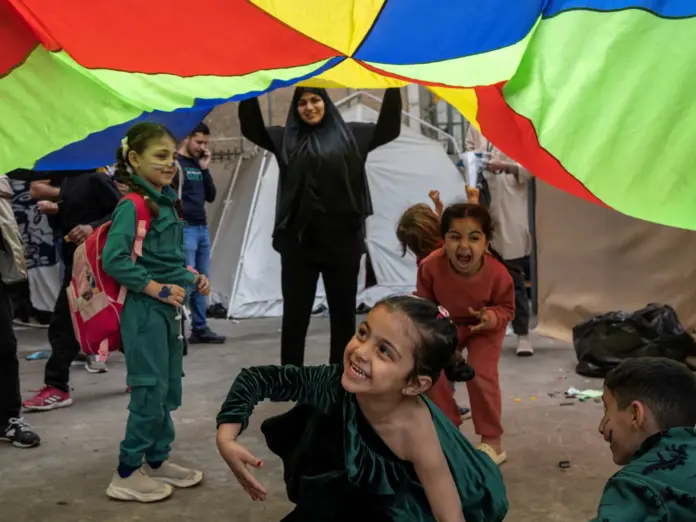
Lebanon Education Crisis — Lebanon’s education system, already battered by six years of overlapping catastrophes, is facing its most severe disruption yet. Since Israel escalated its military campaign on March 2, 2025 — the second major intensification in under two years — more than 1.2 million people have been displaced across the country. Among them are 500,000 school-aged children, according to UNESCO, whose futures hang in the balance as classrooms are destroyed, converted into shelters, or rendered unreachable by active combat.
Israel has committed more than 10,000 violations of the November 2024 ceasefire agreement, systematically destroying schools across southern Lebanon and forcing hundreds of educational institutions to serve as makeshift collective shelters for the displaced. That dual function has directly cut off access to education for an additional 250,000 children. A further 100 schools sit in high-risk zones and could become inaccessible at any moment.
UNESCO has identified 339 schools currently located within active warzones — a figure that underscores the scale of the assault on civilian infrastructure. Teachers and students alike have been swept into the tide of displacement, with hundreds of thousands forced to abandon their schools, their homes, and any semblance of routine.
Recommended Reading
Rima Karami, Lebanon’s minister of education, and the Ministry of Higher Education have coordinated with UNESCO to introduce multiple daily shifts at public schools and establish temporary learning centres. The Ministry of Education, alongside various non-governmental organisations, is also delivering psychosocial and mental health services to students struggling with trauma and instability. Hybrid learning has become the default model across much of the country — yet for the most vulnerable students, even that option is out of reach. Limited internet access, chronic electricity shortages, and a lack of devices mean that online education is a privilege, not a right.
The war is accelerating a collapse that was already well underway. Lebanon’s education system has been interrupted every single year since 2019, disrupted in succession by the October revolution, the COVID-19 pandemic, the catastrophic economic crisis, and now an intensifying military conflict. The consequences are compounding. Since 2019, 30 percent of Lebanon’s public sector teachers have either emigrated or left the profession entirely. Those who remain have seen their salaries eroded by roughly 80 percent due to currency devaluation and economic freefall.
The economic backdrop is stark. Lebanon’s Gini coefficient — the standard measure of income inequality — surged from 0.32 in 2011 to 0.61 in 2023, placing the country among the most unequal societies on earth. A 2024 study by the UN Economic and Social Commission for Western Asia (ESCWA) ranked Lebanon in the top one percent of the world’s most unequal nations. For families already choosing between food, heating, transportation, and internet connectivity, education is increasingly a luxury they cannot afford.
Lebanon Education Crisis: Regional Implications
The human cost of that calculation is visible in rising dropout rates. As more children leave school, cases of child labour and child marriage are increasing — long-term consequences that will outlast any ceasefire. Educational emergencies are among the most chronically underfunded categories of humanitarian response globally, and Lebanon is no exception. Humanitarian funding for the country is under severe strain, leaving critical gaps in support for displaced students and overwhelmed teachers.
Lebanon’s crisis is not new, but its depth is unprecedented. What began as a financial collapse in 2019 has metastasised into a multi-layered emergency in which war, poverty, and institutional failure reinforce one another. For the half-million children now displaced by the latest Israeli offensive, the question is not simply when they will return to school — it is whether the schools they left will still exist when they do.