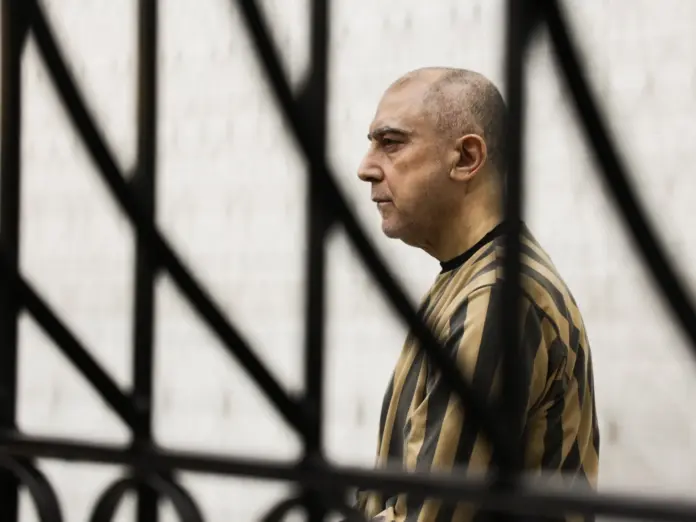
DAMASCUS — Dressed in a striped prison uniform and standing inside a courtroom cage, Atef Najib faced the full weight of Syrian justice on Sunday as the country’s most significant war crimes trial opened in the Fourth Criminal Court in Damascus. The former head of political security in Deraa province — and a cousin of ousted President Bashar al-Assad — confronted at least 10 charges, including murder, torture, and direct responsibility for massacres carried out against civilians during the 2011 uprising.
Syria War Crimes Trial — The session, which lasted approximately one hour in open proceedings before shifting to a closed session to protect witnesses, drew relatives of victims, members of the National Transitional Justice Commission, and representatives of international legal and humanitarian organisations. A total of 75 plaintiffs have filed cases against Najib and are expected to give testimony as the proceedings continue.
Sunday’s hearing was the first substantive day of the trial, following a preparatory session held on April 26. Its significance extends far beyond the fate of a single defendant: it represents the first formal attempt by Syrian authorities to hold officials of the former Assad government criminally accountable for the systematic violence that defined the regime’s final years.
Recommended Reading
Najib’s role in the origins of Syria’s catastrophic civil war is central to the prosecution’s case. In early 2011, teenagers in Deraa were arrested and tortured after scrawling antigovernment graffiti on a school wall — an act of defiance that became a catalyst for the broader nationwide uprising. As the head of political security in the province, Najib is accused of personally overseeing the violent crackdown on those early protesters, a campaign of repression that helped transform local demonstrations into a full-scale armed conflict lasting 14 years and claiming an estimated 500,000 lives.
The Ministry of Interior’s General Security forces arrested Najib in January 2025 during a security campaign targeting remnants of the former government in Latakia province. His detention was immediately regarded as one of the most consequential arrests of a former regime security official since the fall of the Assad government.
Najib does not stand alone in the dock of history, though he is the most prominent figure physically present in court. Bashar al-Assad and his brother Maher al-Assad, the former commander of the military’s elite 4th Armoured Division, are both being tried in absentia. Bashar al-Assad fled to Russia in December 2024 following the collapse of his government, and most members of his inner circle have since escaped Syrian territory. The prospect of their physical return to face justice remains remote.
The trial unfolds under the authority of Syria’s interim government, led by President Ahmed al-Sharaa, which has moved to establish transitional justice mechanisms as part of a broader effort to rebuild state institutions shattered by decades of authoritarian rule and years of war. For survivors and victims’ families who have waited more than a decade for accountability, Sunday’s proceedings carried profound symbolic and legal weight.
Syria War Crimes Trial: Regional Implications
The international community has long documented the Assad government’s use of detention, torture, and extrajudicial killing against political opponents and civilians. Deraa, often described as the cradle of the Syrian revolution, bore some of the earliest and most brutal manifestations of that repression. The charges Najib faces — encompassing both direct acts of violence and command responsibility for atrocities carried out under his authority — reflect the scope of alleged crimes committed in those critical early months of the uprising.
With 75 plaintiffs prepared to testify and international observers closely monitoring proceedings, the trial is expected to be lengthy and legally complex. Whether it can deliver credible justice in a country still emerging from profound institutional collapse will be watched carefully by human rights advocates and transitional justice experts worldwide. For now, the image of a once-feared security chief standing in a cage in a Damascus courtroom signals a striking, if incomplete, reversal of fortune for those who once wielded unchecked power over Syrian lives.