Iran Hormuz Blockade — A coalition of Gulf nations and the United States is pressing the UN Security Council to adopt a sweeping resolution threatening Iran with sanctions unless it ends its stranglehold on the Strait of Hormuz, a waterway that carries roughly a fifth of the world’s energy exports during peacetime.
Saudi Arabia, Qatar, Bahrain, the United Arab Emirates, Kuwait, and the United States are co-drafting the resolution, which operates under Chapter VII of the UN Charter — the provision that authorises measures ranging from economic sanctions to military action. Washington aims to circulate a final draft by Friday and bring it to a vote early the following week.
The Strait of Hormuz has been brought to a near total standstill after Iran launched what it calls the Persian Gulf Straits Authority, an entity established to impose tolls on vessels crossing the waterway. Tehran’s move came in direct response to a campaign of US and Israeli strikes on Iran that began in late February, compounded by a Trump administration embargo on Iranian ports.
Recommended Reading
The draft resolution demands Iran immediately cease imposing what it terms "illegal tolls" on shipping, disclose the precise locations of all sea mines placed in and around the strait, and enable the passage of humanitarian aid, fertiliser, and other essential goods. It also calls on Tehran to "immediately participate in and enable" UN efforts to establish a humanitarian corridor through the waterway.
The human and economic consequences of the blockade are already acute. Qatar, one of the world’s foremost liquefied natural gas exporters, has been forced to halt energy shipments entirely, as its export infrastructure has no alternative route. Saudi Arabia and the UAE, by contrast, possess pipelines that bypass the strait, giving them a degree of insulation from the crisis that Qatar lacks.
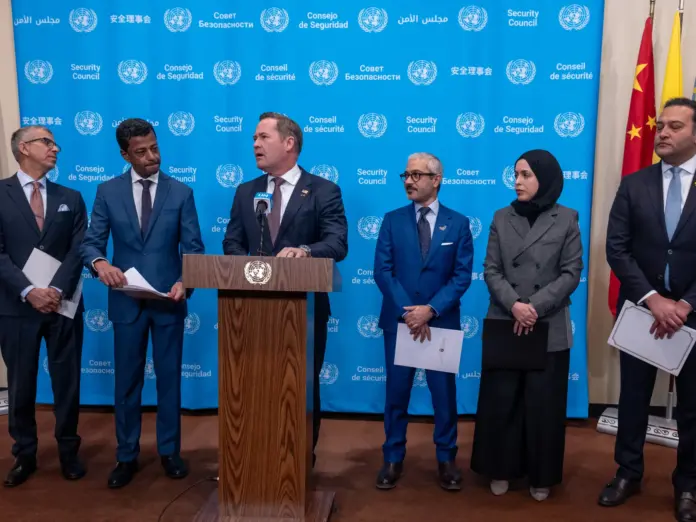
Qatar’s ambassador to the UN, Alya Ahmed Saif al-Thani, is among the senior envoys driving the resolution forward alongside Bahrain’s representative Jamal Alrowaiei, the UAE’s Mohammed Issa Abushahab, and US envoy Mike Waltz.
The push faces a formidable obstacle. Last month, a Bahraini-led resolution on the same crisis was killed when Russia and China exercised their vetoes in the 15-member council. Both countries have a competing text under consideration, signalling that the diplomatic fault lines remain deep. Whether the revised Chapter VII framing and broader co-sponsorship can shift the calculus in Moscow or Beijing remains uncertain.
Iran’s Foreign Minister Abbas Araghchi has not publicly indicated any willingness to negotiate the terms of the strait’s reopening. Tehran has framed its actions as a legitimate defensive response to what it characterises as unlawful aggression, and the establishment of the Persian Gulf Straits Authority suggests the toll regime is intended as a durable policy rather than a temporary pressure tactic.
Iran Hormuz Blockade: Regional Implications
The stakes extend well beyond the immediate parties. The Strait of Hormuz is the world’s most critical oil and gas chokepoint, and even a partial, sustained disruption sends shockwaves through global energy markets. For nations dependent on Gulf hydrocarbon exports — spanning Europe, Asia, and beyond — the standoff represents a direct threat to energy security at a moment when supply chains remain fragile.
Diplomats involved in the drafting process acknowledge that a Russian or Chinese veto remains the most likely outcome, as it was last month. Nevertheless, proponents argue that forcing a public vote places both countries on record as shielding Iran’s blockade, a political cost they calculate may eventually prove untenable. The resolution’s Chapter VII basis also lays groundwork for future action should the council’s composition or political dynamics shift.
For now, tankers remain largely absent from one of the planet’s busiest sea lanes, Qatar’s gas terminals sit idle, and the Security Council prepares for another high-stakes confrontation over a crisis with no clear diplomatic resolution in sight.