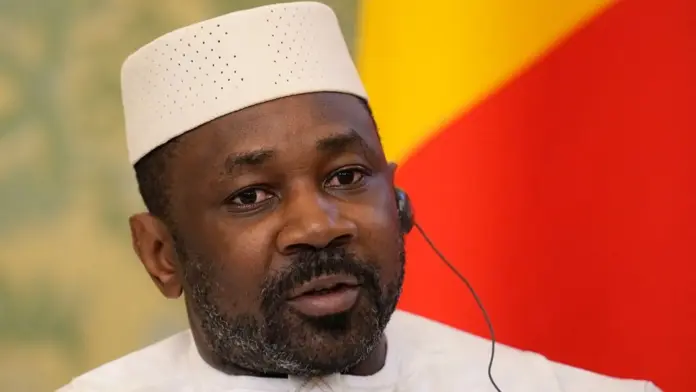
BAMAKO — Mali’s ruling military chief Gen Assimi Goïta has taken direct control of the country’s defence portfolio after his predecessor was killed in a suicide truck bombing at his residence near the capital, Bamako. A decree broadcast on state television Monday confirmed Goïta’s appointment, with Gen Oumar Diarra, the army chief of staff, named as minister delegate to support him.
Mali Goïta Defence — The killing of Sadio Camara marks a dramatic escalation in Mali’s deepening security crisis, which erupted on 25 April when a coordinated offensive swept across the country. The assault was carried out by an alliance of the Azawad Liberation Front (FLA), a separatist movement, and JNIM, a militant organisation affiliated with al-Qaeda. The scale and simultaneity of the attacks exposed critical vulnerabilities in the Malian state’s defences.
Among the most significant consequences of the offensive was the withdrawal of Malian and allied Russian forces from Kidal, a strategically important northern city that has long been a flashpoint in the country’s insurgency. The loss of ground in Kidal underscores the limits of the military government’s counter-insurgency strategy, which has leaned heavily on Russian military support since expelling French forces from the country.
Recommended Reading
Malian authorities moved swiftly to investigate the attacks, arresting a group of soldiers over the weekend on suspicion of involvement. An investigation concluded that both former and serving military personnel were complicit in planning and executing the assault — a revelation that points to dangerous fractures within the armed forces themselves.
The response extended beyond Mali’s borders. In the hours immediately following the 25 April attacks, Mali coordinated with the armed forces of Niger and Burkina Faso to launch joint air strikes against the attacking forces. Niger’s authorities confirmed the operation began almost immediately after the jihadist and separatist coalition struck. The three nations, all governed by military juntas, have formalised their partnership through the Alliance of Sahel States, a bloc that has collectively expelled French troops and welcomed Russian military personnel as a counterweight to the jihadist insurgencies consuming the region.
Despite those efforts, Mali remains in a state of acute insecurity more than a week after the raids. Large swathes of Mali, Niger, and Burkina Faso continue to fall outside effective government control, a reality that has persisted for years and that the military governments of all three countries have struggled to reverse.
Goïta first seized power in a coup in August 2020, positioning himself as a strongman capable of restoring order to a country battered by jihadist violence and political instability. His decision to personally assume the defence ministry signals both the gravity of the current crisis and a desire to centralise command at a moment when the military’s internal cohesion is in question.
Mali Goïta Defence: What This Means for the Sahel
The broader regional picture is one of compounding fragility. France, the former colonial power across the Sahel, has been systematically pushed out of Mali, Niger, and Burkina Faso as their military governments pivot toward Moscow. Russian forces, widely understood to include personnel from private military structures, have filled part of the security vacuum — yet the 25 April offensive demonstrated that their presence has not stabilised the situation.
The assassination of a sitting defence minister in a suicide bombing, the infiltration of the military by elements sympathetic to insurgent forces, and the loss of territory in the north together represent one of the most serious challenges Goïta’s government has faced since taking power. How Bamako responds — and whether its Alliance of Sahel States partners can provide meaningful support — will shape the trajectory of one of West Africa’s most volatile conflicts in the months ahead.