Russian Missiles Ukraine — Russian missile strikes killed at least eight people across Ukraine on Monday, devastating a residential neighbourhood in the northeastern town of Merefa and leaving two men dead in the southern Kherson region — a deadly response that followed an overnight Ukrainian drone attack on the Russian capital.
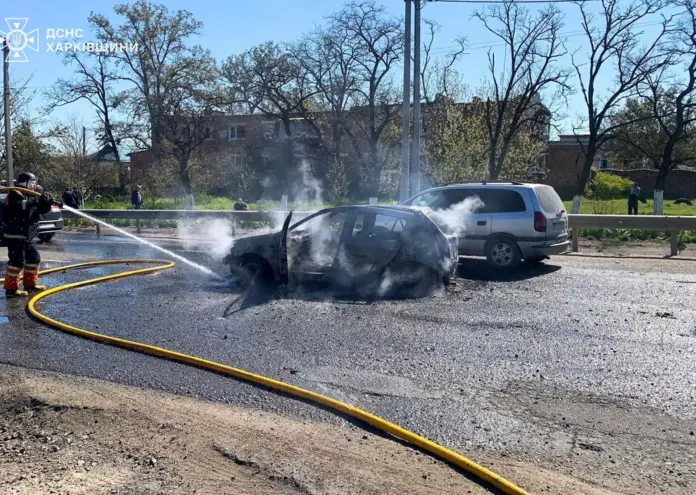
The strike on Merefa, a town in the Kharkiv region, hit midmorning and bore the hallmarks of an Iskander-type ballistic missile, officials said. Six people died — two men and three women killed outright, with a sixth victim, a man, succumbing to his wounds at a hospital. More than 30 others were wounded. At least ten houses and four shops were destroyed or damaged, gutting the town’s civilian infrastructure. Governor Oleh Syniehubov said debris-clearing operations would continue for another one to two days. Russia had not commented on the Kharkiv strike. Two additional men were killed in separate attacks on the Kherson region, according to the regional prosecutor’s office, bringing the day’s confirmed death toll to at least eight.
The strikes came hours after Ukraine launched drones at Moscow overnight into Monday, targeting Mosfilmovskaya Street, an affluent district roughly ten kilometres southwest of the Kremlin. Moscow Mayor Sergei Sobyanin confirmed the attack but said no casualties resulted. State broadcaster Rossiya-1 aired footage showing collapsed interior walls and shattered doors inside one of the affected apartments. Two additional drones targeting the capital were intercepted by air defence systems, Sobyanin added.
Recommended Reading
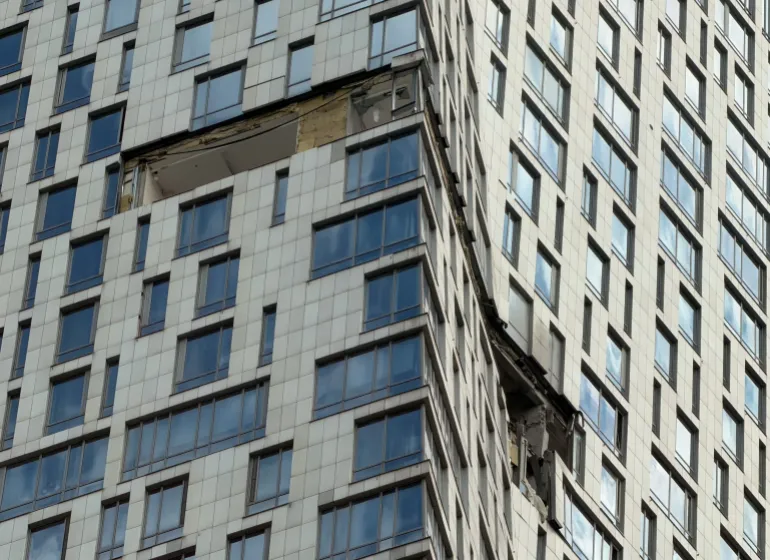
Ukrainian drones rarely penetrate Moscow’s heavily layered air defences, making the strike on one of the city’s most expensive residential streets a notable breach. President Volodymyr Zelenskyy, speaking while attending a summit of European leaders in Armenia, said Russia’s leadership fears that drones could fly over Red Square during the upcoming Victory Day parade — a concern that has already forced a significant change to the event’s format.
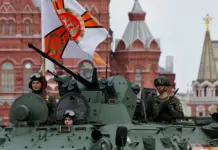
Russia’s Victory Day parade, scheduled five days after the attacks, will be held without military hardware for the first time in recent memory, a concession to the elevated threat posed by Ukrainian long-range strikes. The annual commemoration of the Soviet Union’s victory over Nazi Germany has historically served as a showcase of Russian military power, making the absence of tanks and missile systems a striking symbol of the war’s reach into the Russian heartland.
The tit-for-tat strikes reflect a broader intensification of the conflict. Kyiv has significantly ramped up attacks on Russian oil refineries, ports, and military depots in recent weeks, seeking to degrade Moscow’s logistical capacity and strike at the economic infrastructure sustaining the war effort. Russia, for its part, has continued to target Ukrainian cities and towns with ballistic and cruise missiles, consistently denying that its strikes are aimed at civilians — a claim contradicted by repeated attacks on residential areas, markets, and civilian infrastructure since the full-scale invasion began in February 2022.
Russian Missiles Ukraine: The Wider European Impact
The Merefa attack underscores the persistent vulnerability of communities in the Kharkiv region, which lies close to the Russian border and has endured some of the war’s most sustained bombardment. The use of an Iskander-type ballistic missile — a weapon capable of carrying both conventional and nuclear warheads and difficult to intercept — signals Russia’s continued willingness to deploy high-end munitions against civilian targets far from the front lines.
As both sides trade blows ahead of a symbolically charged Russian national holiday, the prospect of any near-term de-escalation appears remote. Zelenskyy’s appearance at the Armenia summit alongside European allies reinforces Ukraine’s diplomatic posture, even as the battlefield situation demands constant military attention. For the residents of Merefa, the immediate reality is one of rubble, grief, and the slow work of clearing the wreckage left behind.