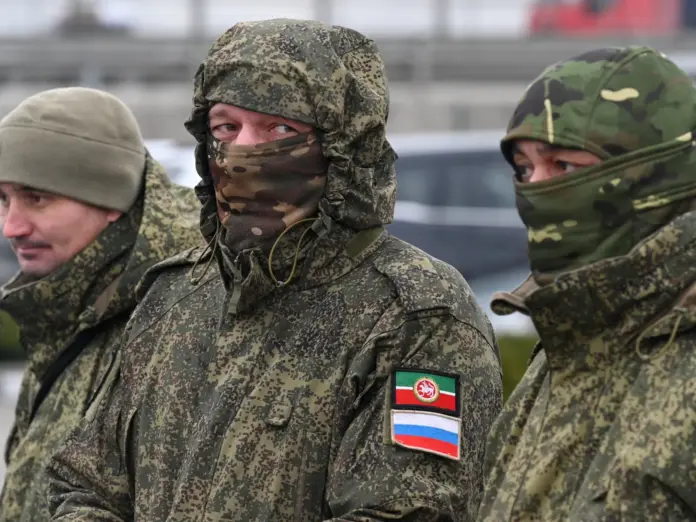
Ukraine War Desertion — When Oleg boarded a train from Moscow to the city of Ryazan last December, he believed he was on his way to a lucrative civilian job — a security guard position at the Zaporizhzhia nuclear power plant paying 200,000 rubles, roughly $2,660 a month. What awaited him instead was a military contract signed at 11pm, a drone pilot assignment buried in an appendix he never fully read, and an eventual desperate flight across three countries to escape the Russian army.
The 24-year-old from Ufa in western Russia had been diagnosed with schizophrenia and was legally barred from handling weapons. None of that stopped military recruiters. He was dispatched to a training unit in the town of Kovrov, failed his drone pilot assessment, and was reassigned as a driver. By March, he found himself in the Voronezh region, which borders Ukraine — far from the power plant job he thought he had accepted.
Oleg’s story is not an isolated case. It is a window into a sprawling desertion crisis that has engulfed both Russia and Ukraine as the war grinds into its fourth year.
Recommended Reading
The United Nations special rapporteur on human rights estimated in September that at least 50,000 Russian soldiers — approximately one in ten servicemen deployed in Ukraine — had deserted since 2022. A separate investigation by Mediazona found that nearly 21,000 Russian servicemen had been convicted for refusing to serve, a figure that underscores the scale of resistance within the ranks.
Oleg fled in late March, tracing a circuitous route through Moscow and then south to Belgorod, where he attempted to cross into Georgia. Border authorities turned him back. He then travelled north to Minsk, the Belarusian capital, before boarding a flight to Yerevan, Armenia. He is now awaiting a humanitarian visa to an European Union country.
His escape was facilitated by Idite Lesom — a Russian phrase meaning roughly ‘get lost in the forest’ — a support network that has assisted at least 3,000 Russian deserters. The group’s spokesman, Ivan Chuvilyaev, a former film critic who left Russia in 2022 over his anti-war stance, says the majority of those the organisation helps never make it out. Around 60 percent of deserters aided by Idite Lesom remain inside Russia, living off the grid and avoiding authorities.
Russia’s recruitment crisis has been building since the Kremlin launched an unpopular partial mobilisation in 2022. Authorities have since relied on a volatile mix of incentives and coercion: large prisoner populations were offered pardons in exchange for frontline service, with many dying in mass assault operations on Ukrainian positions. Volunteers were lured with signup bonuses reaching tens of thousands of dollars. And, as Oleg’s case demonstrates, some recruits were signed up under circumstances that were misleading at best.
Yet the desertion problem is not confined to the Russian side. Ukrainian Defence Minister Mykhailo Fyodorov disclosed in January that more than 200,000 Ukrainian soldiers — exceeding 20 percent of active servicemen — had gone absent without leave or deserted outright. He added that more than two million Ukrainians are currently evading the draft, a figure that points to profound war fatigue within a country fighting for its survival.
Ukraine War Desertion: The Wider European Impact
The human cost of prolonged frontline exposure is visible in documented cases. Soldiers of Ukraine’s 14th Special Mechanised Brigade had not rotated out of their positions near Kupiansk for an entire year. In mid-April, photographs emerged showing emaciated troops from the unit, prompting the dismissal of the brigade’s officers.
Arseny, a 31-year-old Ukrainian soldier, deserted in February after eight months of service. His wife Olena, 29, is the mother of two children. Their situation reflects the impossible choices facing families on both sides of the conflict — loyalty to a state at war weighed against the instinct for survival.
The parallel desertion crises expose a fundamental tension in both nations’ war efforts. Russia has struggled to sustain volunteer recruitment without resorting to deception or coercion, while Ukraine faces the challenge of maintaining a fighting force drawn from a population that has endured years of bombardment, displacement, and loss. For men like Oleg, the distance between a promised job and a frontline posting proved to be the difference that changed everything.