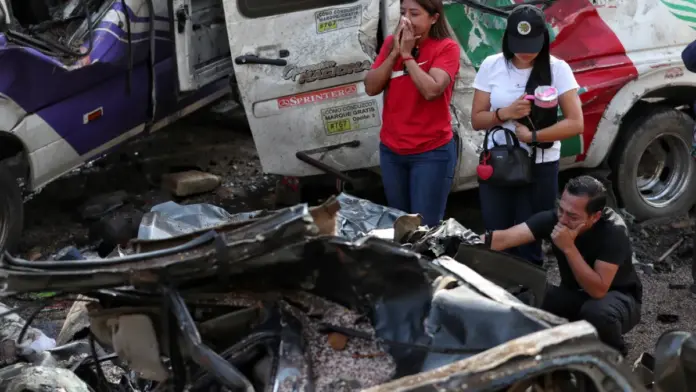
A powerful bomb detonated on the Pan-American Highway in southwestern Colombia on Sunday, killing at least 20 people and wounding 36 others in one of the country’s deadliest attacks in more than two decades. The blast, which struck near a tunnel in the Cauca region, sent shockwaves through a nation already gripped by political tension ahead of a critical presidential election.
Governor Octavio Guzman of Cauca confirmed the death toll on Monday, identifying the victims as 15 women and 5 men. Three of the wounded remained in intensive care, while five injured minors were reported out of danger. Some tallies placed the final death count at 21 by late Monday as emergency responders continued to assess the scene.
A dozen of the dead came from a village near the town of Cajibio, a community now plunged into grief. Hundreds of mourners gathered in Cajibio on Monday evening for a candlelit vigil, many dressed in white and carrying white sheets or balloons — a silent, collective plea for peace in a region long scarred by armed conflict.
President Gustavo Petro swiftly condemned the attack, attributing it to a narco-terrorist organisation led by Nestor Vera, widely known by his alias Ivan Mordisco. Mordisco, described as one of Colombia’s most wanted men, is a dissident former member of the FARC guerrilla movement, which signed a landmark peace agreement with the Colombian government in 2016. Factions that rejected that accord have continued to operate in rural areas, frequently targeting civilian populations and infrastructure.
The bombing ranks among the deadliest attacks on Colombian soil since FARC detonated a bomb at a Bogotá nightclub in 2003, killing 36 people. Sunday’s assault underscores the persistent threat posed by armed dissident groups even as successive governments have pursued negotiated settlements to end decades of internal conflict.
The timing carries acute political weight. Colombia is scheduled to hold presidential elections on May 31, when voters will choose a successor to President Petro. Security has become one of the central fault lines of the campaign, with candidates clashing over how best to confront organised crime, drug trafficking, and dissident armed groups. The attack is likely to intensify those debates in the final weeks of campaigning.
The election season has already been marked by violence. A suspect was recently arrested in connection with the assassination of conservative presidential hopeful Miguel Uribe Turbay, who was killed last June. That killing, combined with Sunday’s highway bombing, has deepened anxieties about the safety of both candidates and ordinary citizens as the country approaches the polls.
The Cauca region has historically been one of Colombia’s most volatile departments, a corridor where coca cultivation, illegal mining, and competing armed factions converge. Communities along the Pan-American Highway — a vital artery linking Colombia to the rest of South America — have repeatedly been caught in the crossfire between state forces and dissident groups vying for territorial control.
For the families of Cajibio, the political dimensions of Sunday’s massacre offer little comfort. The white-clad mourners who filled the town’s streets on Monday were not making a political statement so much as a human one — demanding an end to the cycle of bloodshed that has claimed generations of Colombian lives. Whether the government’s response will match the scale of their grief remains to be seen.