ADAMAWA STATE, Nigeria — Islamic State militants claimed responsibility for a devastating multi-hour assault on Guyaku village in northeastern Nigeria’s Adamawa State that left at least 29 people dead, as a separate armed raid on an orphanage in north-central Nigeria resulted in the abduction of 23 children on the same day.
The attack on Guyaku lasted several hours, leaving the community shattered. ISIL claimed responsibility through a post on the Telegram messaging platform, marking one of the deadliest single incidents in a year already defined by relentless violence against Nigerian civilians.
Adamawa State Governor Ahmadu Umaru Fintiri visited the bereaved community on Monday, pledging that his administration would bolster support for both military units and local vigilante groups to prevent further bloodshed. The governor’s visit reflected the urgency felt by regional authorities as armed groups continue to strike with near-impunity across Nigeria’s north and northeast.
Hours after the Guyaku massacre, gunmen stormed an orphanage in north-central Nigeria, seizing 23 children — referred to locally as pupils, a term that in Nigeria typically encompasses kindergarten and primary school students up to approximately 12 years of age. Security forces subsequently rescued 15 of the abducted children, but eight remain missing. No armed group has claimed responsibility for the orphanage raid.
The twin attacks illustrate the breadth and complexity of Nigeria’s security crisis. Two major ISIL-backed armed groups operate within the country, alongside Boko Haram and factions affiliated with al-Qaeda. Together, these organisations have sustained a campaign of violence that has claimed thousands of civilian lives across the country’s north, northeast, and middle-belt regions.
The scale of the crisis is starkly documented by ACLED, a United States-based crisis-monitoring organisation, which recorded 1,923 attacks on civilians in Nigeria between January and November 2025. Of those incidents, 50 were specifically targeted at Christians because of their religion — a figure that has become the centre of a charged political dispute.
US President Donald Trump has accused Nigerian authorities of failing to protect Christians, characterising the violence as a ‘Christian genocide.’ The Nigerian government has firmly rejected that framing, pointing out that victims of armed attacks include Muslims and traditional worshippers alongside Christians, and that the violence is driven by territorial, criminal, and ideological motivations rather than a singular sectarian agenda.
Washington has nonetheless deepened its military engagement in Nigeria. US forces conducted air strikes against ISIL-affiliated fighters in December, and in February the United States deployed 100 soldiers to northern Nigeria to train and advise local security forces — a sign that American policymakers view the country’s militant insurgency as a threat with regional and global dimensions.
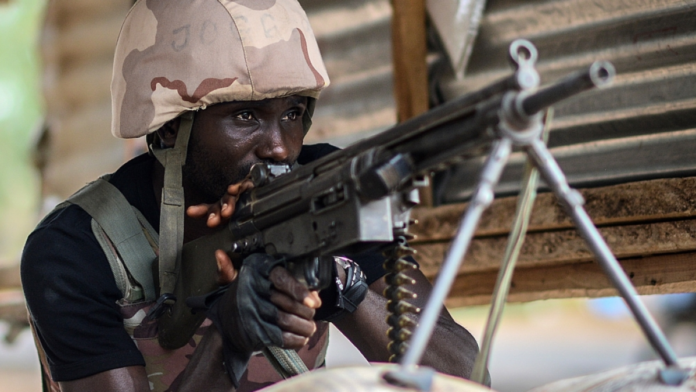
The Guyaku attack and the orphanage abductions arrive at a moment of acute pressure on Nigerian security institutions. Armed groups have demonstrated a capacity to strike simultaneously across geographically distant areas, stretching the response capabilities of both federal and state authorities. Governor Fintiri’s commitment to strengthening vigilante networks reflects a broader pattern across Nigeria’s northern states, where community-based defence groups have increasingly filled gaps left by overstretched conventional forces.
The fate of the eight children still missing from the orphanage raid remains unknown. Their abduction echoes a long history of mass kidnappings in Nigeria, a tactic employed by Boko Haram and affiliated groups to terrorise communities, extract ransoms, and recruit or coerce new members. Families and local officials are pressing for an accelerated search operation.
With nearly 2,000 civilian attacks recorded in under a year, Nigeria faces one of the most intense internal security challenges of any country in sub-Saharan Africa. The convergence of jihadist militancy, intercommunal conflict, and organised criminal violence has created overlapping crises that no single policy response has yet been able to contain.