Somalia is sliding toward catastrophe. More than 6.5 million people are skipping meals daily as a compounding crisis of drought, displacement, and collapsing humanitarian funding strips communities of their last means of survival.
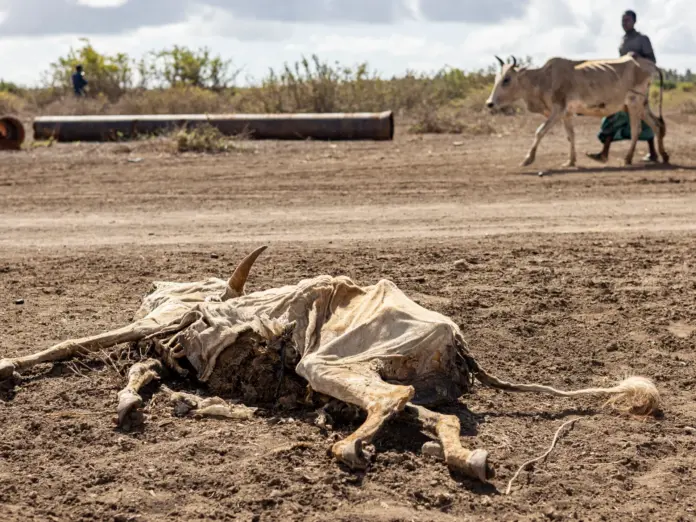
Three consecutive failed rainy seasons have ravaged the country’s agricultural and pastoral heartlands, decimating livestock herds and eliminating the primary source of food and income for millions of families. In communities stretching from the southern port city of Kismayo to the banks of the River Juba, pastoralists who once measured their wealth in cattle now count their remaining animals on one hand.
One displaced woman described watching her herd shrink from 200 animals to just four — a loss that represents not only food but an entire way of life. Hodhan Mohamed walked for days across parched terrain and crossed the River Juba by boat before reaching a displacement settlement, one of millions undertaking desperate journeys in search of food and safety.
Barwaqo Aden, originally from Jamame in Lower Juba, arrived at a medical facility with her eight-month-old daughter hospitalised for severe acute malnutrition. Her story is not exceptional — it is emblematic. An estimated 1.8 million children under five across Somalia are at risk of acute malnutrition, a figure that humanitarian workers describe as staggering even by the country’s historically grim standards.
One-third of Somalia’s entire population — more than 2 million people — has been classified at IPC Phase 4, or emergency levels of food insecurity, the most critical threshold short of an officially declared famine. Overall, the proportion of Somalis facing severe food insecurity at IPC Phase 3 and above represents a national emergency unfolding in slow motion.
Displacement is accelerating the crisis. More than 3.8 million Somalis — approximately 22 percent of the population — are currently displaced, with secondary displacement becoming increasingly common as services and commodities in settlement areas shrink. Armed group al-Shabab continues to control portions of territory, driving further flight from affected regions. Doctors Without Borders (MSF) puts the displaced population at more than 3.3 million, and the organisation has also documented transport costs rising by as much as 50 percent in parts of the country, placing even basic movement out of reach for the most vulnerable.
What makes the current crisis particularly alarming is not only the scale of need but the simultaneous collapse of the international response. The United Nations response plan for Somalia requires $1.42 billion to function. Only $288 million — roughly 20 percent of the required total — has been received. The practical consequences are severe: the humanitarian response has been cut by 75 percent, and the number of people targeted for assistance has been reduced from 6 million to just 1.3 million.
More than 200 health and nutrition facilities across Somalia have closed since early 2025 as funding cuts bite. For communities already hours or days from the nearest clinic, those closures are potentially fatal.
Francesca Sangiorgi, humanitarian director at Save the Children, has warned that the withdrawal of international support is compounding an already dire situation in a country that relies heavily on both imported food and external assistance. Tom Fletcher, the UN humanitarian chief, raised the alarm over the crisis in March, emphasising that the gap between need and response had reached a critical point.
Somalia’s dependence on food imports leaves it acutely exposed to global price shocks and supply disruptions, while decades of conflict and instability have hollowed out domestic institutions. The combination of environmental collapse, armed conflict, mass displacement, and funding failure has created conditions that aid workers say are among the most dangerous they have encountered.
For families like Barwaqo Aden’s, the arithmetic of survival has become brutally simple. With health facilities closing, transport costs rising, and food assistance reaching fewer than one in four people originally identified as needing help, the margin between life and death is narrowing by the week.