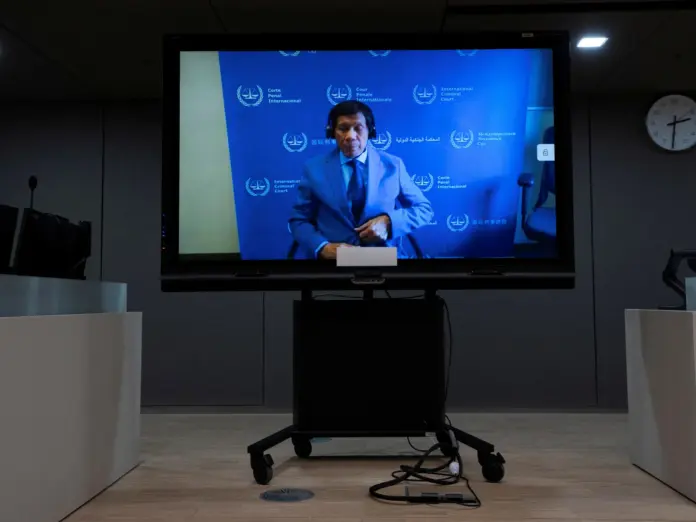
The International Criminal Court has confirmed charges of crimes against humanity against former Philippine President Rodrigo Duterte, committing him to trial over a brutal anti-narcotics campaign that left thousands dead across the archipelago nation.
ICC judges ruled on Thursday that there were substantial grounds to believe the 81-year-old played a central role in the murders of 76 people and the attempted murder of two others. All three counts of murder as crimes against humanity were confirmed, marking one of the most significant international accountability proceedings against a former head of state in recent memory.
The court determined that a common plan existed between Duterte and co-perpetrators to kill individuals perceived or alleged to be associated with drug use, sale, or production. Prosecutors contend that Duterte created, funded, and armed death squads specifically tasked with eliminating suspected narcotics dealers and users — a systematic campaign of violence that operated under the guise of law enforcement.
Duterte governed the Philippines between 2016 and 2022, during which time his administration’s war on drugs became one of the most controversial and lethal domestic security operations in Southeast Asian history. Philippine police recorded approximately 6,000 deaths attributable to the campaign, though human rights organisations place the true toll far higher — some estimating as many as 30,000 civilians were killed during his tenure.
Two Philippine senators were also named as co-perpetrators in the ICC proceedings, broadening the scope of the case beyond Duterte himself and suggesting prosecutors view the campaign as an institutionally coordinated enterprise rather than the actions of a single leader.
Duterte was arrested in the Philippines last year and has consistently denied the charges. He maintains that any instructions he gave to police were limited to the use of lethal force strictly in self-defence. His lead defence lawyer, Nick Kaufman, has argued that Duterte never intended to incite violence, framing the killings as the product of individual police conduct rather than a directed policy from the top.
The question of whether Duterte will be present at his own trial remains unresolved. His defence team has raised concerns about his mental fitness, asserting he is too cognitively impaired to follow the proceedings. The ICC has historically allowed up to a year between the confirmation of charges and the commencement of trial, meaning a full hearing may not begin until late 2026 at the earliest.
Reactions from human rights advocates were swift and pointed. Ritz Lee Santos, Director of Amnesty International Philippines, welcomed the confirmation as a critical step toward justice for victims and their families. Maria Elena Vignoli, senior international justice counsel at Human Rights Watch, echoed that sentiment, emphasising the importance of the ICC process for establishing accountability in cases where domestic mechanisms have failed.
The case carries profound implications not only for the Philippines but for the broader principle that leaders who deploy state power against their own civilian populations cannot expect permanent impunity. Families of those killed during the drug war have waited years for any form of legal reckoning, and Thursday’s ruling represents the most concrete step yet toward that end.
The confirmation of charges does not constitute a finding of guilt — that determination will rest with a full trial chamber. But the threshold cleared by ICC judges, that substantial grounds exist to believe Duterte bears criminal responsibility for the deaths of named individuals, is a significant legal and moral marker in a case that has drawn global scrutiny since the drug war’s earliest and bloodiest days.