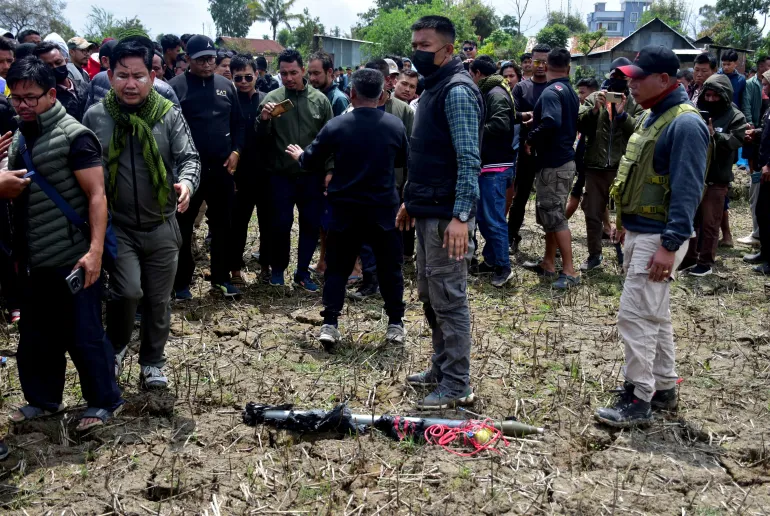
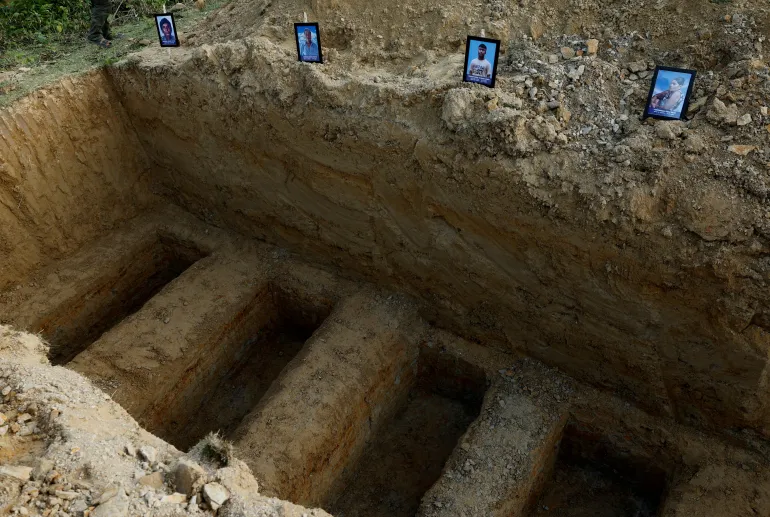
A bomb explosion in the Tronglaobi Awang Leikai area of Manipur’s Bishnupur district on April 7 killed two children — aged five and six — and wounded their mother, igniting a new cycle of violence in a northeastern Indian state already scarred by nearly three years of ethnic conflict. The children’s father serves as a soldier in India’s Border Security Force.
Meitei community leaders swiftly attributed the blast to Kuki fighters. Kuki groups rejected the accusation, arguing the village lay outside any area accessible to their fighters. The competing claims reflect the deep mutual suspicion that has defined the conflict since it erupted in May 2023.
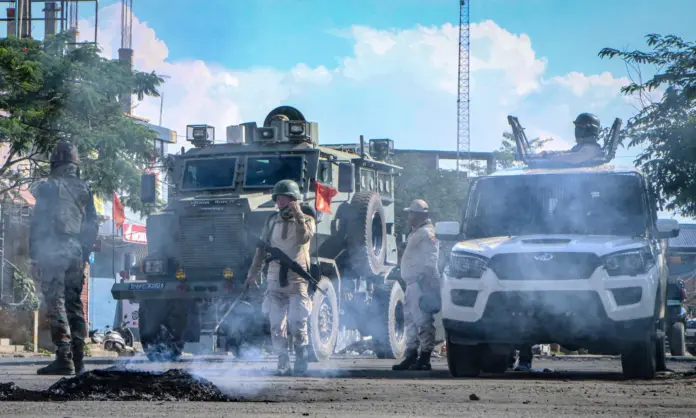
The same day as the blast, paramilitary forces opened fire on protesters, killing at least three people. In the days that followed, alleged fighters ambushed vehicles on a national highway in the Ukhrul region, killing two men, one of them a retired soldier. The total death toll from this latest episode of violence has reached at least seven, with more than a dozen people arrested. The key road linking Bishnupur to the Kuki-dominated district of Churachandpur remained blocked for two weeks, severing a critical artery between communities already living in near-total separation.
The violence is the latest chapter in a conflict that has killed more than 260 people and displaced at least 60,000 into segregated relief camps since April 2023. That month, a Manipur High Court order seen as a step toward granting the majority Meitei community scheduled tribe status — a classification already held by the Kuki-Zo and Naga communities, conferring rights to jobs, education, and political representation — triggered state-wide clashes that have never fully subsided.
Manipur is geographically and demographically complex. The state shares a 400-kilometre border with Myanmar and is divided between the predominantly Hindu Meitei population concentrated in the central valley and the largely Christian Kuki-Zo communities inhabiting the surrounding hills. Land laws introduced after independence were designed to maintain this balance, restricting Meitei settlement in hill areas. The court order of April 2023 was perceived by Kuki-Zo groups as a direct threat to those protections, and violence erupted within days.
The state’s location compounds its instability. Manipur sits on the edge of the Golden Triangle, one of Southeast Asia’s most prolific drug trafficking corridors, spanning Myanmar and neighbouring territories. The trade in heroin, opium, and synthetic drugs such as methamphetamine has long fuelled armed groups and criminal networks operating across the porous border, adding a narcotics dimension to what is already a volatile ethnic and political crisis.
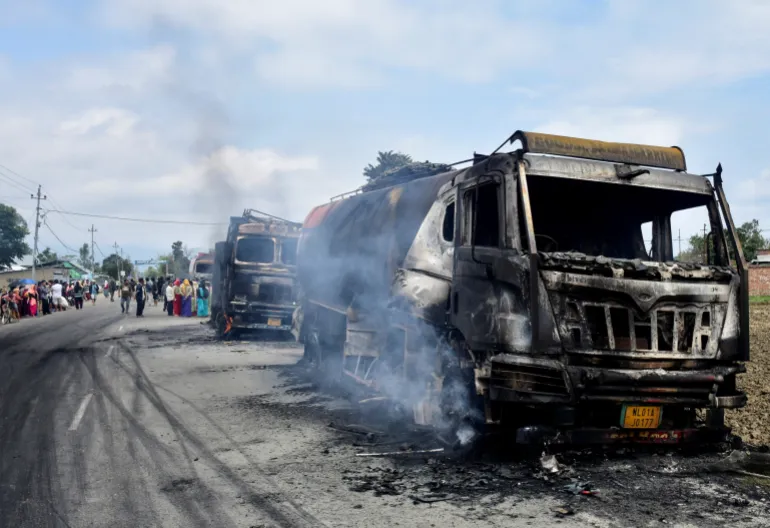
More than 250 companies of Central Armed Police Forces are currently deployed across Manipur, yet their presence has failed to prevent recurring bloodshed. The scale of the security commitment reflects both the severity of the crisis and the limits of a purely military response to what is fundamentally a political and social rupture.
The political landscape has shifted considerably since the conflict began. Nongthombam Biren Singh, a former professional footballer who became chief minister under the Bharatiya Janata Party (BJP) in 2017 and is himself from the Meitei community, stepped down in February 2025 amid sustained criticism of his handling of the crisis. The BJP had already suffered a significant political blow when it lost both of Manipur’s parliamentary seats in the 2024 national elections to the opposition Congress party. Yumnam Khemchand Singh, also of the BJP, has since assumed the chief ministership.
Prime Minister Narendra Modi visited Manipur in September 2025, a trip that signalled federal attention to the crisis but has yet to translate into a durable ceasefire or political settlement. The state’s history as a princely kingdom absorbed into independent India in 1947 has left a legacy of contested identity and autonomy that continues to shape the grievances of all communities involved.
For the families caught in the crossfire — among them the parents of two children killed by a bomb on an April morning — the political and historical dimensions offer little comfort. With roads blocked, camps overflowing, and armed groups still active on multiple fronts, Manipur’s path toward peace remains as uncertain as ever.